Guide
Nominal vs. Actual Lumber Sizes
A chart of real lumber dimensions from the national standard, dry versus green sizes, lengths, and board feet.
By the Yardwork editorial team · Published
Measure a 2×4 and you get 1-1/2 by 3-1/2 inches. That isn't a short board; it is the size the national lumber standard sets. Knowing the real sizes matters every time a plan stacks boards side by side, sets a post in a bracket, or adds up a deck surface. This guide gives the actual dimensions of common lumber from Voluntary Product Standard PS 20, the American Softwood Lumber Standard published by NIST, and explains why the board foot calculator still uses the nominal size.
Why a 2×4 isn't 2 by 4 inches
PS 20 calls a size like 2×4 a nominal size: “the label designation for lumber size categories that does not reflect the dressed size.” Its own example: “a dry 2 by 4 is surfaced to 38.1 mm by 88.9 mm (1 1/2 by 3 1/2 inches).” The standard is explicit that “no inferences shall be drawn that the ‘nominal’ sizes are dressed sizes.”
The difference comes from how lumber is made. It is sawn rough, and the standard sets rough lumber generally at least 1/8 in thicker than its dressed size; then it is dressed (surfaced) smooth to the minimum sizes in the standard's tables. The nominal size names the category; the finished board is smaller.
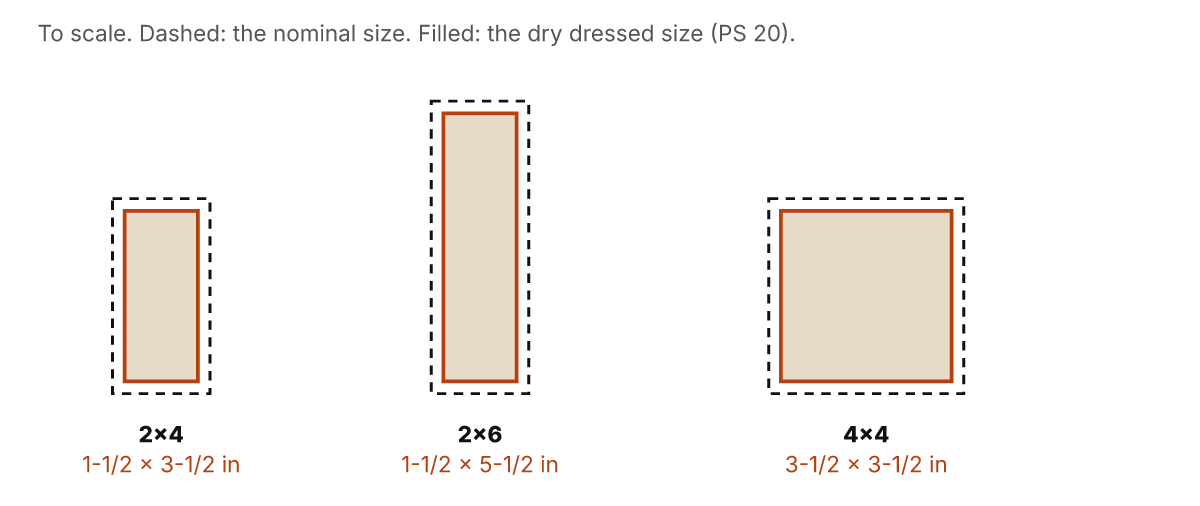
Actual size chart
PS 20 Table 3 sets the minimum dressed sizes for boards (under 2 in thick), dimension lumber (2 in up to 5 in thick), and timbers (5 in and thicker). For the sizes most people buy:
| Nominal | Dry (≤ 19% moisture) | Green |
|---|---|---|
| 1×4 | 3/4 × 3-1/2 in | 25/32 × 3-9/16 in |
| 1×6 | 3/4 × 5-1/2 in | 25/32 × 5-5/8 in |
| 1×8 | 3/4 × 7-1/4 in | 25/32 × 7-1/2 in |
| 1×12 | 3/4 × 11-1/4 in | 25/32 × 11-1/2 in |
| 2×4 | 1-1/2 × 3-1/2 in | 1-9/16 × 3-9/16 in |
| 2×6 | 1-1/2 × 5-1/2 in | 1-9/16 × 5-5/8 in |
| 2×8 | 1-1/2 × 7-1/4 in | 1-9/16 × 7-1/2 in |
| 2×10 | 1-1/2 × 9-1/4 in | 1-9/16 × 9-1/2 in |
| 2×12 | 1-1/2 × 11-1/4 in | 1-9/16 × 11-1/2 in |
| 4×4 | 3-1/2 × 3-1/2 in | 3-9/16 × 3-9/16 in |
| 4×6 | 3-1/2 × 5-1/2 in | 3-9/16 × 5-5/8 in |
| 6×6 (timber) | 5-1/2 × 5-1/2 in | 5-1/2 × 5-1/2 in |
Timbers 5 and 6 in thick or wide are dressed 1/2 in under nominal, dry or green. Some species have different green sizes; see the standard.
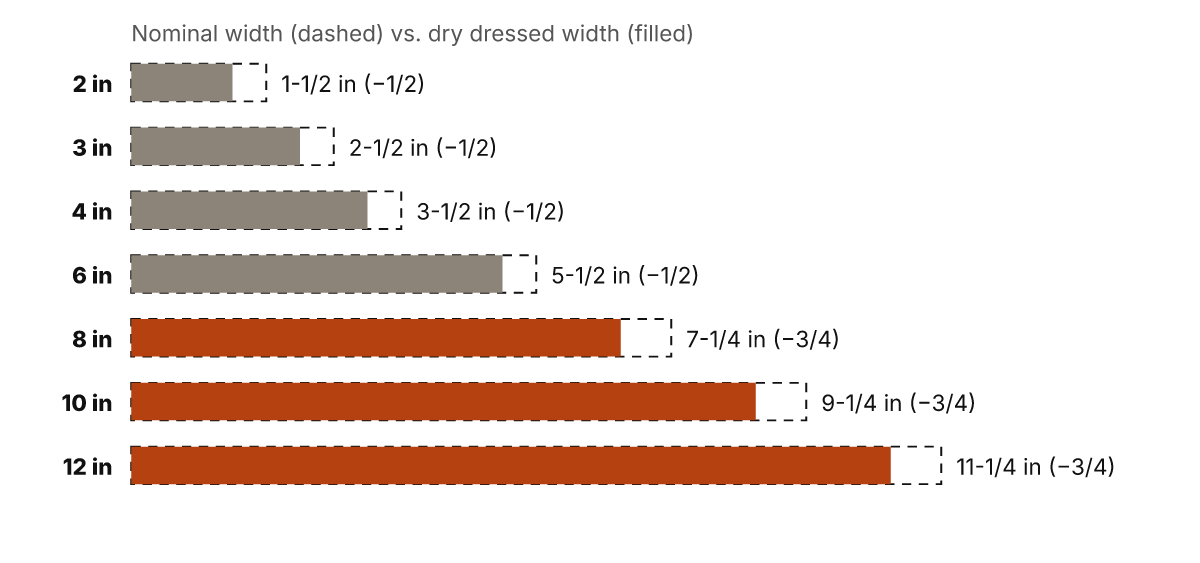
Two rules of thumb fall out of the table for dry lumber:
- Nominal 2 in and 4 in thicknesses are 1/2 in less: 1-1/2 and 3-1/2 in. A nominal 1 in board is 3/4 in.
- Widths up to 6 in are 1/2 in less; widths of 8 in and more are 3/4 in less (2×8 is 7-1/4 in, 2×12 is 11-1/4 in).
Dry and green sizes
PS 20 defines dry lumber (under 5 in nominal thickness) as lumber “seasoned or dried to a maximum moisture content of 19 percent.” Green lumber has more moisture than that, and the standard dresses it slightly larger, for example 1-9/16 by 3-9/16 in for a green 2×4, because it will shrink as it dries.
Lengths
Length is the one dimension that is not smaller than its name. Standard lengths come in multiples of 1 or 2 ft, and lumber 2 in or less in nominal thickness is trimmed to “not less than the nominal length and … not more than 76 mm (3 inches) in excess of nominal length,” unless the purchase contract says otherwise. Nominal 2 in lumber over 12 in wide or over 20 ft long may run up to 12 in over. So an 8 ft 2×4 is between 8 ft and 8 ft 3 in long.
Reading the grade stamp
Graded softwood lumber carries a grade stamp, and PS 20 requires the stamp on lumber under 5 in thick to say whether it was dry or green when it was surfaced:
| Mark | Meaning | Sizes to expect |
|---|---|---|
| S-DRY | Surfaced dry: 19% moisture content or less when surfaced | Dry column of the chart |
| KD | Kiln dried to 19% or less in a heated chamber | Dry column of the chart |
| S-GRN | Surfaced green: wetter than 19% when surfaced | Green column; it shrinks as it dries |
The stamp also protects you from undersized boards. If lumber is dressed below the minimum sizes in the standard's tables, PS 20 says “the mark shall show that size.” And for invoices, the standard notes they should show the actual thickness and width as well as the nominal size, which is worth checking when you compare quotes.
Board feet use the nominal size
Lumber priced by the board foot is measured with the nominal size, not the dressed one. PS 20 defines board measure as “the nominal thickness in inches … by the nominal width in feet by the length in feet.” That keeps the tally simple, but it means a board foot of dimension lumber holds less than 144 cubic inches of wood:
Board feet      = 2 × 6 × 10 ÷ 12 = 10 bf
Nominal volume  = 2 × 6 × 120 = 1,440 cu in
Actual (dry)    = 1.5 × 5.5 × 120 = 990 cu in = 6.875 bf of solid wood
Share           = 990 ÷ 1,440 = 68.75%
That is why price lists and the board foot calculator use nominal sizes: it matches how lumber is sold. If you need the real volume or weight of wood, use the dressed sizes from the table.
| Piece | Board feet | Solid wood | Share of nominal |
|---|---|---|---|
| 2×4, 8 ft | 5.33 | 3.5 bf | 65.6% |
| 2×6, 12 ft | 12 | 8.25 bf | 68.8% |
| 2×8, 10 ft | 13.33 | 9.06 bf | 68% |
| 2×10, 12 ft | 20 | 13.88 bf | 69.4% |
| 2×12, 16 ft | 32 | 22.5 bf | 70.3% |
| 4×4, 8 ft | 10.67 | 8.17 bf | 76.6% |
Board feet from the calculator's PS 20 formula. Solid wood uses the dry dressed sizes; green lumber is slightly larger.
Planning with actual sizes
Whenever pieces add up side by side, use the dressed size:
- Built-up posts and beams. Three 2×4s nailed face to face make a post 3 × 1-1/2 = 4-1/2 in thick, not 6 in.
- Deck surfaces. A 2×6 deck board covers 5-1/2 in plus its gap; see deck board spacing and layout, and count boards with the deck calculator.
- Stair stringers. A 2×12 is 11-1/4 in deep before any notches are cut; see stair layout basics and the stair calculator.
Frequently asked questions
What are the actual dimensions of a 2x4?
Under the American Softwood Lumber Standard (PS 20), a dry 2×4 is dressed to 1-1/2 by 3-1/2 inches. Green (unseasoned) 2×4s are dressed slightly larger, to 1-9/16 by 3-9/16 inches.
How big is a 4x4 post really?
A dry 4×4 is 3-1/2 by 3-1/2 inches under PS 20. A 6×6 is a timber, dressed 1/2 inch under nominal, so it is 5-1/2 by 5-1/2 inches.
Why is lumber smaller than its name?
The nominal size names a size category; the standard says no one should infer that nominal sizes are dressed sizes. Lumber is sawn oversize, then surfaced (dressed) smooth, and the standard's tables set the minimum finished sizes.
Is an 8-foot board actually 8 feet long?
At least. PS 20 says lumber 2 inches or less in nominal thickness is trimmed to no less than the nominal length and no more than 3 inches over it, so an 8 ft board is between 8 ft and 8 ft 3 in. Very long or wide 2-in lumber may run up to 12 inches over.
Do board feet use nominal or actual dimensions?
Nominal. PS 20 defines board measure as nominal thickness in inches times nominal width in feet times length in feet, so a 10 ft 2×6 is 10 board feet, although its actual wood volume is about 69% of that.
Related calculators and guides
Calculators
- Board Foot Calculator — Board feet per piece and in total from thickness, width, length, and quantity, with optional cost at your price per board foot.
- Deck Calculator — Decking board count from deck size, actual board width, gap, and board length, with the cutting assumptions shown.
- Stair Calculator — Number of risers and treads, exact riser height, total run, stair angle, and stringer length from floor-to-floor rise.
Guides
- Deck board spacing and layout: gaps, direction, and joints — Side and end gaps, board direction, joint placement, and last-board planning from Trex and American Wood Council guides.
- How to Lay Out Stairs: Rise, Run, and Stringers — From total rise to equal risers, tread depth, total run, and a marked-out stringer, with a worked example.
Sources
- Voluntary Product Standard PS 20-25, American Softwood Lumber Standard: nominal and dressed sizes — National Institute of Standards and Technology. Used for: Dry dressed: 1 → 3/4 in; 2 → 1-1/2; 4 → 3-1/2; 6 → 5-1/2; 8 → 7-1/4; 10 → 9-1/4; 12 → 11-1/4. Green: 2 → 1-9/16; 4 → 3-9/16; 6 → 5-5/8; 8 → 7-1/2. Timbers 5–6 in: 1/2 in off. Dry ≤ 19% moisture. Lengths in 1 or 2 ft multiples, trimmed 0 to 3 in over nominal. Checked 2026-10-05.
- Voluntary Product Standard PS 20-25, American Softwood Lumber Standard: definition of board measure — National Institute of Standards and Technology. Used for: Board feet = nominal thickness (in) × nominal width (ft) × length (ft). Checked 2026-10-05.
- Voluntary Product Standard PS 20-25, American Softwood Lumber Standard — National Institute of Standards and Technology. Used for: Nominal 6 in width = 5-1/2 in minimum dressed (dry). Checked 2026-10-03.