Guide
Gravel driveway layers: base, depth, and stone types
Layer thickness, stone choice, crown, ditches, and ordering for a gravel driveway, from road agency manuals.
By the Yardwork editorial team · Published
A gravel driveway is a small gravel road. It has to carry vehicles, shed water, and keep its shape between gradings. The road agencies that manage thousands of miles of gravel roads publish practical rules for exactly that, and they apply directly to a driveway. This guide pulls together what the Federal Highway Administration (FHWA), Idaho's Local Highway Technical Assistance Council (LHTAC), and the Vermont Agency of Natural Resources say about layers, thickness, stone, crown, drainage, and maintenance. It then shows how to turn those depths into an order with the gravel calculator.
How the layers work
A durable gravel driveway has three parts, from the bottom up:
- Subgrade. The natural ground the driveway sits on. The gravel above it spreads the load from tires.
- Base layer. Coarser material that builds height and strength. As Vermont's guidance puts it, coarse material “provides strength and has large voids between the particles that provide good drainage.”
- Surface (wearing) course. Crushed stone with enough fine material to bind into a hard, smooth surface. This is the layer you see, drive on, grade, and top up.
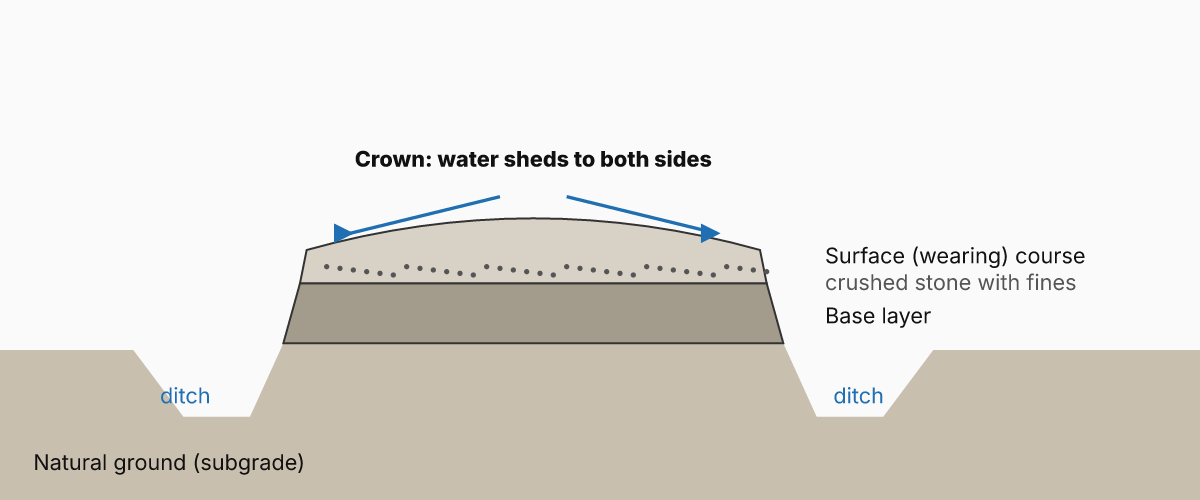
Vermont's driveway guidance links most problems to these layers. It says soft roads usually point to too manyfines in the base material holding water, a base below the water table, or “a base layer that is not thick enough to support the road.” Loose surface material, by contrast, generally means the surface lacks fines.
How thick each layer should be
FHWA's unpaved-road guidance gives two numbers that frame the design:
- Surface course: “Wearing course materials should be at least 4 in. (100 mm) thick, but preferably at least 6 in. (150 mm) thick to ensure a good crown and to facilitate maintenance activities.”
- Total gravel structure: the gravel covering the natural subgrade “should be at least 12 inches (300 mm) above natural ground level, and higher in high rainfall regions and areas with weak subgrade.”
Put together, a typical layout is a 6 in surface course over enough base to bring the gravel at least 12 in above the surrounding ground. Soft, wet, or clay soils, heavy vehicles, and high rainfall all call for more. FHWA treats thickness as a design calculation based on subgrade strength and traffic, so treat these as minimums, not targets.
Choosing stone for each layer
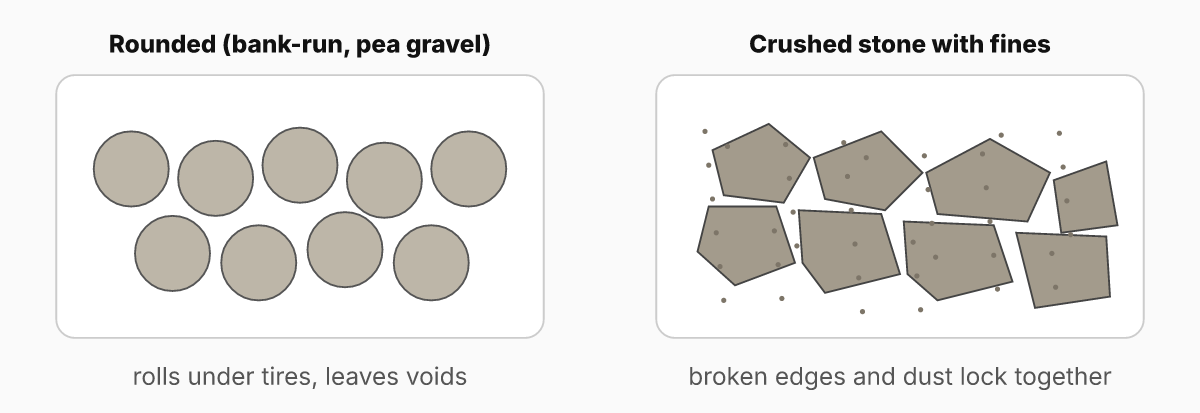
Surface course: crushed, well graded, with fines
Vermont's guidance is blunt: “Be sure to buy crushed gravel, rather than bank run gravel,” because crushed material has edges that lie flat and pack well, while rounded bank-run stone can be rolled out of the surface by tires and leave holes that pond water and start potholes. For the top layer it recommends ¾ in stone and asking for quality “crusher run” gravel, which packs into a hard surface.
“Well graded” means a mix of sizes, from stone down to dust. As an example of what that looks like on paper, Idaho's manual walks through a state ¾ in aggregate specification:
| Sieve | Percent passing | What it means |
|---|---|---|
| 1 in | 100% | No stone larger than 1 in |
| ¾ in | 90–100% | Almost all stone is ¾ in or smaller |
| No. 4 and No. 8 (about 0.2–0.1 in) | 30–65% (range across these sieves) | Sand that fills the voids between stones |
| No. 200 | 3–9% | Fine binder that bonds the surface |
This is one agency's specification, shown to explain gradation. Ask your supplier for the gradation of the product they sell.
Base layer
The base needs strength and drainage. Vermont's guidance warns that too many fines in base material hold water and make a soft road. Ask your supplier which of their crushed products they sell for driveway or road base in your area, and how they recommend placing it over your soil.
Where pea gravel fits
Pea gravel and river rock are rounded. Vermont's guidance says “Stone that is round should not be used as packing gravel,” and that stone with all uniform particles is not proper driveway gravel. Rounded stone suits paths, drainage, and decorative areas better than a surface that has to carry turning tires.
Crown and cross-slope
Idaho's manual calls crown “the most important element to gravel road construction and maintenance.” A crown is a high line down the center of the driveway with the surface sloping to each edge, so rain runs off rather than soaking in and softening the gravel.
- Vermont: count ½ in for every foot from the center to the edge, so a 10 ft driveway has a 2½ in crown.
- Idaho: about ½ in per foot of width, which “works out to a 4% cross-slope.” Do not go above 6% or below 2%.
- FHWA: a target crown of 5% ± 1%. Below 4% water can pond; above 6% runoff causes more erosion.
| Driveway width | Half width | Crown height at center |
|---|---|---|
| 8 ft | 4 ft | 2 in |
| 10 ft | 5 ft | 2.5 in |
| 12 ft | 6 ft | 3 in |
| 14 ft | 7 ft | 3.5 in |
| 16 ft | 8 ft | 4 in |
| 20 ft | 10 ft | 5 in |
½ in of rise per 12 in of run is 4.2% cross-slope.
Ditches and drainage
A crown only works if the water has somewhere to go. Vermont's guidance for driveway ditches:
- Put ditches on the uphill side so water from the slope does not cross the driveway.
- Dig deep enough to drain the road base, typically 1.5 to 2 ft deep and at least 2 ft wide.
- Keep side slopes no steeper than 2 horizontal to 1 vertical. Line ditches with grass or stone to stop erosion.
- Do not drain into wetlands, lakes, or streams, and never toward wells or septic systems. Outlet into vegetated areas where you can.
How much gravel to order
Volume is length × width × depth, calculated separately for each layer. The catch is compaction: depths above are compacted, but gravel is delivered and priced loose. Idaho's manual advises: “expect 25-30% of your volume to be reduced once spread and compacted.”
Worked example: the surface course
A 60 ft × 12 ft driveway with a 6 in compacted surface course:
Placed volume = 60 ft × 12 ft × (6 ÷ 12) ft = 360 ft³ = 13.33 yd³
Loose, 25% loss = 13.33 ÷ (1 − 0.25) = 17.78 yd³
Loose, 30% loss = 13.33 ÷ (1 − 0.30) = 19.05 yd³
Order in ½ yd³ steps = 19.5 yd³
Crown at center   = (12 ÷ 2) ft × ½ in = 3 in
So about 13.3 cubic yards end up in place, but you would order around 19.5 cubic yards of loose gravel. To do the same for your driveway, enter each layer's depth in the gravel calculator and set the allowance to cover the compaction loss your supplier expects (25–30% loss is roughly a 33–43% allowance, because the loss is a share of the loose volume).
If your supplier sells by the ton, ask for their weight per cubic yard for that exact product and enter it as the density; how much a yard of gravel weighs explains loose and compacted figures. Curved or flared driveways can be measured with the methods in measuring irregular areas, and the delivery planning guide covers where to dump each load.
Maintenance
- Grade regularly. Vermont recommends grading at least 2–4 times a year, in the spring and fall, to restore the crown and fill ruts.
- Work it damp, not dry. FHWA says to “Never shape a road when it is dry,” because it loosens the crust and separates the material. Wet the top 2 in first.
- Top up with the right material. Add crushed, well-graded gravel with fines, not rounded stone, and restore the crown as you spread it.
- Keep ditches clear. Clean out sediment and debris, and check ditches after big storms.
Frequently asked questions
Can I use pea gravel for a driveway surface?
Rounded stone does not lock together under tires. Vermont's driveway guidance says stone that is round should not be used as packing gravel and recommends crushed gravel with packing dust instead.
How much crown should a 12 foot wide gravel driveway have?
At ½ inch per foot from the center to the edge, the center of a 12 ft driveway sits about 6 × ½ = 3 inches higher than its edges.
Why did my gravel go further than I expected, or not far enough?
Delivered gravel is loose. Idaho's gravel roads manual advises expecting a 25–30% loss in volume once it is spread and compacted, so a compacted layer needs more loose material than its finished volume.
How often should a gravel driveway be graded?
Vermont's driveway guidance recommends grading at least 2–4 times a year, in the spring and fall. Shape it when the top is damp, not dry, so the surface does not loosen and ravel.
Why do driveway guides recommend crusher run?
Vermont's driveway guidance recommends asking for quality crusher run gravel because it packs into a hard surface that resists erosion. Correct driveway gravel has packing dust plus irregular, broken edges that bind together. Ask your supplier for the gradation of the specific product.
Related calculators and guides
Calculators
- Gravel Calculator — Gravel, crushed rock, or landscape rock volume in cubic yards and meters, with an optional weight from your supplier's density.
- Topsoil Calculator — Topsoil volume in cubic yards and meters for lawns, beds, and fill, with an optional weight from your supplier's density.
Guides
- How Much Does a Cubic Yard of Gravel Weigh? — Tons per cubic yard for crushed aggregate, loose versus compacted, and how to convert a volume into an order by weight.
- What Is a Cubic Yard? — What a cubic yard is, how to convert area × depth into yards, and how much ground one yard covers.
- How to Plan a Bulk Material Delivery — Rounding to supplier increments, questions to ask, and a checklist before bulk material arrives.
- How to Measure an Irregular Area — Split odd shapes into rectangles, triangles, circles, and trapezoids, then average width and depth.
- Bagged vs. Bulk Materials: Which Should You Buy? — How to compare bags and bulk delivery using bags per cubic yard and your own local prices.
Sources
- Unpaved Road Dust Management, Chapter 6: Construction and Additive Application — Federal Highway Administration, Center for Local Aid Support. Used for: Wearing course ≥ 4 in, preferably ≥ 6 in; gravel structure ≥ 12 in above natural ground; target crown 5% ± 1%. Checked 2026-10-05.
- Crowned Driveways, Good Gravel, and Rock- or Grass-lined Drainage Ditches (Lake Wise BMP) — Vermont Agency of Natural Resources, Lakes & Ponds Section. Used for: Crown ½ in per foot of width from the center; ¾ in top-layer stone; ditches 1.5–2 ft deep, side slopes no steeper than 2:1. Checked 2026-10-05.
- Gravel Roads Manual (2021) — Local Highway Technical Assistance Council (Idaho). Used for: Crown ≈ ½ in per foot (4%), not above 6% or below 2%; loose loads lose 25–30% of volume when spread and compacted. Checked 2026-10-05.
- NIST Handbook 44 (2026), Appendix C: General Tables of Units of Measurement — National Institute of Standards and Technology. Used for: 1 yd³ = 27 ft³; 1 US gal = 231 in³. Checked 2026-10-03.