Guide
How Much Concrete Do I Need for a Fence Post?
Hole size, concrete volume, and bags per post from the manufacturers' instructions, with a bags-per-hole table for 4×4 and 6×6 posts.
By the Yardwork editorial team · Published
The concrete for a fence post fills the hole around it, so the amount comes down to three numbers: how wide you dig, how deep the concrete goes, and the post's actual size. Take a 4×4 in a 12 in hole with 27 in of concrete, which is a 36 in hole with 6 in of gravel under the post and the top 3 in left for soil. That is 1.58 cubic feet, or 4.20 bags of QUIKRETE Fast-Setting mix at 0.375 cu ft per 50 lb bag, so you buy 5 for each post. This guide shows where those dimensions come from in QUIKRETE's and Sakrete's instructions, how to work out any hole, and how the setting method changes the count. It covers square wood posts (4×4 and 6×6). Round and metal posts need their own arithmetic.
How big to dig the hole
Both manufacturers size the hole from the post. QUIKRETE's data sheets say to dig “about 3 times the diameter of the post,” and Sakrete's say the hole “should be 3 times the diameter of the pole or post width.” QUIKRETE's examples put numbers on it: about 12 in wide for a 4 in wood post on its setting-posts how-to page, 18 in for a 6 in post on its online calculator, and a 9 in hole for a 3 in square post on its Fast-Setting data sheet. Sakrete's bag chart is based on an average 10 in hole.
Those examples use the post's name, not its size. A 4×4 is a nominal size: under the American Softwood Lumber Standard it is 3-1/2 in square, and a 6×6 is 5-1/2 in. Three times the actual width of a 4×4 is 10-1/2 in, so QUIKRETE's 12 in hole is the roomier one. Measure the hole you dig for the circle, and use the actual post size for the part the concrete doesn't fill. The nominal vs. actual lumber sizes guide has the full chart.
Depth is where the documents differ, so here they are one at a time:
- QUIKRETE's data sheets for Fast-Setting Concrete Mix and Concrete Mix: “Hole depth should be 1/3 the overall post height.”
- Sakrete's data sheets: depth “should be 1/3 the length of the post or pole.” The High-Strength sheet calls it “a general rule of thumb.”
- QUIKRETE's online calculator: “one-half of the above-ground post height,” with the example of a 9 ft post standing 6 ft above ground with 3 ft in the ground. That is the same rule in other words: a third of the whole post is half of the part above ground.
- QUIKRETE's how-to page: “1/3-1/2 the post height above ground,” adding that “a 6-foot tall fence would require a hole depth of at least 2 feet.”
So for a 6 ft fence, the documents put the hole somewhere between 2 ft (the how-to page's minimum) and 3 ft (the data sheets). The table below covers both depths.
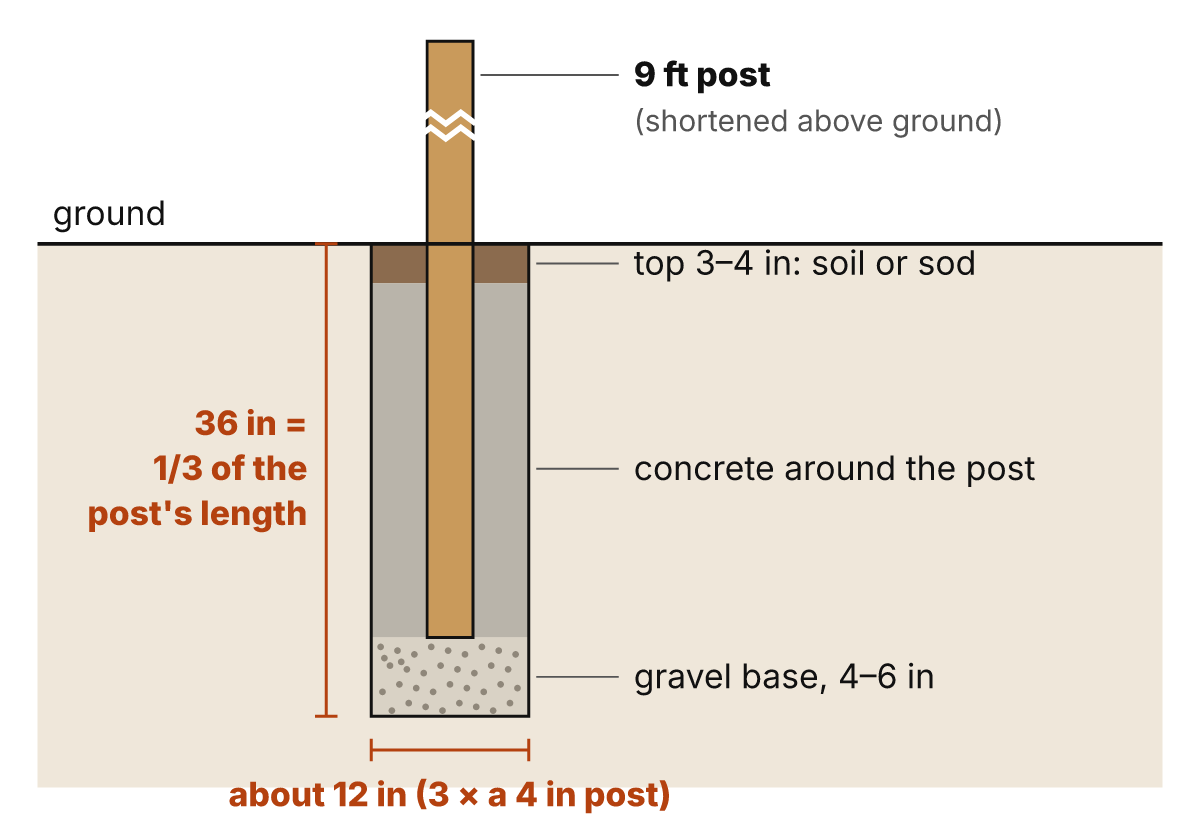
None of these rules is a building code. QUIKRETE's Concrete Mix sheet adds, “For load-bearing applications, follow local building codes for proper footing specifications,” and Sakrete's High-Strength sheet says to check your local code first if the post will be load-bearing. Ask your building department about permits, post depth and frost depth before you dig.
How much concrete fills a hole
The concrete is a cylinder with the post taken out of the middle. Work out the area of the hole, subtract the area of the post, and multiply by the depth the concrete actually fills:
Hole area     = π × (hole diameter ÷ 2)²
Post area     = post width × post width (actual size)
Concrete      = (hole area − post area) × concrete depth
Cubic feet    = cubic inches ÷ 1,728
Bags          = cubic feet ÷ yield per bag, rounded up
Concrete depth is not always the hole depth. Gravel under the post, a base of dry mix, or soil on top each change it, as the next sections show. The bag's yield is the volume of concrete it makes, printed on the bag and the data sheet; see concrete bag yields for every product this site lists. The circle area is the same one used in measuring irregular areas, and the square footage calculator can take a circle with a square cut out of it if you want to check a hole size.
Bags per hole for 4×4 and 6×6 posts
Find your post and hole, then the row for the depth of concrete: your hole depth minus any gravel and any soil left on top. Each bag column applies to any product with that published yield.
| Post, hole width | Concrete depth | Concrete | 50 lb bags (0.375 cu ft) | 60 lb bags (0.45 cu ft) | 80 lb bags (0.60 cu ft) |
|---|---|---|---|---|---|
| 4×4, 10 in | 18 in | 0.69 cu ft | 1.84 → 2 | 1.53 → 2 | 1.15 → 2 |
| 4×4, 10 in | 24 in | 0.92 cu ft | 2.46 → 3 | 2.05 → 3 | 1.53 → 2 |
| 4×4, 10 in | 30 in | 1.15 cu ft | 3.07 → 4 | 2.56 → 3 | 1.92 → 2 |
| 4×4, 12 in | 18 in | 1.05 cu ft | 2.80 → 3 | 2.33 → 3 | 1.75 → 2 |
| 4×4, 12 in | 24 in | 1.40 cu ft | 3.74 → 4 | 3.11 → 4 | 2.33 → 3 |
| 4×4, 12 in | 30 in | 1.75 cu ft | 4.67 → 5 | 3.89 → 4 | 2.92 → 3 |
| 4×4, 12 in | 36 in | 2.10 cu ft | 5.60 → 6 | 4.67 → 5 | 3.50 → 4 |
| 6×6, 18 in | 24 in | 3.11 cu ft | 8.30 → 9 | 6.92 → 7 | 5.19 → 6 |
| 6×6, 18 in | 30 in | 3.89 cu ft | 10.38 → 11 | 8.65 → 9 | 6.49 → 7 |
| 6×6, 18 in | 36 in | 4.67 cu ft | 12.46 → 13 | 10.38 → 11 | 7.79 → 8 |
| 6×6, 18 in | 42 in | 5.45 cu ft | 14.53 → 15 | 12.11 → 13 | 9.08 → 10 |
Computed with this site's area and concrete calculators, using actual post sizes (4×4 = 3-1/2 in, 6×6 = 5-1/2 in) and yields of 0.375 cu ft (QUIKRETE Fast-Setting, 50 lb), 0.45 cu ft (QUIKRETE Concrete Mix, 60 lb) and 0.60 cu ft (QUIKRETE Concrete Mix, 80 lb). Hole sizes come from the documents: 10 in is the average hole Sakrete's chart is based on (Sakrete names no post size), 12 in is QUIKRETE's hole for a 4 in post, and 18 in is QUIKRETE's calculator hole for a 6 in post. No allowance is included.
QUIKRETE also sells Fast-Setting Concrete Mix in a 60 lb bag at 0.45 cu ft, so the 60 lb column covers it too. For a hole size that isn't listed, the concrete scales with the ring area: a 6×6 in an 18 in hole holds about 2.2 times as much as a 4×4 in a 12 in hole at the same depth.
How the setting method changes the count
Each set of instructions puts something different at the bottom and the top of the hole, and that changes how deep the concrete goes:
- QUIKRETE Concrete Mix (No. 1101), mixed. “Place 6 in (150 mm) of dry concrete mix in the bottom of the hole,” stand the post on it, fill with concrete mixed beforehand, and taper the top so rain runs away from the post. The base is concrete too, under the post, so it counts as a full circle. This guide counts it at the bag's published yield; that is our assumption, since yield is measured on mixed concrete and no source gives the volume of mix poured dry.
- QUIKRETE Fast-Setting (No. 1004), poured dry. The how-to page starts with about 6 in of All-Purpose Gravel, compacted. The dry mix goes in up to 3 to 4 in below ground, then water, and the top is finished with soil or sod.
- Sakrete Fast Setting, water first. A 4 to 6 in gravel base, compacted, with the post on it. Fill the hole a third full of water, then add the mix straight from the bag and slope the top to shed water.
- Sakrete High-Strength, mixed. A gravel base, then concrete mixed beforehand, rodded to settle it, and overfilled so the surface slopes away from the post.
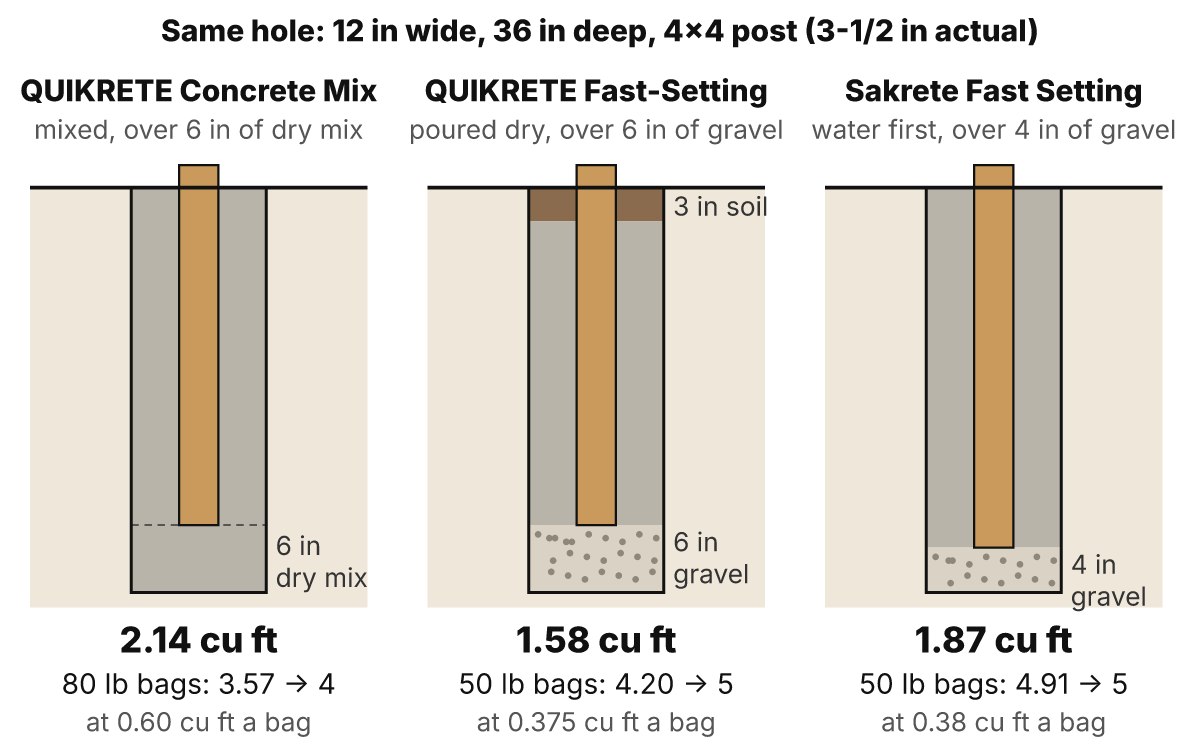
Gravel takes the place of concrete, so it lowers the count; a dry-mix base is concrete, so it raises it. Pick the method for the product you are buying before you count bags, and don't mix one maker's method with another's yield.
Worked example: ten posts for a 6 ft fence
Ten 4×4 posts, each 9 ft long, for a 6 ft fence, set with QUIKRETE Fast-Setting Concrete Mix. The hole is 12 in wide (the how-to page's hole for a 4 in post) and 36 in deep, a third of the post (the data sheets). The how-to page's own depth rule would allow anything from 24 to 36 in for this fence; this example takes the deeper hole. It has 6 in of gravel (how-to page) and the top 3 in left for soil (data sheet and how-to page).
Ring area   = 113.10 − 12.25 = 100.85 sq in
Depth       = 36 − 6 gravel − 3 soil = 27 in
Per hole    = 100.85 × 27 ÷ 1,728 = 1.58 cu ft
50 lb bags  = 1.5757 ÷ 0.375 = 4.202 per hole
Ten posts   = 10 × 4.202 = 42.02 → 43 bags
Water       = about 1 gal per bag → about 43 gal
Gravel      = 0.39 cu ft per hole, 3.93 cu ft in all
Rounding each hole up would mean 5 bags a post, 50 in all. With dry-poured mix you can finish one hole with the rest of an open bag and carry it to the next, so count the whole fence and round up once: 43 bags. With 80 lb bags of mixed concrete at 0.60 cu ft, the same fence needs 26.26 bags, so 27. QUIKRETE doesn't publish a bag volume for its gravel, so the gravel is given in cubic feet; check the coverage printed on the bag you buy.
Checking the arithmetic against the bag charts
Both makers publish per-post figures. They make a good cross-check, and they show why it pays to count your own hole.
Sakrete's Fast Setting data sheet gives bags for an “Average 10” Diameter Hole” at four depths, using its 0.38 cu ft yield per 50 lb bag. It doesn't name a post size. Assuming a 4×4, which is our choice, the arithmetic lands within 0.18 bag of every figure:
| Hole depth | Sakrete's chart | Arithmetic, 4×4 assumed |
|---|---|---|
| 12 in | 1.25 bags | 1.21 bags |
| 18 in | 2 bags | 1.82 bags |
| 24 in | 2.5 bags | 2.42 bags |
| 30 in | 3 bags | 3.03 bags |
(10 in circle − 3-1/2 in square) × depth ÷ 1,728 ÷ 0.38 cu ft per bag.
QUIKRETE's Fast-Setting data sheet says two 50 lb bags “will set a 3 in (75 mm) square post in a 9 in (225 mm) diameter hole 30 in (0.75 m) deep.” Filled to 3 to 4 in below the top, as the same sheet directs, that hole holds 2.19 to 2.28 bags' worth: a little more than two. Have a third bag on hand, and measure the hole you actually dug before you buy the last bags.
Filling the hole and loading the post
Both makers sell fast-setting concrete for posts. QUIKRETE calls its Fast-Setting mix “suitable for setting posts and pouring slabs when a rapid return to service is desired,” and Sakrete describes its Fast Setting mix as “For setting posts and poles without mixing or bracing.” QUIKRETE's data sheet gives these steps for its mix:
- Stand the post in the hole and hold it straight. The how-to page braces it with 2×4s on two adjacent sides.
- Pour the dry mix into the hole up to about 3 to 4 in from the top.
- Add water until the powder is saturated: about 1 gallon per 50 lb bag, depending on the soil. For holes deeper than 30 in, fill and water the first 30 in or less, let the water soak in, then add the rest.
- Fill the top 3 to 4 in with sod or the soil you dug out.
The mix sets in 20 to 40 minutes, and QUIKRETE says to wait 4 hours before putting any strain on the post. With mixed concrete the wait is longer: 24 hours for QUIKRETE Concrete Mix, and at least 24 hours for Sakrete High-Strength. QUIKRETE's video shows the dry-pour method from start to finish:
Before you buy
- Measure the post you will set; use its actual size, not its name.
- Decide on the hole width and depth from the instructions for your product, and ask your building department about local depth and frost rules.
- Subtract any gravel and soil cap to get the depth of concrete, and add a dry-mix base if your method uses one.
- Work out one hole, multiply by the number of posts, and round up once. The figures here include no allowance for spills or holes dug oversize; add your own.
- Buy gravel and, for dry-poured mix, plan on about a gallon of water per 50 lb bag.
Frequently asked questions
How many bags of concrete do I need per fence post?
For a 4×4 in a 12 in hole with 27 in of concrete (a 36 in hole with 6 in of gravel under the post and the top 3 in left for soil), the concrete is 1.58 cu ft: 4.20 bags of 50 lb fast-setting mix at 0.375 cu ft each, or 2.63 bags of 80 lb concrete mix at 0.60 cu ft. Buy 5 or 3 for one post; for several posts, multiply before you round up.
How big a hole do I need for a 4x4 fence post?
QUIKRETE's how-to page says about 12 in wide for a 4 in wood post, three times the post's width, and Sakrete's data sheets also call for three times the post width. For depth, both makers' data sheets say 1/3 of the post's overall length, which is 3 ft for a 9 ft post.
How deep should fence posts be for a 6 ft fence?
QUIKRETE's how-to page says 1/3 to 1/2 of the height above ground, so at least 2 ft. QUIKRETE's data sheets and online calculator put 1/3 of the whole post in the ground: a 9 ft post with 3 ft buried. Local codes and frost depth can require more, so check before you dig.
Do you have to mix fast-setting concrete for fence posts?
Not with QUIKRETE's or Sakrete's post methods. QUIKRETE says to pour the dry mix to 3 to 4 in below the top of the hole and then add about 1 gallon of water per 50 lb bag. Sakrete says to fill the hole a third full of water first, then add the mix straight from the bag. Regular concrete mix is mixed before it goes in.
How long before I can attach fence rails to new posts?
QUIKRETE says its Fast-Setting Concrete Mix sets in 20 to 40 minutes and to wait 4 hours before putting any strain on the post. For QUIKRETE Concrete Mix the wait is 24 hours, and Sakrete says to wait at least 24 hours with its High-Strength mix.
Should I put gravel in the bottom of a fence post hole?
QUIKRETE's how-to page adds about 6 in of All-Purpose Gravel, compacted, and Sakrete's Fast Setting sheet calls for a 4 to 6 in compacted gravel base. QUIKRETE's Concrete Mix sheet puts 6 in of dry concrete mix in the bottom instead. Gravel takes the place of concrete; a dry-mix base is concrete, so it adds to the bag count.
Related calculators and guides
Calculators
- Concrete Calculator — Slab volume in cubic feet, cubic yards, and cubic meters, with ready-mix order size and bag counts for documented products.
Guides
- Concrete Bag Yields by Bag Size — Published cubic-foot yields for bagged concrete mixes, with bags per cubic foot, cubic yard, and cubic meter.
- How to Pour a Concrete Slab — Plan, form, mix, place, finish, joint, and cure a slab, following the manufacturer's published method.
- Nominal vs. Actual Lumber Sizes — A chart of real lumber dimensions from the national standard, dry versus green sizes, lengths, and board feet.
Buying guides
- Best Concrete Mixers for DIY Slabs and Posts (2026) — Six drum and paddle mixers ranked on published specs for bagged concrete, with bags per batch and batches per slab or post worked out from the calculators.
- DEWALT vs Milwaukee Drill/Driver Kits Compared (2026) — Seven 20V MAX and M18 drill/driver kits side by side on their makers' published specs, ranked for deck, drywall and fence work, with screw counts per job.
Sources
- QUIKRETE Fast-Setting Concrete Mix (No. 1004) product data sheet: setting posts — QUIKRETE Companies. Used for: Final set in 20–40 min; 50 lb = 0.375 cu ft, 60 lb = 0.45 cu ft; hole about 3 × the post, 1/3 of the overall post height deep; dry mix to 3–4 in from the top, about 1 gal of water per 50 lb bag; holes deeper than 30 in filled in stages; wait 4 h before strain; two 50 lb bags set a 3 in square post in a 9 in × 30 in hole. Checked 2026-10-06.
- QUIKRETE Concrete Mix (No. 1101) product data sheet: setting fence posts — QUIKRETE Companies. Used for: Hole about 3 × the post, 1/3 of the overall post height deep; 6 in of dry concrete mix in the bottom; mixed concrete; wait 24 h before strain. Checked 2026-10-06.
- QUIKRETE Concrete Mix (No. 1101) product data sheet — QUIKRETE Companies. Used for: 40 lb = 0.30 ft³; 60 lb = 0.45 ft³; 80 lb = 0.60 ft³; 90 lb = 0.675 ft³ (regional). Checked 2026-10-03.
- Setting Posts without Mixing: QUIKRETE how-to video and project instructions — QUIKRETE Companies. Used for: Hole 3 × the post width (about 12 in for a 4 in wood post), 1/3–1/2 of the height above ground deep (at least 2 ft for a 6 ft fence); about 6 in of gravel; fill to 3–4 in below ground; about 1 gal of water per 50 lb bag; wait about 4 h. Checked 2026-10-06.
- QUIKRETE concrete calculator: Fast-Setting Concrete Mix for posts — QUIKRETE Companies. Used for: Hole 1/2 of the above-ground post height deep (a 9 ft post: 6 ft above ground, 3 ft in the ground); post/hole pairs 2/6, 3/9, 4/12 and 6/18 in. Checked 2026-10-06.
- Sakrete Fast Setting Concrete Mix technical data sheet — Sakrete. Used for: 50 lb = 0.38 cu ft; sets in about 1/2 hour; hole 1/3 of the post length deep and 3 × the post wide; 4–6 in gravel base; for an average 10 in hole: 1.25 bags at 12 in deep, 2 at 18 in, 2.5 at 24 in, 3 at 30 in. Checked 2026-10-06.
- Sakrete High-Strength Concrete Mix technical data sheet: posts and poles — Sakrete. Used for: Depth 1/3 of the post length and diameter 3 × the post (a rule of thumb); mixed concrete rodded in and overfilled to slope; wait at least 24 h. Checked 2026-10-06.
- Voluntary Product Standard PS 20-25, American Softwood Lumber Standard: nominal and dressed sizes — National Institute of Standards and Technology. Used for: Dry dressed: 1 → 3/4 in; 2 → 1-1/2; 4 → 3-1/2; 6 → 5-1/2; 8 → 7-1/4; 10 → 9-1/4; 12 → 11-1/4. Green: 2 → 1-9/16; 4 → 3-9/16; 6 → 5-5/8; 8 → 7-1/2. Timbers 5–6 in: 1/2 in off. Dry ≤ 19% moisture. Lengths in 1 or 2 ft multiples, trimmed 0 to 3 in over nominal. Checked 2026-10-05.