Guide
How to mulch garden beds: depth, timing, and types
Extension-backed mulch depths, timing, materials, and tree-ring technique, with a worked example for buying bags.
By the Yardwork editorial team · Published
Mulch is one of the cheapest ways to keep beds healthier and tidier, and one of the easiest to overdo. University extension services agree on most of the details: a few inches is enough, mulch should never touch trunks, and spring is the preferred time. This guide collects their recommendations from Penn State, the University of New Hampshire, and the University of Vermont, then shows how to work out how much to buy with the mulch calculator.
What mulch does
Penn State Extension lists the benefits of a proper layer of mulch. It:
- conserves soil moisture by increasing water infiltration and slowing evaporation;
- improves soil structure, fertility, and aeration as it decomposes (organic mulches);
- moderates soil temperature, protecting roots from summer and winter extremes;
- keeps mowers and trimmers away from trunks, and reduces soil compaction from foot traffic;
- slows the growth of weeds and grass that compete with plants for water and nutrients.
How deep to spread mulch
Penn State Extension's rule for trees and shrubs is: “Apply a 2- to 4-inch layer of organic mulch and no more; use less if the soil is poorly drained.” Finely textured or double-shredded mulch should be only 1 to 2 inches, “since these materials allow less oxygen through to the root zone.” UNH Extension gives depths by material:
| Material | Depth | Source |
|---|---|---|
| Shredded hardwood mulch | 2–3 in | UNH Extension |
| Pine bark mulch | 2–3 in | UNH Extension |
| Compost | 2–3 in | UNH Extension |
| Leaves (chopped or mixed) | 3–4 in | UNH Extension |
| Pine needles (pine straw) | 3–4 in | UNH Extension |
| Organic mulch around trees | 2–4 in, less on poorly drained soil | Penn State Extension |
| Finely textured or double-shredded mulch | 1–2 in | Penn State Extension |
Keep it off stems and trunks
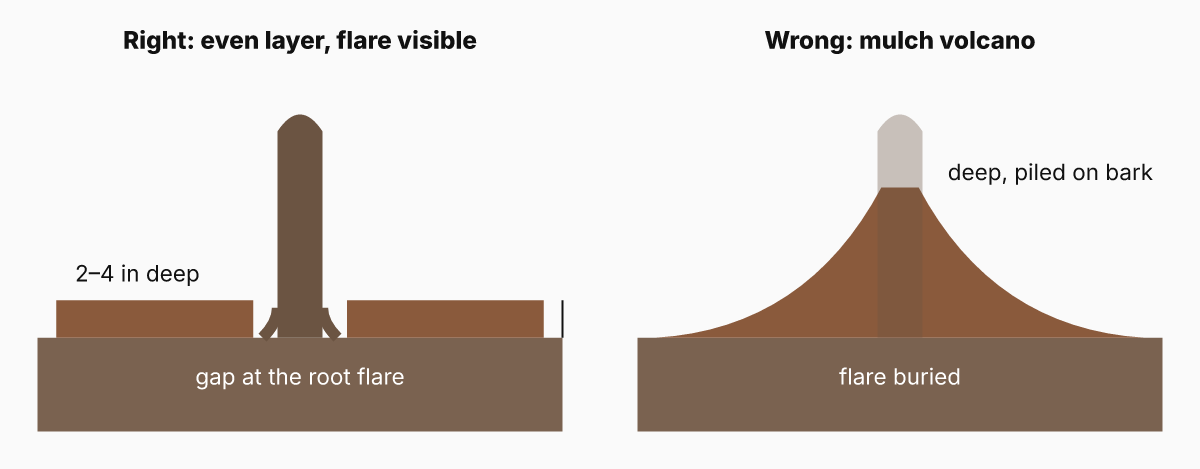
The single most common mistake is the “mulch volcano”: mulch heaped in a cone up a trunk. Penn State calls it a practice that “is never recommended and should not be utilized.” University of Vermont Extension explains why: mulch piled against bark traps moisture and encourages decay, buries the root flare where the trunk widens into the roots, shelters voles that chew bark, and when more than 4 inches deep can encourage roots that grow from the trunk and eventually girdle it.
- Plants and perennials: keep mulch 2–3 inches from the base of plants (UNH Extension).
- Trees: pull mulch 3–5 inches away from young trees and 8–10 inches from mature trees, so the root flare shows (Penn State Extension).
- Shape: “Instead of volcano, think donut.” Spread a wide, even ring out toward the drip line, the area under the outer edge of the canopy (University of Vermont Extension).
When to mulch
UNH Extension says new plantings should be mulched immediately after planting, and that “Early spring is ideal,” because it conserves soil moisture as plants come out of dormancy and stops many weed seeds from germinating. Penn State notes mulch can go down at almost any time of year, but the best time is “the middle of spring, once soil temperatures have warmed enough for root growth to begin.” For vegetable gardens, UNH advises applying natural mulches after the crop has begun to grow and the soil has warmed.
Before topping up an existing bed, check how much is still there. Penn State points out that applying new mulch over old mulch year after year “is the same as applying too deep a layer all at once.” Often a light raking to break up matted layers is enough to refresh it.
Choosing a mulch
Organic mulches
Penn State says tree care professionals prefer organic mulches (wood chips, pine needles, hardwood and softwood bark, leaves, and compost mixes) because they decompose and improve the soil. Notes from UNH Extension on common choices:
- Shredded hardwood: good at suppressing weeds, does not wash away easily, decomposes relatively slowly.
- Pine bark: dark and attractive; larger nuggets may float away in heavy rain.
- Leaves: dry leaves blow and wet leaves compact, so chop them or mix them with other materials.
- Grass clippings: let them dry for 2–3 days first; they can mat, especially on slopes.
- Compost: an excellent source of nutrients, but it can contain weed seeds if not fully finished.
Pine straw
UNH Extension describes pine needles as “A very easy material to apply and will not compact,” applied 3–4 inches thick. Pine straw is commonly sold in bales rather than by volume, so ask your supplier how many square feet a bale covers at your depth and divide your bed area by that figure.
Inorganic mulches and fabrics
Penn State says inorganic mulches such as gravel, stone chips, river rock, and rubber “do not provide the same benefits as organic mulches as they do not decompose.” UNH notes stone is not convenient where you need to cultivate. Woven landscape cloth lets water and air through and works on most weeds, though some grasses grow through the holes; UNH recommends pinning it down and covering it with several inches of organic mulch for better results. For stone, size the job with the gravel calculator instead.
How much mulch to buy
Volume is area × depth. Convert depth to feet (inches ÷ 12), multiply by the area in square feet, and divide by 27 for cubic yards, or by the bag volume for bags. The examples below use 2 cu ft bags, the size listed for Scotts Nature Scapes mulch; use the size printed on the bags you buy.
Example 1: topping up a bed
A 20 × 10 ft bed still has about 1 inch of old mulch, and you want to bring it back to 3 inches, so you add 2 inches.
Area   = 20 ft × 10 ft = 200 ft²
Volume = 200 ft² × (2 ÷ 12) ft = 33.33 ft³ = 1.23 yd³
Bags   = 33.33 ft³ ÷ 2 ft³ = 16.67 → 17 bags
Example 2: a ring around a tree
A ring 4 ft in radius around a trunk 1 ft across, with 3 inches left clear around the trunk, spread 3 inches deep:
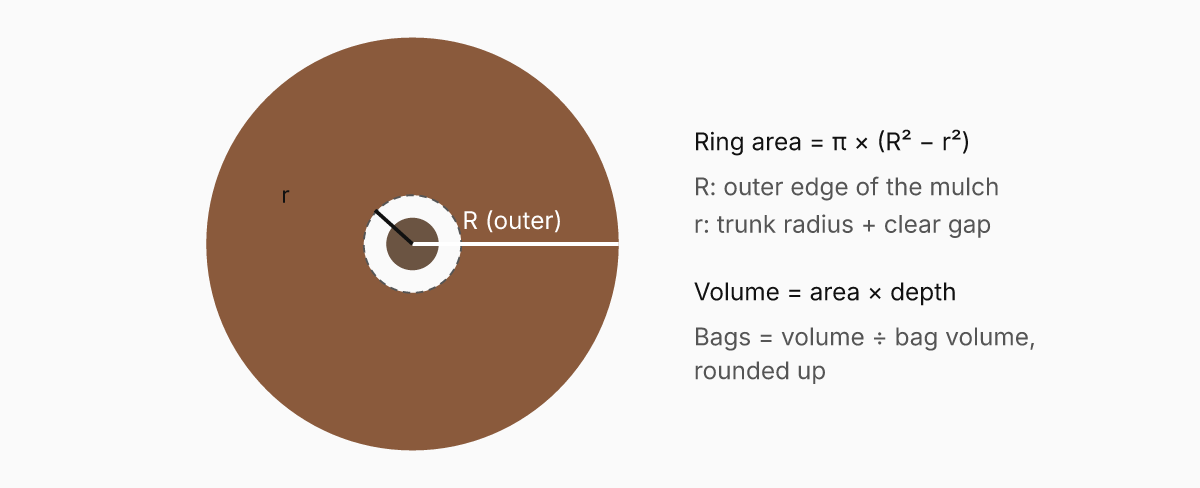
r      = 0.5 ft trunk radius + 0.25 ft gap = 0.75 ft
Area   = π × (4² − 0.75²) = 48.5 ft²
Volume = 48.5 ft² × (3 ÷ 12) ft = 12.12 ft³ = 0.45 yd³
Bags   = 12.12 ÷ 2 = 6.06 → 7 bags
For rectangular beds, the mulch calculator does this arithmetic and rounds up to whole bags or a bulk order. Curved beds can be measured with the methods for irregular areas, and bagged vs bulk explains when a delivered load beats bags.
Step by step
- Pull weeds and water the bed if the soil is dry (UNH advises the soil be weed-free and moist).
- Check the depth of any old mulch; rake it to break up matted layers, or remove some if it is already deep.
- Measure the bed and work out the volume for your target depth.
- Spread mulch evenly to 2–4 inches (1–2 inches for fine mulch), checking depth with a ruler as you go.
- Pull mulch back from stems and trunks so the root flare shows. No volcanoes.
Frequently asked questions
Should I remove old mulch before adding new mulch?
Check the depth first. Penn State Extension notes that applying new mulch over old mulch year after year is the same as applying too deep a layer at once, so some old mulch may need to be removed, or simply raked to break up matted layers.
Is pine straw a good mulch?
UNH Extension describes pine needles as a very easy material to apply that will not compact, applied 3–4 inches thick. Pine straw is usually sold in bales, so ask your supplier how much area a bale covers.
Is rock or rubber mulch better than wood mulch?
Penn State Extension says inorganic mulches such as gravel, stone chips, river rock, and rubber do not provide the same benefits as organic mulches because they do not decompose and improve the soil.
Can I put mulch over landscape fabric?
UNH Extension says woven landscape cloth lets water and air through and works on most weeds, though some grasses grow through the holes. It recommends pinning it down and notes better results when several inches of organic mulch are added on top.
What is a mulch volcano?
Mulch piled in a cone up the trunk of a tree. University of Vermont Extension warns it traps moisture against the bark, buries the root flare, shelters voles, and above 4 inches can encourage roots that girdle the trunk.
Related calculators and guides
Calculators
- Mulch Calculator — Mulch volume in cubic yards for any bed, plus a whole-bag count for the bag size you are buying.
- Topsoil Calculator — Topsoil volume in cubic yards and meters for lawns, beds, and fill, with an optional weight from your supplier's density.
Guides
- What Is a Cubic Yard? — What a cubic yard is, how to convert area × depth into yards, and how much ground one yard covers.
- Bagged vs. Bulk Materials: Which Should You Buy? — How to compare bags and bulk delivery using bags per cubic yard and your own local prices.
- How to Measure an Irregular Area — Split odd shapes into rectangles, triangles, circles, and trapezoids, then average width and depth.
- How to Plan a Bulk Material Delivery — Rounding to supplier increments, questions to ask, and a checklist before bulk material arrives.
Sources
- Mulching Landscape Trees — Penn State Extension. Used for: 2–4 in of organic mulch (less on poorly drained soil; 1–2 in for finely textured or double-shredded mulch); pull mulch 3–5 in from young trees, 8–10 in from mature trees. Checked 2026-10-05.
- Garden Mulches [fact sheet] — UNH Cooperative Extension. Used for: Shredded hardwood, pine bark, compost: 2–3 in; leaves and pine needles: 3–4 in; keep mulch 2–3 in from plant bases. Checked 2026-10-05.
- Beware the Mulch Volcano — University of Vermont Extension. Used for: Ring of mulch at least 3 in from the root flare, no more than 2–4 in deep. Checked 2026-10-05.
- Scotts Nature Scapes Color Enhanced Mulch product page — The Scotts Company. Used for: 2 cu ft per bag (a 1.5 cu ft size is also listed). Checked 2026-10-03.