Buying guide · 2026
Best Plate Compactors and Hand Tampers for Pavers and Gravel (2026)
Plate compactors and hand tampers ranked on their makers' published specs for paver patios and gravel bases, with lifts and base gravel worked out from the calculators.
As an Amazon Associate I earn from qualifying purchases.
Quick picks
As an Amazon Associate I earn from qualifying purchases.
| Pick | Key specs | Amazon link | |
|---|---|---|---|
| 1. | Tomahawk TPC80H 5.5 HP Honda Vibratory Plate CompactorBest overall for paver patios and walkways |
| Check price on Amazon |
| 2. | Tomahawk TPC90H 5.5 HP Honda Vibratory Plate Compactor with Water TankBest for driveway bases and asphalt |
| Check price on Amazon |
| 3. | Tomahawk eJXPC50 2 HP Electric Plate CompactorBest electric plate compactor |
| Check price on Amazon |
| 4. | XtremepowerUS 61019 6HP Gas Plate CompactorBest for 15 kN on a smaller plate |
| Check price on Amazon |
| 5. | VEVOR CNP60C-2 6.5 HP Gas Plate CompactorBest for covering open ground quickly |
| Check price on Amazon |
| 6. | Kraft Tool CC939 10 in. × 10 in. All Steel TamperBest hand tamper for edges and small areas |
| Check price on Amazon |
| 7. | Bully Tools 92540 Thick Steel Plate TamperBest lighter hand tamper |
| Check price on Amazon |
How we chose
Ranked on published manufacturer specs and features for compacting the gravel base under DIY paver patios and walkways and setting the laid pavers; not hands-on tested. Every spec is quoted from the maker's product page or manual, linked under each pick, and was checked on . We show no ratings, and no prices except Amazon's own, with the time Amazon reported them; the order is our judgment on these criteria:
The 6 criteria
- A paver pad from the maker. Unilock tamps the laid pavers with a compactor in all directions and calls a protective plate cover a must, because the steel plate can mar or damage the stones. A compactor whose maker sells a pad for it can make that final pass as well as compact the base. One point.
- Published depth per lift. Unilock says most plate compactors will not compact more than 4 in of base and asks for layers of 3 to 4 in. A maker that states the depth its plate compacts per lift lets you plan those layers; a "compaction depth" of 12 in or more describes how deep vibration reaches, not a lift. One point.
- Published machine weight. You lift a compactor into a truck and steer it around the patio by hand. A published weight tells you before it arrives whether you need a helper or a ramp. One point.
- Force, compared like for like. The force the plate's exciter produces, in kN, breaks ties between compactors with the same points. We compare it only between makers that call it centrifugal force; a pick that quotes another force term ranks after them.
- Power source: gas or electric. A gas engine works anywhere on the site. An electric plate runs from a household outlet with no exhaust, but needs a heavy extension cord. Not scored: it decides which pick suits your yard.
- Plate and weight for hand tamping. A hand tamper firms edges, corners and spots around posts that a plate compactor cannot reach. Plate compactors rank above tampers for a whole base; tampers rank by published weight, heaviest first.
The picks in detail
1. Best overall for paver patios and walkways: Tomahawk TPC80H
- Type Forward plate compactor, gas
- Plate 17 × 21 in
- Weight 176 lb
As an Amazon Associate I earn from qualifying purchases.
Check price on AmazonTomahawk TPC80H 5.5 HP Honda Vibratory Plate Compactor
Compacting the gravel base under paver patios and walkways in 3–4 in lifts, then setting the laid pavers with a poly pad.
Why we picked it
The only pick whose maker states a depth per lift: 3–4 in at 100% compaction, the same layers Unilock asks for, so a 6 in patio base is 2 lifts. It puts 13 kN of centrifugal force on a 17 × 21 in plate from a 5.5 HP Honda GX160, weighs a published 176 lb, and Tomahawk sells it with a poly pad for the final pass over the pavers.
Ranked on: a paver pad from the maker, published depth per lift, published machine weight, force, compared like for like.
All 9 published specs and source
- Type
- Forward plate compactor, gas
- Plate
- 17 × 21 in
- Force
- 13 kN centrifugal force
- Power
- 5.5 HP Honda GX160 gas engine
- Weight
- 176 lb
- Lift depth
- 3–4 in per lift at 100% compaction
- Travel speed
- 79 ft/min
- Paver pad
- Poly pad sold with the compactor as an option
- Warranty
- 3-year engine, 2-year product
Specs from Tomahawk 5.5 HP Honda Vibratory Plate Compactor (TPC80H) product page (checked 2026-10-06).
2. Best for driveway bases and asphalt: Tomahawk TPC90H
- Type Forward plate compactor, gas
- Plate 22 × 20 in
- Weight 240 lb
As an Amazon Associate I earn from qualifying purchases.
Check price on AmazonTomahawk TPC90H 5.5 HP Honda Vibratory Plate Compactor with Water Tank
Compacting deeper driveway bases and asphalt patches, with a water tank for asphalt and a poly pad option for pavers.
Why we picked it
15 kN of centrifugal force, tied for the most here, on the largest plate here, 22 × 20 in, with a 3.5 gal water tank for asphalt and the same poly pad option. Unilock's driveway base is 8 to 12 in; Tomahawk states compaction of soils up to 12 in but no depth per lift, so still lay it in 3–4 in layers. At 240 lb it is the heaviest compactor here.
Ranked on: force, compared like for like, a paver pad from the maker, published machine weight.
All 8 published specs and source
- Type
- Forward plate compactor, gas
- Plate
- 22 × 20 in
- Force
- 15 kN centrifugal force
- Power
- 5.5 HP Honda GX160 gas engine
- Weight
- 240 lb
- Compaction depth
- Up to 12 in (cohesive and granular soils)
- Water tank
- 3.5 gal
- Paver pad
- Poly pad sold with the compactor as an option
Specs from Tomahawk 5.5 HP Honda Vibratory Plate Compactor for Asphalt, Aggregate and Soil (TPC90H) product page (checked 2026-10-06).
3. Best electric plate compactor: Tomahawk eJXPC50
- Type Plate compactor, electric
- Plate 19 × 15 in
- Weight 110 lb
As an Amazon Associate I earn from qualifying purchases.
Check price on AmazonTomahawk eJXPC50 2 HP Electric Plate Compactor
Compacting small patio, walkway and turf bases from a 120 V outlet, with no engine exhaust near the house.
Why we picked it
A 2.0 HP brushless 120 V motor instead of an engine, so there is no exhaust beside the house; Tomahawk says to run it on a 12-gauge extension cord or heavier. At 110 lb it is the lightest compactor here with a published weight, and it puts 9.4 kN of centrifugal force on a 19 × 15 in plate. Tomahawk gives 6.2 in of compaction in granular soils but no depth per lift, and lists no paver pad for it.
Ranked on: power source: gas or electric, published machine weight, force, compared like for like.
All 9 published specs and source
- Type
- Plate compactor, electric
- Plate
- 19 × 15 in
- Force
- 9.4 kN centrifugal force
- Power
- 2.0 HP (1.5 kW) brushless 120 V electric motor
- Weight
- 110 lb
- Compaction depth
- 6.2 in (granular soils)
- Travel speed
- 79 ft/min
- Cord
- 12-gauge extension cord or heavier
- Warranty
- 1 year
Specs from Tomahawk 2 HP Electric Vibratory Plate Compactor (eJXPC50) product page (checked 2026-10-06).
4. Best for 15 kN on a smaller plate: XtremepowerUS 61019
- Type Vibratory plate compactor, gas
- Plate 20 × 17 in
As an Amazon Associate I earn from qualifying purchases.
Check price on AmazonXtremepowerUS 61019 6HP Gas Plate Compactor
Compacting gravel and paver base under patios, walkways and driveways too large to tamp by hand.
Why we picked it
15 kN of centrifugal force, tied for the most here, on a 20 × 17 in plate, from a 6 HP, 208 cc Kohler CH260 engine. XtremepowerUS publishes no weight, no depth per lift and no paver pad, so use it on the gravel base and lay that base in Unilock's 3–4 in layers rather than its stated 13 in compaction depth.
Ranked on: force, compared like for like, power source: gas or electric.
Watch out for: not stated in the maker's cited page or manual: Weight.
All 6 published specs and source
- Type
- Vibratory plate compactor, gas
- Plate
- 20 × 17 in
- Force
- 15 kN centrifugal force
- Power
- 6 HP (4.1 kW), 208 cc Kohler CH260 gas engine
- Compaction depth
- Up to 13 in
- Travel speed
- 80 ft/min
Specs from XtremepowerUS 6HP Plate Compactor (61019) product page (checked 2026-10-06).
5. Best for covering open ground quickly: VEVOR CNP60C-2
- Type Walk-behind plate compactor, gas
- Plate 20.1 × 15 in
As an Amazon Associate I earn from qualifying purchases.
Check price on AmazonVEVOR CNP60C-2 6.5 HP Gas Plate Compactor
Compacting gravel and soil base for patios, walkways and foundations on a 6.5 HP gas engine.
Why we picked it
A 6.5 HP, 196 cc gas engine and a 20.1 × 15 in plate that travels 82 ft/min, the fastest published travel speed here. VEVOR rates it at 10.5 kN of compaction force, a different term from the centrifugal force the others state, so we do not rank the two against each other. It has no published weight, depth per lift or paver pad; lay the base in 3–4 in layers.
Ranked on: power source: gas or electric, force, compared like for like.
Watch out for: not stated in the maker's cited page or manual: Weight.
All 6 published specs and source
- Type
- Walk-behind plate compactor, gas
- Plate
- 20.1 × 15 in
- Force
- 10.5 kN compaction force
- Power
- 6.5 HP, 196 cc gas engine
- Compaction depth
- 12 in
- Travel speed
- 82 ft/min
Specs from VEVOR Plate Compactor, 6.5 HP 196CC Gas Engine (CNP60C-2) product page (checked 2026-10-06).
6. Best hand tamper for edges and small areas: Kraft Tool CC939
- Type Hand tamper, one-piece steel
- Plate 10 × 10 in
- Weight 23 lb
As an Amazon Associate I earn from qualifying purchases.
Check price on AmazonKraft Tool CC939 10 in. × 10 in. All Steel Tamper
Tamping gravel base by hand along edges, around posts and in corners a plate compactor cannot reach.
Why we picked it
A one-piece steel tamper with a 10 × 10 in plate and a published weight of 23 lb, the heavier of the two tampers here, standing 48 in tall with a rubber end grip. Each blow covers 0.69 sq ft, so keep it for edges, corners and posts and leave the open base to a plate compactor.
Ranked on: plate and weight for hand tamping.
All 4 published specs and source
- Type
- Hand tamper, one-piece steel
- Plate
- 10 × 10 in
- Weight
- 23 lb
- Handle
- 48 in tall, rubber end grip
Specs from Kraft Tool Co. 10" x 10" All Steel Tamper (CC939) product page (checked 2026-10-06).
7. Best lighter hand tamper: Bully Tools 92540
- Type Hand tamper, steel plate and steel handle
- Plate 9.75 × 9.75 × 3/8 in steel
- Weight 16 lb
As an Amazon Associate I earn from qualifying purchases.
Check price on AmazonBully Tools 92540 Thick Steel Plate Tamper
Firming gravel, sand and paver base by hand in small areas such as walkways and around posts.
Why we picked it
A 9.75 × 9.75 in plate of 3/8 in steel on an all-steel handle with a rubber grip. At 16 lb it is the lighter of the two tampers here, for longer stretches of tamping by hand along walkway edges and around posts.
Ranked on: plate and weight for hand tamping.
All 5 published specs and source
- Type
- Hand tamper, steel plate and steel handle
- Plate
- 9.75 × 9.75 × 3/8 in steel
- Handle
- All-steel, rubber grip
- Overall size
- 48 × 10 × 10 in
- Weight
- 16 lb
Specs from Bully Tools Thick Steel Plate Tamper (92540) product page (checked 2026-10-06).
Spec comparison
| Pick | Type | Plate | Weight | Source |
|---|---|---|---|---|
| 1. Tomahawk TPC80H | Forward plate compactor, gas | 17 × 21 in | 176 lb | Tomahawk Power |
| 2. Tomahawk TPC90H | Forward plate compactor, gas | 22 × 20 in | 240 lb | Tomahawk Power |
| 3. Tomahawk eJXPC50 | Plate compactor, electric | 19 × 15 in | 110 lb | Tomahawk Power |
| 4. XtremepowerUS 61019 | Vibratory plate compactor, gas | 20 × 17 in | Not published | XtremepowerUS |
| 5. VEVOR CNP60C-2 | Walk-behind plate compactor, gas | 20.1 × 15 in | Not published | VEVOR |
| 6. Kraft Tool CC939 | Hand tamper, one-piece steel | 10 × 10 in | 23 lb | Kraft Tool Co. |
| 7. Bully Tools 92540 | Hand tamper, steel plate and steel handle | 9.75 × 9.75 × 3/8 in steel | 16 lb | Bully Tools, Inc. |
Values as each manufacturer publishes them, checked on the date under each pick. “Not published” means the maker's page or manual does not state it.
Top pickTomahawk TPC80H
Check price on AmazonWhat to look for in a plate compactor for pavers
A paver job uses a plate compactor twice: on the gravel base, one layer at a time, and once more on top of the laid pavers. These are the specs that tell you whether a machine does both:
- A pad for the final pass. Unilock compacts the laid pavers in all directions and calls a protective plate cover a must, because the steel plate can mar or damage the stones. Tomahawk sells the TPC80H and TPC90H with a poly pad as an option; the other compactor pages here list none, so ask the maker before you run one over pavers.
- Depth per lift, not compaction depth. Unilock says most plate compactors will not compact more than 4 in of base and asks for layers of 3 to 4 in. Tomahawk's TPC80H page states 3–4 in per lift at 100% compaction. The bigger “compaction depth” figures other makers quote, such as up to 13 in for the XtremepowerUS, describe how deep the vibration reaches, not how much loose gravel to spread before each pass.
- Force, compared like for like. Tomahawk and XtremepowerUS state centrifugal force in kN, from 9.4 kN to 15 kN. VEVOR states 10.5 kN compaction force, a different term, so we do not rank it against those numbers.
- Plate size. The plates here run from 19 × 15 in to 22 × 20 in. A larger plate covers more base per pass; a smaller one turns more easily on a narrow walkway.
- Weight and power. Tomahawk publishes 110 lb for the electric eJXPC50, 176 lb for the TPC80H and 240 lb for the TPC90H; XtremepowerUS and VEVOR publish none. The eJXPC50 runs on a brushless 120 V electric motor and needs a 12-gauge extension cord or heavier; every other compactor here has a gas engine.
The spec comparison above shows type, plate and weight for every pick, hand tampers included. The table below compares the specs only plate compactors have.
Plate compactor specs side by side
| Compactor | Force | Power | Depth (maker's figure) | Travel speed | Water tank | Paver pad |
|---|---|---|---|---|---|---|
| 1. Tomahawk TPC80H | 13 kN centrifugal force | 5.5 HP Honda GX160 gas engine | 3–4 in per lift at 100% compaction | 79 ft/min | Not published | Poly pad sold with the compactor as an option |
| 2. Tomahawk TPC90H | 15 kN centrifugal force | 5.5 HP Honda GX160 gas engine | Compaction depth: up to 12 in (cohesive and granular soils) | Not published | 3.5 gal | Poly pad sold with the compactor as an option |
| 3. Tomahawk eJXPC50 | 9.4 kN centrifugal force | 2.0 HP (1.5 kW) brushless 120 V electric motor | Compaction depth: 6.2 in (granular soils) | 79 ft/min | Not published | Not published |
| 4. XtremepowerUS 61019 | 15 kN centrifugal force | 6 HP (4.1 kW), 208 cc Kohler CH260 gas engine | Compaction depth: up to 13 in | 80 ft/min | Not published | Not published |
| 5. VEVOR CNP60C-2 | 10.5 kN compaction force | 6.5 HP, 196 cc gas engine | Compaction depth: 12 in | 82 ft/min | Not published | Not published |
“Not published” means the maker's page does not state it. Each value is quoted from the maker's product page, linked in the pick's card and the spec comparison above.
Base gravel and lifts for a paver patio
Unilock's base guideline is 4 to 6 in of compacted gravel for pedestrian walkways and 8 to 12 in for driveways, more on clay. The base should run past the paved edge by its own depth, and the bedding layer on top is leveled, not compacted. Take the paver calculator's default patio, 12 × 12 ft (144 sq ft), with a 6 in base, the top of the walkway range. The paver calculator gives 72 cu ft of base under the paved area. Running it 6 in past each edge makes the base 13 × 13 ft, which the gravel calculator turns into the order:
Base footprint = (12 + 2 × 0.50) × (12 + 2 × 0.50) ft = 169 sq ft
Base gravel    = 169 sq ft × 6 ÷ 12 ft = 84.5 cu ft = 3.13 cu yd
Order          = 3.5 cu yd in half-yard steps, before any compaction allowance
Lifts          = 6 ÷ 4 = 1.50 → 2; 6 ÷ 3 = 2.00 → 2
               = 2 lifts of 3 in, each compacted before the next is spread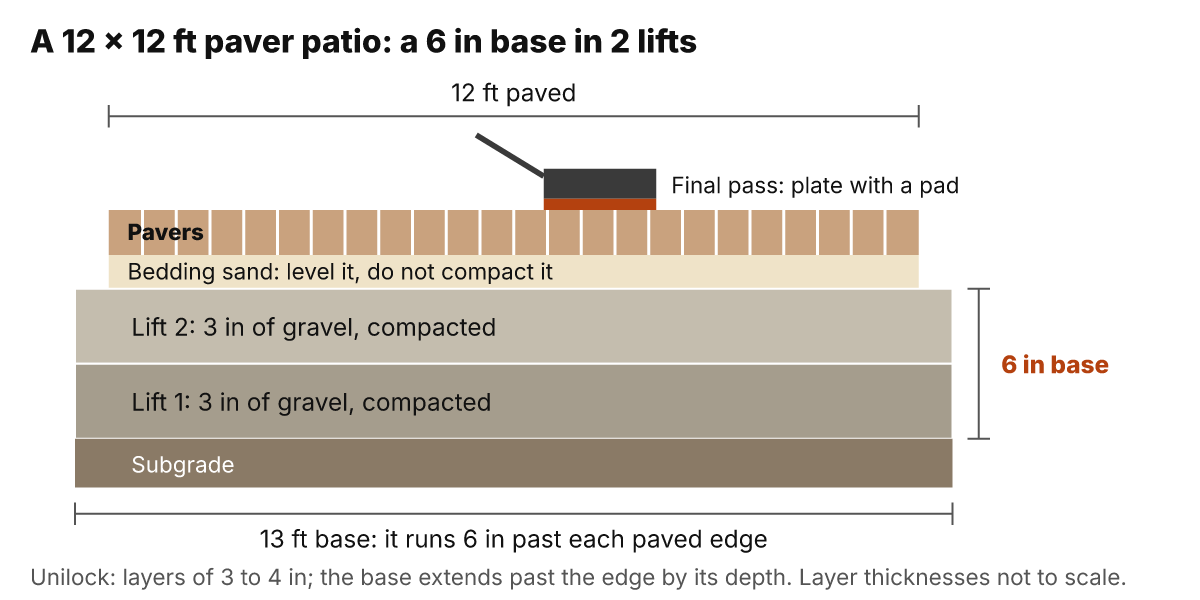
Compacted gravel takes up less room than the loose gravel the truck delivers, and the gravel calculator adds no compaction allowance on its own, so ask your supplier how much extra to order for the stone you buy. The gravel sizes and types guide covers which stone packs into a base, and how much a yard of gravel weighs helps you plan the delivery. Count the pavers and pallets for the same patio with how many pavers come on a pallet.
| Base depth | Use (Unilock) | Lifts at 4 in | Lifts at 3 in |
|---|---|---|---|
| 4 in | Walkways and patios | 1 | 2 |
| 6 in | Walkways and patios | 2 | 2 |
| 8 in | Driveways | 2 | 3 |
| 12 in | Driveways | 3 | 4 |
Lifts = base depth ÷ lift thickness, rounded up. Plan on the 3 in column unless your compactor's maker states more per lift. A gravel driveway is built differently from a paver base; see the gravel driveway layers guide.
For a driveway, the base is deeper and the job is bigger: see the gravel driveway layers guide for how each layer is built, and the TPC90H above, tied for the most force and with the largest plate here.
Hand tamper or plate compactor?
A hand tamper puts its weight on one small square at a time. On the 13 × 13 ft base above, the Kraft Tool CC939's 10 × 10 in plate takes about 244 blows to cover one lift once, before any overlap; the TPC80H's 17 × 21 in plate covers it in about 69 plate footprints, travelling on its own. With 2 lifts that is about 488 tamper blows against 138 plate footprints.
So most patio jobs use both: a plate compactor for the open base, and a tamper along the edges, in corners and around posts where the plate cannot reach. For a short path or a few stepping stones, a tamper alone may be enough. To move the gravel to the patio a load at a time, see the best wheelbarrows for concrete and gravel; every tool on this page is also listed with the rest in our top tool picks.
Frequently asked questions
How thick should each layer of paver base be?
Unilock asks for layers of 3 to 4 in, because most plate compactors will not compact more than 4 in of base. A 6 in patio base is 2 lifts; a 12 in driveway base is 3–4, depending on whether each layer is 4 or 3 in.
Can I run a plate compactor over pavers?
Yes, as the last step: after the pavers are laid and swept clean, Unilock tamps them with a compactor in all directions and says a protective plate cover is a must, because the steel plate can mar or damage the stones. Do not compact the bedding sand before the pavers go down.
How much gravel base do I need for a 12 × 12 paver patio?
At 6 in deep, run 6 in past each edge as Unilock describes, the base covers 13 × 13 ft: 84.5 cu ft or 3.13 cu yd, 3.5 cu yd in half-yard steps. Compacted gravel takes up less room than the loose gravel delivered, so ask your supplier how much extra to order.
More questions (3)
Is a hand tamper enough for a paver patio?
For edges, corners and small areas, yes. Over a whole base it is slow: the 13 × 13 ft base is about 244 blows of a 10 × 10 in tamper per lift before any overlap, against about 69 footprints of a 17 × 21 in compactor plate.
What does compaction depth mean on a plate compactor?
Makers quote it in different ways: XtremepowerUS gives 13 in, VEVOR 12 in, and Tomahawk up to 12 in of soil for the TPC90H. Only Tomahawk's TPC80H page states a depth per lift, 3–4 in at 100% compaction. For a paver base, follow Unilock's 3 to 4 in layers whatever the larger figure says.
Did you test these compactors?
No. They are ranked on each maker's published specs for compacting a paver or gravel base, and every spec on this page links to the maker's own page. The lifts and gravel figures come from Unilock's installation guidance and this site's paver and gravel calculators.
Related calculators and guides
Calculators
- Paver Calculator — Pavers and pallets for a patio or walkway from area and paver size, with optional base gravel and bedding sand volumes.
- Gravel Calculator — Gravel, crushed rock, or landscape rock volume in cubic yards and meters, with an optional weight from your supplier's density.
Guides
- Gravel driveway layers: base, depth, and stone types — Layer thickness, stone choice, crown, ditches, and ordering for a gravel driveway, from road agency manuals.
- How Many Pavers Are on a Pallet? — Units, square feet, and weight per pallet from manufacturer cut sheets, and how to order pallets for a patio.
- Gravel Sizes and Types: #57, #8, Crusher Run, and More — Size numbers, sieve ranges, and stated uses for #57, #8, crusher run, #411, and pea gravel, from state DOT specifications.
- How Much Does a Cubic Yard of Gravel Weigh? — Tons per cubic yard for crushed aggregate, loose versus compacted, and how to convert a volume into an order by weight.
Sources
- Do's and Don'ts of Paver Installation: Step 2 of 3 - Base Preparation — Unilock. Used for: Base 4–6 in for pedestrian walkways, 8–12 in for driveways; compact in layers of 3–4 in; base extends past the paved edge by its depth; bedding layer not compacted. Checked 2026-10-06.
- Do's and Don'ts of Paver Installation: Step 3 of 3 - Installing the Pavers — Unilock. Used for: Compact the laid, cleaned pavers in all directions with a protective plate cover on the compactor. Checked 2026-10-06.
- NIST Handbook 44 (2026), Appendix C: General Tables of Units of Measurement — National Institute of Standards and Technology. Used for: 1 yd³ = 27 ft³; 1 US gal = 231 in³. Checked 2026-10-03.