Guide
Gravel Sizes and Types: #57, #8, Crusher Run, and More
Size numbers, sieve ranges, and stated uses for #57, #8, crusher run, #411, and pea gravel, from state DOT specifications.
By the Yardwork editorial team · Published
Ask a quarry for gravel and the first question back is usually “what size?” The answer is a number such as #57 or #8, or a name such as crusher run, and each one stands for a specific mix of stone sizes that a specification defines with sieves. This guide explains how the numbers work, shows one state's size chart, and sorts out the names that change from place to place, so you can match the product to the job before you work out how much to buy with the gravel calculator.
How gravel size numbers work
A size number is shorthand for a gradation: the share of the stone, by weight, that passes each sieve in a stack. Penn State's Center for Dirt and Gravel Road Studies describes the test as “filtering an aggregate through successively smaller sieves and measuring the weight retained on each sieve.” The national standard behind the numbers is ASTM D448, which “defines aggregate size number designations and standard size ranges” for highway and bridge work. State transportation departments then publish their own tables; Ohio's, for example, falls back on “the size specified in the material specification, the construction item, or as shown in AASHTO M 43.”
- A bigger number means smaller stone. In Penn State's summary, AASHTO numbers sizes from 1 to 10, “with 1 being the largest (all material passing a 4″ sieve opening) and 10 being the smallest (all material passing a 3/8″ sieve opening).”
- Two or three digits mean a blend. Penn State's example: “AASHTO 57 is a blend of AASHTO 5 and AASHTO 7.”
- Sieves come in two kinds. Inch sizes are square openings. Numbered sieves are “those of the U.S. Standard Sieve Series”; Ohio's specification lists the No. 4 at 4.75 mm and the No. 200 at 75 µm.
- The number says nothing about shape or rock. Virginia's coarse aggregate may be “crushed stone, crushed slag, crushed or uncrushed gravel, or lightweight aggregate” and still meet a size number.
Gravel size chart: Virginia DOT Table II-3
The Virginia DOT Road and Bridge Specifications (2020) list 15 open-graded sizes in Table II-3, “Sizes of Open-Graded Coarse Aggregates.” Each cell is the percent by weight finer than that sieve. “Min. 100” marks the sieve every stone passes, and “Max. 5” means no more than 5% may pass. VDOT uses these sizes for concrete, asphalt, surface treatments, and drainage.
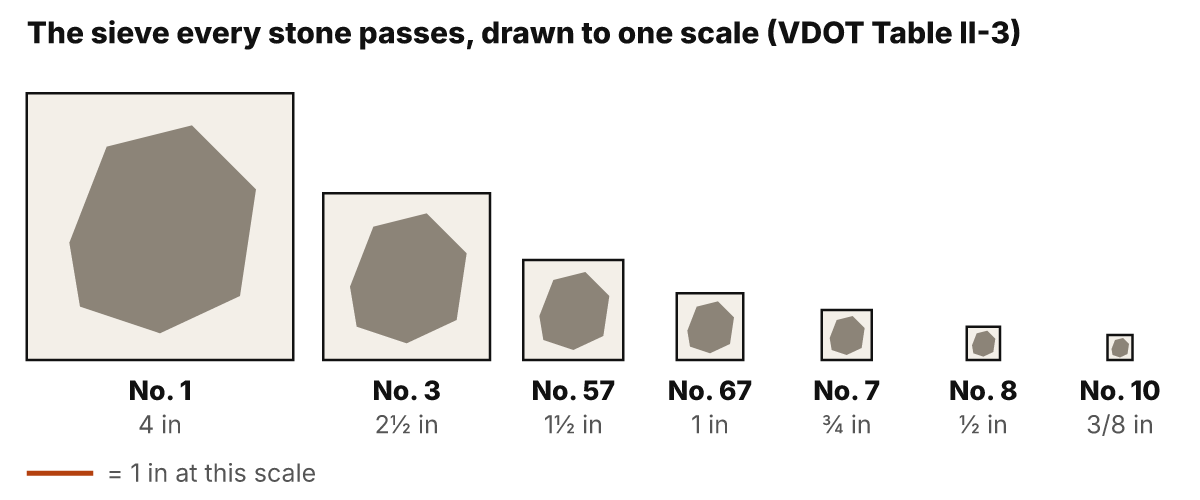
| Size No. | Every stone passes (Min. 100) | Other sieves: % passing |
|---|---|---|
| 1 | 4 in. | 3½ in.: 90-100; 2½ in.: 25-60; 1½ in.: Max. 15; 3/4 in.: Max. 5 |
| 2 | 3 in. | 2½ in.: 90-100; 2 in.: 35-70; 1½ in.: Max. 15; 3/4 in.: Max. 5 |
| 3 | 2½ in. | 2 in.: 90-100; 1½ in.: 35-70; 1 in.: 0-15; 1/2 in.: Max. 5 |
| 357 | 2½ in. | 2 in.: 95-100; 1 in.: 35-70; 1/2 in.: 10-30; No. 4: Max. 5 |
| 5 | 1½ in. | 1 in.: 90-100; 3/4 in.: 20-55; 1/2 in.: Max. 10; 3/8 in.: Max. 5 |
| 56 | 1½ in. | 1 in.: 90-100; 3/4 in.: 40-85; 1/2 in.: 10-40; 3/8 in.: Max. 15; No. 4: Max. 5 |
| 57 | 1½ in. | 1 in.: 95-100; 1/2 in.: 25-60; No. 4: Max. 10; No. 8: Max. 5 |
| 67 | 1 in. | 3/4 in.: 90-100; 3/8 in.: 20-55; No. 4: Max. 10; No. 8: Max. 5 |
| 68 | 1 in. | 3/4 in.: 90-100; 3/8 in.: 30-65; No. 4: 5-25; No. 8: Max. 10; No. 16: Max. 5 |
| 7 | 3/4 in. | 1/2 in.: 90-100; 3/8 in.: 40-70; No. 4: Max. 15; No. 8: Max. 5 |
| 78 | 3/4 in. | 1/2 in.: 90-100; 3/8 in.: 40-75; No. 4: 5-25; No. 8: Max. 10; No. 16: Max. 5 |
| 8 | 1/2 in. | 3/8 in.: 85-100; No. 4: 10-30; No. 8: Max. 10; No. 16: Max. 5 |
| 8P | 1/2 in. | 3/8 in.: 75-100; No. 4: 5-30; No. 8: Max. 5 |
| 9 | 3/8 in. | No. 4: 85-100; No. 8: 10-40; No. 16: Max. 10; No. 50: Max. 5 |
| 10 | 3/8 in. | No. 4: 85-100; No. 100: 10-30 |
Transcribed from VDOT's 2020 Road and Bridge Specifications, Section 203, Table II-3. This is one state's table: other states and suppliers can grade the same size number differently, so ask for the gradation of the product you buy.
#57 vs. #8 stone
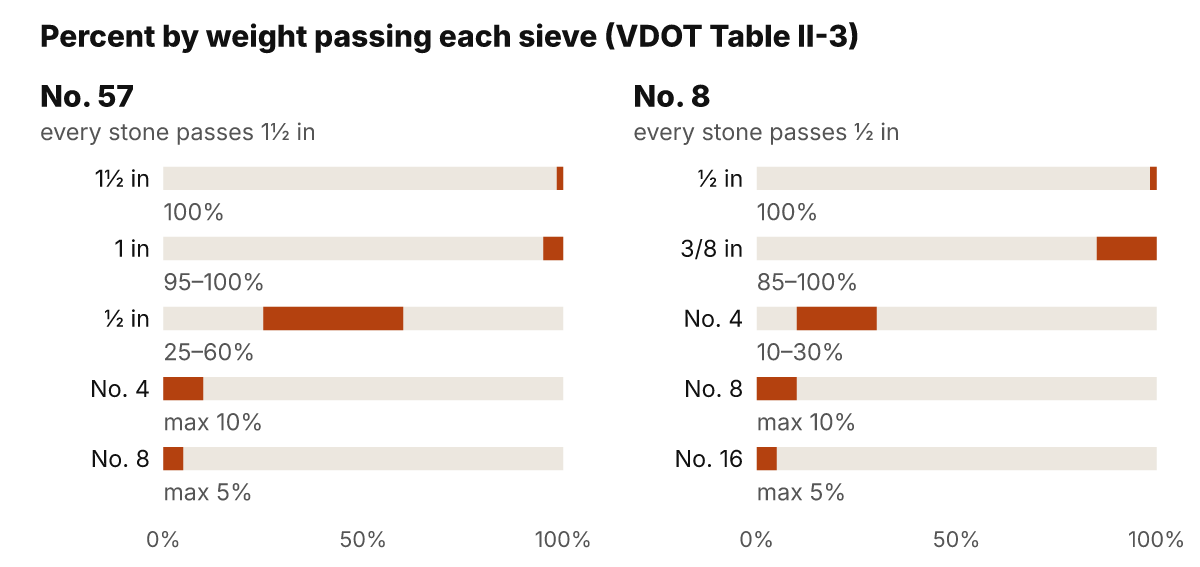
No. 57 is the coarser of the two. Every piece passes a 1½ in sieve, 95–100% passes 1 in, and only 25–60% passes ½ in. No. 8 is finer: every piece passes ½ in, 85–100% passes 3/8 in, and 10–30% passes the No. 4 sieve. Both are clean. No. 57 lets at most 5% through the No. 8 sieve, and No. 8 at most 5% through No. 16.
In Pennsylvania the same two sizes go by other names. Penn State lists AASHTO #57 as PennDOT “2B” and #8 as “1B,” describing #8 as clean stone for “chip surfacing.”
Clean stone vs. dense-graded base
Every size in Table II-3 is open-graded, or clean. Penn State describes clean aggregates as “‘porous’ with notable air voids between individual stones, and little to no ‘fines’,” adding that they “drain effectively, but do not compact well to form a dense conglomerate.” A dense-graded (well-graded) mix is the opposite, with “few air voids between individual stones”: “not suitable for drainage but … preferred for use when compaction is important such as pipe bedding, fill, and road surfaces.”
Virginia grades its dense-graded subbase and base, the “material used to form a foundation for base or surface pavement,” to Table II-9. Compare the finest sieves: 21A keeps 6–12% passing the No. 200 sieve, while No. 57 allows no more than 5% through the much coarser No. 8.
| Size No. | 2 in | 1 in | 3/8 in. | No. 10 | No. 40 | No. 200 |
|---|---|---|---|---|---|---|
| 21A | 100 | 94-100 | 63-72 | 32-41 | 14-24 | 6-12 |
| 21B | 100 | 85-95 | 50-69 | 20-36 | 9-19 | 4-7 |
| 22 | --- | 100 | 62-78 | 39-56 | 23-32 | 8-12 |
A design range: each producer's job-mix formula falls within it, and VDOT's Table II-10 tolerances apply. Numbered sieves are those of the U.S. Standard Sieve Series.
Crusher run, #411, and other regional names
Most of the confusion comes from names that are not size numbers. Their meaning depends on the state, so each one below is tied to the specification that defines it.
Crusher run (Virginia)
Virginia defines crusher run as aggregate crushed from stone, slag, or gravel that “shall contain all of the sizes produced when the original aggregate is reduced through a series of crushers to the maximum size specified.” Its stated uses are “backfilling and bedding pipe and box culverts, maintaining traffic, and repairing and constructing all-weather private access pavements.” Size 25 has 32±18% passing the No. 4 sieve, where No. 57 allows at most 10%.
| Size No. | Every stone passes (Min. 100) | Other sieves: % passing |
|---|---|---|
| 24 | 2½ in | 2 in: 95±5; No. 4: 32±18 |
| 25 | 1½ in | 1 in: 95±5; No. 4: 32±18 |
| 26 | 1 in | ¾ in: 95±5; No. 4: 38±22 |
Cells as printed in VDOT's Section 205.03(a); 95±5 means 90 to 100 percent.
#411 (Ohio)
There is no size 411 in Virginia's table. Ohio DOT's specifications have an Item 411, Stabilized Crushed Aggregate: “placing a compacted course or courses of crushed aggregate,” in compacted lifts of no more than 6 in. Its gradation runs from 100% passing 1 1/2 inch (37.5 mm) through 30 to 60% passing No. 4 (4.75 mm) to 3 to 15% passing No. 200 (75 µm), so it carries fines like a dense-graded base. A product sold as “#411” elsewhere may or may not be made to Ohio's gradation, so ask the supplier which specification it meets.
2A, 2B, and “modified” (Pennsylvania)
Penn State describes PennDOT 2A as a base for placing asphalt with a 2 in top size and fines that are “allowed to vary from 0-10%.” It also warns that “‘modified’ is NOT an official specification,” even though many municipalities and quarries use the term.
Pea gravel and rounded stone
Pea gravel has no size number in Virginia's table or in Penn State's list of common Pennsylvania aggregates, so its size is whatever the supplier screens it to. Ask for the sieve it passes and its gradation, the same as for any other product.
Shape matters as much as size. Penn State says bankrun gravel is “typically rounded in shape and must be crushed before use” as a road aggregate. The driveway layers guide covers why driveway surfaces use crushed stone with fines instead.
Where loose fill is the point, pea gravel has a documented use. The CPSC's home playground handbook lists sand or pea gravel as protective surfacing for equipment up to 5 ft high, at least 9 in deep. For equipment up to 8 ft it lists wood mulch or chips, engineered wood fiber, or shredded rubber mulch instead.
Which size for which job
ASTM notes that some contract documents “specify certain aggregate sizes for specific uses.” These are the uses the sources here name. For your own project, follow your plans, local code, and the supplier's advice for your soil and climate.
| Job | Size or type named | Source |
|---|---|---|
| Underdrain, crossdrain, and outlet pipe trench backfill | No. 57 or No. 8 | VDOT 501.02(c) |
| Porous backfill | No. 78 or 8 | VDOT 204.02(c), 2022 Supplement |
| Pipe culvert bedding | No. 25 or 26 crusher run; No. 57 where water is standing or running, capped with 4 in of No. 25 or 26 | VDOT 302.03 |
| All-weather private access pavements | Crusher run | VDOT 205.01 |
| Foundation for base or surface pavement | Dense-graded 21A, 21B, or 22 | VDOT 208 |
| Base, mattress, underdrains | AASHTO #1 (PennDOT #4) | Penn State |
| Chip surfacing | AASHTO #8 (PennDOT 1B) | Penn State |
| Road base, road surface | PennDOT 2A | Penn State |
| Play surfacing, equipment up to 5 ft | Pea gravel or sand, at least 9 in | CPSC Pub 324 |
Uses as written in each source, for public works (VDOT, PennDOT) and home playgrounds (CPSC). They are examples, not a design.
For a patio, the base and bedding materials and their depths come from the paver manufacturer's installation guide. Enter those depths in the paver calculator to get the volume of each layer along with the paver count.
How size and type change your order
- Volume does not depend on size. Length × width × depth gives the same number of cubic yards whether you fill it with No. 57 or No. 8. The gravel calculator works this way for every product.
- Weight depends on the product. When Ohio DOT has to convert Item 411 from weight to compacted volume, it counts 3,800 lb of crushed stone or 3,900 lb of crushed gravel as one cubic yard. Your supplier's figure for the exact product is the one to use; see how much a yard of gravel weighs.
- Compacted volume is smaller than loose. Ohio pays for Item 411 by the cubic yard “compacted in place.” Compaction shrinks a loose load, so order more loose material than the finished volume.
- Loose fill settles. CPSC notes that an initial 12 in of playground surfacing compresses to about 9 in over time, which the worked example below builds in.
Worked example: pea gravel under a play set
A backyard climber with a 10 × 8 ft frame, platforms no higher than 5 ft, and no swings. CPSC calls for surfacing at least 6 ft beyond the equipment in all directions and, for pea gravel, an initial fill of 12 in that compresses to about 9 in.
Surfaced area = (10 + 2 × 6) × (8 + 2 × 6) = 22 × 20 ft = 440 sq ft
Volume        = 440 sq ft × (12 ÷ 12) ft = 440 ft³ = 16.3 yd³
Order         = round up to ½ yd³ steps = 16.5 yd³
The 12 in depth already allows for compression, so no extra allowance is added here; add one if the ground is uneven. CPSC also says the surfacing “should be periodically refilled to maintain at least a 9-inch depth,” so expect to top it up. A swing needs more room: the handbook extends surfacing in front of and behind it to twice the height of the top bar. Run your own area in the gravel calculator, and if you buy by the ton, enter your supplier's density for that pea gravel.
Frequently asked questions
What is the difference between #57 and #8 stone?
Size. In Virginia DOT's specification, every piece of No. 57 passes a 1½ in sieve, 95–100% passes 1 in, and 25–60% passes ½ in. Every piece of No. 8 passes ½ in, 85–100% passes 3/8 in, and 10–30% passes the No. 4 sieve. Both are clean stone with little fine material.
Is crusher run the same as #57 stone?
No. Virginia DOT defines crusher run as containing all of the sizes the crushers produce, and its Size 25 has 32±18% passing the No. 4 sieve. No. 57 is a clean, open-graded size with at most 10% passing No. 4.
What is #411 gravel?
There is no size 411 in Virginia DOT's size table. Ohio DOT's specifications have an Item 411, Stabilized Crushed Aggregate: a compacted course of crushed aggregate graded from 100% passing 1½ in down to 3 to 15% passing the No. 200 sieve. Ask your supplier which specification its #411 is made to.
What size gravel is best for drainage?
Clean, open-graded stone, whose air voids let water through. Virginia DOT backfills underdrain trenches with No. 57 or No. 8 and uses No. 78 or 8 as porous backfill. Penn State's Center for Dirt and Gravel Road Studies says dense, well-graded mixes are not suitable for drainage.
Is pea gravel safe under a home play set?
The CPSC's home playground handbook lists sand or pea gravel for equipment up to 5 ft high, at least 9 in deep, starting from a 12 in fill that compresses over time. For taller equipment, up to 8 ft, it lists wood mulch or chips, engineered wood fiber, or shredded rubber instead.
Related calculators and guides
Calculators
- Gravel Calculator — Gravel, crushed rock, or landscape rock volume in cubic yards and meters, with an optional weight from your supplier's density.
- Paver Calculator — Pavers and pallets for a patio or walkway from area and paver size, with optional base gravel and bedding sand volumes.
Guides
- Gravel driveway layers: base, depth, and stone types — Layer thickness, stone choice, crown, ditches, and ordering for a gravel driveway, from road agency manuals.
- How Much Does a Cubic Yard of Gravel Weigh? — Tons per cubic yard for crushed aggregate, loose versus compacted, and how to convert a volume into an order by weight.
- What Is a Cubic Yard? — What a cubic yard is, how to convert area × depth into yards, and how much ground one yard covers.
- How to Plan a Bulk Material Delivery — Rounding to supplier increments, questions to ask, and a checklist before bulk material arrives.
Sources
- Road and Bridge Specifications (2020), Section 203 Coarse Aggregate, Table II-3: Sizes of Open-Graded Coarse Aggregates — Virginia Department of Transportation. Used for: No. 57: 1½ in. Min. 100, 1 in. 95-100, 1/2 in. 25-60, No. 4 Max. 10, No. 8 Max. 5; No. 8: 1/2 in. Min. 100, 3/8 in. 85-100, No. 4 10-30, No. 8 Max. 10, No. 16 Max. 5 (% passing). Checked 2026-10-06.
- Road and Bridge Specifications (2020), Section 205: Crusher Run Aggregate — Virginia Department of Transportation. Used for: Sizes 24, 25 and 26; all sizes produced by the crushers; No. 4 passing 32±18 (24, 25) or 38±22 (26). Checked 2026-10-06.
- Road and Bridge Specifications (2020), Section 208 Subbase and Aggregate Base Material, Table II-9: Design Range for Dense-Graded Aggregates — Virginia Department of Transportation. Used for: 21A: No. 200 6-12; 21B: No. 200 4-7; 22: No. 200 8-12 (% passing, design range). Checked 2026-10-06.
- Road and Bridge Specifications (2020), Sections 302.03 (pipe culvert bedding) and 501.02 (underdrains) — Virginia Department of Transportation. Used for: Culvert bedding No. 25 or 26; No. 57 in standing or running water, capped with 4 in of No. 25 or 26; underdrain trench backfill No. 57 or No. 8. Checked 2026-10-06.
- 2022 Supplement to the VDOT 2020 Road and Bridge Specifications: Sections 203.02 and 204.02(c) — Virginia Department of Transportation. Used for: Porous backfill: No. 78 or 8 aggregate. Checked 2026-10-06.
- Aggregates 101: Common Aggregates in PA (technical bulletin, 1/2021) — Penn State Center for Dirt and Gravel Road Studies. Used for: AASHTO 1 = largest (all passing 4 in), 10 = smallest (all passing 3/8 in); #57 = PA 2B (1.5 in - 3/32 in clean); #8 = PA 1B (0.5 in - 3/32 in clean, chip surfacing); 2A: top size 2 in, fines 0-10%. Checked 2026-10-06.
- ASTM D448-12(2022), Standard Classification for Sizes of Aggregate for Road and Bridge Construction (scope) — ASTM International. Checked 2026-10-06.
- Construction and Material Specifications (2023), online version 07/17/2026: Item 411 Stabilized Crushed Aggregate and 703.18 — Ohio Department of Transportation. Used for: Max compacted lift 6 in; crushed stone 3800 lb/yd³, crushed gravel 3900 lb/yd³ (conversion factors). Checked 2026-10-06.
- Outdoor Home Playground Safety Handbook (Publication 324) — U.S. Consumer Product Safety Commission. Used for: 9 in of sand or pea gravel for equipment up to 5 ft high; 12 in initial fill; surfacing 6 ft beyond the equipment. Checked 2026-10-06.