Guide
How Many Pavers Are on a Pallet?
Units, square feet, and weight per pallet from manufacturer cut sheets, and how to order pallets for a patio.
By the Yardwork editorial team · Published
Pavers are sold by the pallet, the piece, or the square foot, but they arrive on pallets, and the pallet count drives both the price and the delivery. How many pavers fit on one depends on the paver, so the only reliable number is the one the manufacturer publishes for the exact product. This guide shows where to find it, why it changes so much with thickness, and how to turn the count from the paver calculator into pallets.
What a cut sheet tells you
Paver manufacturers publish a cut sheet (or spec sheet) for each product. Pavestone's list three pallet figures alongside the stone dimensions:
- Units per pallet, the number of pieces.
- Square feet per pallet, the area those pieces cover.
- Pallet weight, which, the sheets note, is approximate and doesn't include the shipping pallet.
The figures check out against each other. Pavestone's Holland 4×8 is actually 7.87 × 3.94 in (200 × 100 mm), so one face covers 0.2153 sq ft. At 60 mm thick there are 480 on a pallet, and 480 × 0.2153 = 103.4 sq ft, which the sheet rounds to 103. That is the area of the paver faces alone; joints between pavers add a little coverage on top.
Thickness changes coverage per pallet
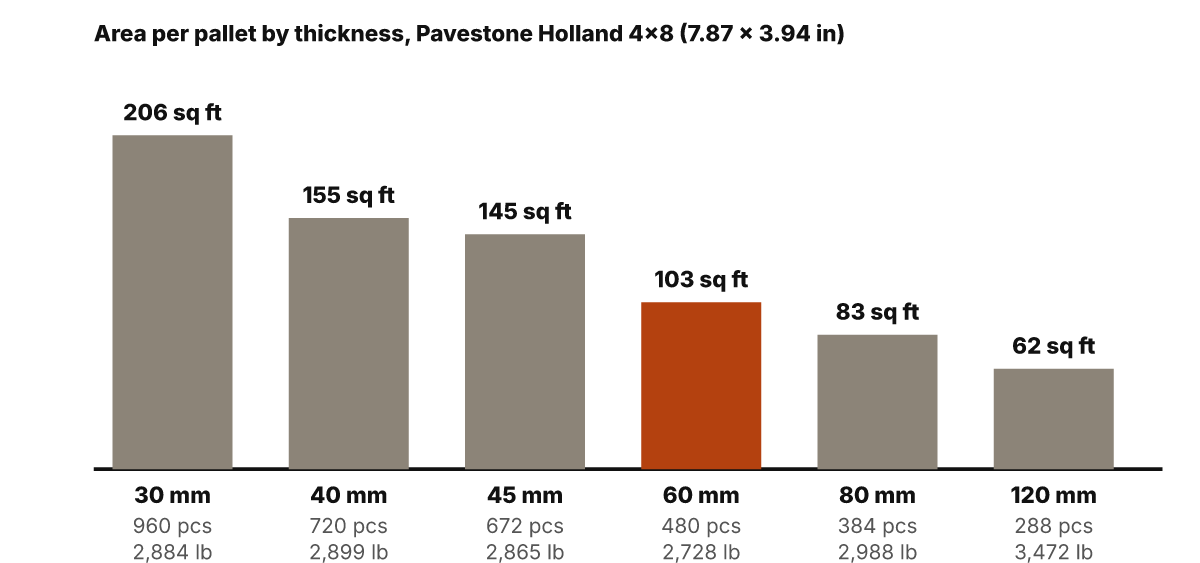
Pavestone makes the same Holland 4×8 shape in six thicknesses. Their cut sheets show how much the pallet changes:
| Thickness | Cut sheet use | Units per pallet | Sq ft per pallet | Pallet weight | Weight per sq ft |
|---|---|---|---|---|---|
| 30 mm (1.18 in) | Pedestrian | 960 | 206 | 2,884 lb | 14 lb |
| 40 mm (1.57 in) | Vehicular and pedestrian | 720 | 155 | 2,899 lb | 18.7 lb |
| 45 mm (1.77 in) | Light vehicular | 672 | 145 | 2,865 lb | 19.8 lb |
| 60 mm (2.36 in) | Light vehicular | 480 | 103 | 2,728 lb | 26.5 lb |
| 80 mm (3.15 in) | Heavy vehicular | 384 | 83 | 2,988 lb | 36 lb |
| 120 mm (4.72 in) | Heavy vehicular | 288 | 62 | 3,472 lb | 56 lb |
Pallet weights exclude the wooden pallet. Pallet configurations can vary by plant and region; use the sheet for the product your supplier stocks.
The pattern is clear: every pallet weighs roughly 2,700 to 3,500 lb, so as each paver gets heavier, fewer fit. A 120 mm paver weighs four times as much per square foot as a 30 mm one (56 vs. 14 lb). The cut sheets also label the intended use, from pedestrian at 30 mm to heavy vehicular at 80 and 120 mm, so the thickness you need for a driveway changes the pallet count as much as the area does.
Multi-size sets
Some pavers come as a set of sizes laid in a repeating pattern. Pavestone's Venetian 6×6|9 at 80 mm ships 80 squares and 160 rectangles per pallet, “two Recs for each Square,” covering 78 sq ft. Check: (80 × 5.91² + 160 × 5.91 × 8.86) in² ÷ 144 = 77.6 sq ft, which the sheet rounds to 78.
For a set like this, dividing by a single paver size doesn't work. Count pallets by area instead: the area with your allowance, divided by the square feet per pallet. For the patio in the worked example below, that is 211.2 ÷ 78 = 2.71, so 3 pallets.
Patterns and cuts
Pavestone describes the Holland's 2:1 shape as one that “easily forms stacked, runner, basketweave, and herringbone patterns.” The pattern doesn't change how many pavers cover a square foot: every paver has the same face, so the count per square foot and the coverage per pallet stay the same. What changes is the cutting.
- Stacked and running bond rows meet a straight edge square, so cuts are simple and the offcuts are often reusable.
- Herringbone, especially laid at 45° to the edge, leaves an angled cut on every paver along the border, and many offcuts are too small to reuse.
- Curves and corners add cuts in any pattern.
So the pattern belongs in the allowance, not in the pavers per pallet. Raise the allowance in the calculator for herringbone, curved edges, or lots of corners, and check the result against whole pallets.
Counting pallets for a project
by count:  pallets = pavers needed ÷ units per pallet         (round up)
by area:   pallets = area × (1 + allowance) ÷ sq ft per pallet (round up)
The two should agree to within a few pavers. The count method uses the calculator's paver count and is the one to order from; the area method is a quick check, and the only method for multi-size sets. Measure odd shapes as described in measuring irregular areas before you start.
| Patio | Area | Pavers | Pallets at 60 mm (480 per pallet) | Pallets at 80 mm (384 per pallet) |
|---|---|---|---|---|
| 10 × 10 ft | 100 sq ft | 511 | 2 | 2 |
| 10 × 12 ft | 120 sq ft | 614 | 2 | 2 |
| 12 × 12 ft | 144 sq ft | 736 | 2 | 2 |
| 12 × 16 ft | 192 sq ft | 981 | 3 | 3 |
| 14 × 20 ft | 280 sq ft | 1,431 | 3 | 4 |
| 16 × 20 ft | 320 sq ft | 1,635 | 4 | 5 |
| 20 × 20 ft | 400 sq ft | 2,044 | 5 | 6 |
Computed with the paver calculator's formula, actual size 7.87 × 3.94 in, no joint width. Pallet counts round up, so a partial pallet counts as one.
Worked example: a 16 × 12 ft patio
A 16 × 12 ft patio in Pavestone Holland 60 mm (7.87 × 3.94 in, 480 per pallet, 2,728 lb per pallet), with a 10% allowance for cuts and breakage:
Area       = 16 × 12 = 192 sq ft
Pavers     = 192 ÷ 0.2153 = 891.6; + 10% = 980.8 → 981
Pallets    = 981 ÷ 480 = 2.04 → 3
Check      = 192 × 1.10 ÷ 103 = 2.05 → 3
Weight     = 981 × (2,728 ÷ 480) = 5,575 lb
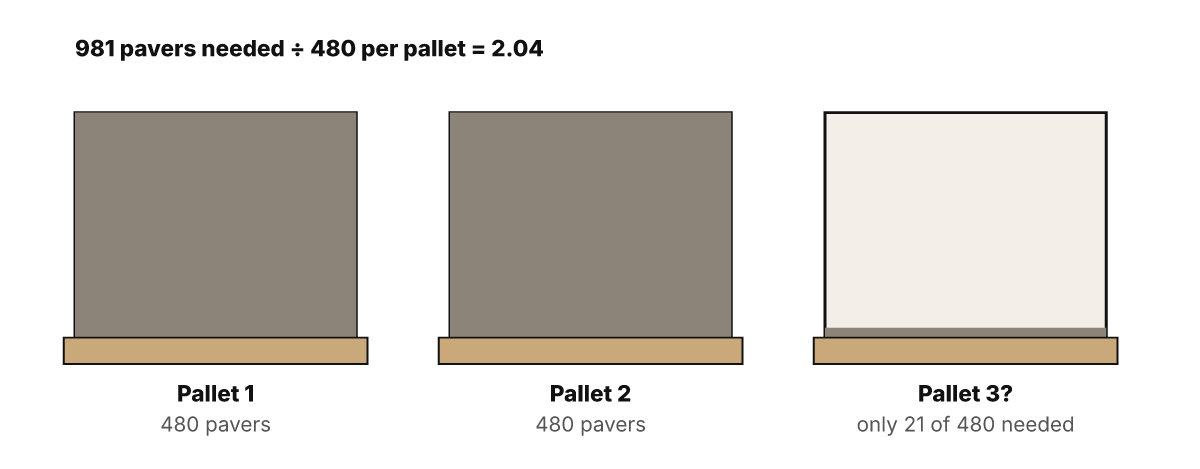
Two pallets give 960 pavers, just 21 short. That is the case to ask about: if the supplier sells loose pavers, buy 21 extra instead of a third pallet; if not, you'll have most of a pallet left over for future repairs. Don't solve it by cutting the allowance; you need those pavers for cuts. Run your own patio in the paver calculator, which also works out base gravel and bedding sand if you enter their depths.
Delivery and handling
At roughly 1.4 to 1.7 tons each, pallets of pavers are heavy loads. Before you order:
- Add up the weight. Multiply pallets by the weight on the cut sheet, and compare with the rated payload of any truck or trailer before you collect them yourself.
- Choose where they land. Pick a firm, level spot close to the work, away from septic systems, sprinkler lines, and soft lawn.
- Ask the supplier how they unload, whether they sell loose pavers or partial pallets, and whether pallets carry a deposit or can be returned.
- Order base and sand at the same time. They are bulk materials with their own delivery; see planning a bulk delivery.
Frequently asked questions
How many pavers are on a pallet?
It depends on the paver. Pavestone's Holland 4×8 paver, for example, comes 960 to a pallet at 30 mm thick, 480 at 60 mm, and 288 at 120 mm. Check the cut sheet for the exact product and thickness you are buying.
How many square feet does a pallet of pavers cover?
For Pavestone's Holland 4×8, from 206 sq ft per pallet at 30 mm down to 62 sq ft at 120 mm, with 103 sq ft at 60 mm. That figure is the area of the paver faces, so joints add slightly to what is actually covered.
How much does a pallet of pavers weigh?
Pavestone lists about 2,700 to 3,500 lb per pallet across the Holland thicknesses, not counting the wooden pallet itself. Compare that with the rated payload of any truck or trailer before hauling one yourself.
Why do thicker pavers cover less area per pallet?
Each thicker paver is heavier, and the pallets in Pavestone's cut sheets all weigh roughly the same, so fewer pavers fit on each. The 120 mm Holland pallet covers less than a third of the area of the 30 mm pallet.
Can I buy part of a pallet of pavers?
Ask your supplier. Some sell loose pavers or partial pallets, others only full pallets. If your count is just over a whole number of pallets, buying the last few pavers loose, where offered, can cost less than a full extra pallet.
Related calculators and guides
Calculators
- Paver Calculator — Pavers and pallets for a patio or walkway from area and paver size, with optional base gravel and bedding sand volumes.
Guides
- How to Plan a Bulk Material Delivery — Rounding to supplier increments, questions to ask, and a checklist before bulk material arrives.
- How to Measure an Irregular Area — Split odd shapes into rectangles, triangles, circles, and trapezoids, then average width and depth.
- What Is a Cubic Yard? — What a cubic yard is, how to convert area × depth into yards, and how much ground one yard covers.
Sources
- Pavestone Holland 30MM cut sheet (Product #218) — Pavestone. Used for: 7.87 × 3.94 × 1.18 in; 960 units per pallet; 206 sq ft per pallet; 2,884 lb per pallet. Checked 2026-10-05.
- Pavestone Holland 40MM cut sheet (Product #215) — Pavestone. Used for: 7.87 × 3.94 × 1.57 in; 720 units per pallet; 155 sq ft per pallet; 2,899 lb per pallet. Checked 2026-10-05.
- Pavestone Holland 45MM cut sheet (Product #220) — Pavestone. Used for: 7.87 × 3.94 × 1.77 in; 672 units per pallet; 145 sq ft per pallet; 2,865 lb per pallet. Checked 2026-10-05.
- Pavestone Holland 60MM cut sheet (Product #217) — Pavestone. Used for: 7.87 × 3.94 × 2.36 in; 480 units per pallet; 103 sq ft per pallet; 2,728 lb per pallet. Checked 2026-10-05.
- Pavestone Holland 80MM cut sheet (Product #219) — Pavestone. Used for: 7.87 × 3.94 × 3.15 in; 384 units per pallet; 83 sq ft per pallet; 2,988 lb per pallet. Checked 2026-10-05.
- Pavestone Holland 120MM cut sheet (Product #222) — Pavestone. Used for: 7.87 × 3.94 × 4.72 in; 288 units per pallet; 62 sq ft per pallet; 3,472 lb per pallet. Checked 2026-10-05.
- Pavestone Venetian 6X6|9 80MM cut sheet (Product #247) — Pavestone. Used for: 80 squares (5.91 × 5.91 in) + 160 rectangles (5.91 × 8.86 in) per pallet; 78 sq ft per pallet; 2,856 lb per pallet. Checked 2026-10-05.