Paver Calculator
Free paver calculator for patios, paths, and walkways. Enter the area and paver size to see how many pavers and pallets to buy, plus optional base and sand.
- Updated October 2026
7.87 × 3.94 in pavers · 10% allowance
736pavers
Pallets
2
384 per pallet
Area
144 sq ft
668.7 pavers before allowance
- Area per paver incl. joint
- 0.2153 sq ft
Base and sand are the volumes of the layers you entered, before compaction or allowance. Size them with your supplier.
Shopping list
As an Amazon Associate I earn from qualifying purchases.
You may also need
Links open Amazon search results. Check each product's label for coverage or yield before buying; quantities above come from your inputs.
AnswerCovering 144 sq ft with 7.87 × 3.94 in pavers takes 668.7 pavers, so buy 736 including a 10% allowance (2 pallets of 384).
How to use this paver calculator
- Enter the patio's length and width, or switch to Total area for odd shapes you have already measured.
- Enter the paver's actual length and width from the product sheet, or tap a published size. Add the joint width if your pavers are laid with a gap.
- Set an allowance for cuts at edges, curves, and borders, and for breakage.
- Optionally enter pavers per pallet to count pallets, and the base and sand depths from your installation plan.
How to calculate pavers: the formula, shown
Each paver covers its own face plus its share of the joint around it. Divide the area by that “module” area to get the number of pavers, add an allowance for cuts and breakage, and round up. If you buy by the pallet, divide by the pavers per pallet and round up again.
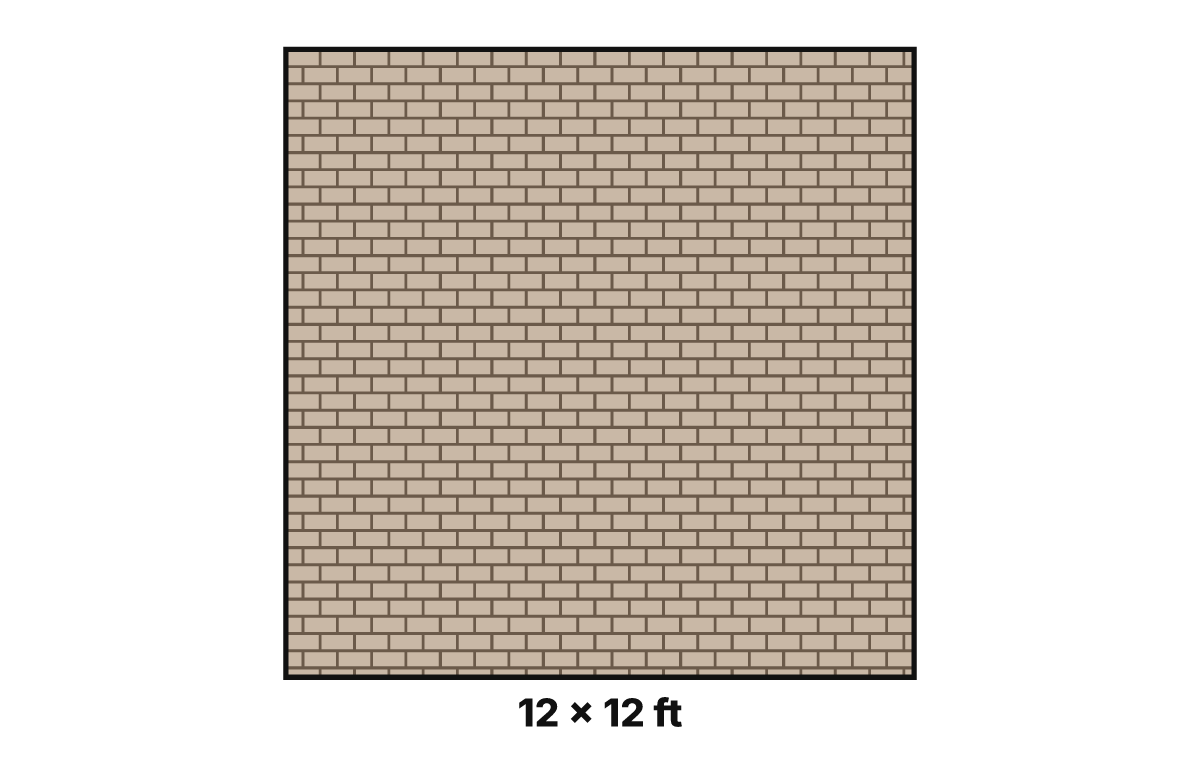
Default example. A 12 × 12 ft patio with 7.87 × 3.94 in pavers (the size Pavestone publishes for Holland Stone II 80mm), no joint width entered, a 10% allowance, and 384 pavers per pallet (Pavestone's published count for that product). Change the inputs above and the result panel recalculates; this worked example always shows the default.
Area        = 12 ft × 12 ft = 144 ft²
Paver area  = (7.87 ÷ 12) × (3.94 ÷ 12) = 0.21533 ft²
Pavers      = 144 ÷ 0.21533 = 668.73
Allowance   = 668.73 × (1 + 10/100) = 735.61 → 736 pavers
Pallets     = 736 ÷ 384 = 1.917 → 2 pallets
A check against the product sheet: Pavestone lists 83 sq ft per pallet for this paver, and 384 × 0.21533 ft² = 82.7 ft², which agrees. Base and sand layers are area × depth, converted to cubic yards by dividing cubic feet by 27.
How many pavers do I need for common patio sizes
Pavers for common patio sizes using 7.87 × 3.94 in pavers with no joint width, computed with the same formula as the calculator. The first count has no allowance; the second includes a 10% allowance, rounded up.
| Patio | Area | Pavers (no allowance) | Pavers (+10%) | Pallets of 384 |
|---|---|---|---|---|
| 10 × 10 ft | 100 sq ft | 465 | 511 | 2 |
| 10 × 12 ft | 120 sq ft | 558 | 614 | 2 |
| 12 × 12 ft | 144 sq ft | 669 | 736 | 2 |
| 12 × 16 ft | 192 sq ft | 892 | 981 | 3 |
| 16 × 16 ft | 256 sq ft | 1189 | 1308 | 4 |
| 16 × 20 ft | 320 sq ft | 1487 | 1635 | 5 |
| 20 × 20 ft | 400 sq ft | 1858 | 2044 | 6 |
A wider joint lowers the count slightly; cuts at curves and borders raise it. Enter your own paver and joint sizes above.
Quick answers: how many pavers for common patios
Each answer is computed with the same formula as the calculator, using its default settings unless the question says otherwise.
How many pavers do I need for a 10x20 patio?
A 10 × 20 ft patio (200 sq ft) takes 928.8 pavers of 7.87 × 3.94 in with no joint gap, so buy 1,022 including a 10% allowance, which is 3 pallets of 384.
How many pavers for a 14x14 patio?
A 14 × 14 ft patio (196 sq ft) takes 910.2 pavers of 7.87 × 3.94 in with no joint gap, so buy 1,002 including a 10% allowance, which is 3 pallets of 384.
How many pallets of pavers for a 20x30 patio?
A 20 × 30 ft patio (600 sq ft) takes 2,786.4 pavers of 7.87 × 3.94 in with no joint gap, so buy 3,066 including a 10% allowance, which is 8 pallets of 384.
How many 12x12 pavers for a 10x16 patio?
A 10 × 16 ft patio (160 sq ft) takes 160 pavers of 12 × 12 in with no joint gap, so buy 176 including a 10% allowance.
How many 16x16 pavers for a 14x20 patio?
A 14 × 20 ft patio (280 sq ft) takes 157.5 pavers of 16 × 16 in with no joint gap, so buy 174 including a 10% allowance.
How many 6x9 pavers for a 4x30 walkway?
A 4 × 30 ft walkway (120 sq ft) takes 320 pavers of 6 × 9 in with no joint gap, so buy 352 including a 10% allowance.
How many 4x8 pavers for 100 square feet?
Covering 100 sq ft takes 450 pavers of 4 × 8 in with no joint gap, so buy 495 including a 10% allowance.
How much gravel base for a 12x16 paver patio 6 inches deep?
A 12 × 16 ft patio needs 3.56 cubic yards (96 ft³) of base material 6 in deep, with no allowance for compaction, before any bedding sand.
What to order for a paver patio
For the default patio, buy 736 pavers: 2 pallets of 384. Partial pallets may be available; ask your supplier. How many pavers are on a pallet shows why the count and weight change with paver thickness.
- Pavers: order all of them from one production run if you can, so color matches across the patio.
- Edges and borders: a soldier or border course uses a different count. Measure the perimeter and calculate it separately.
- Base, sand, and joint sand: layer depths and joint products come from the paver manufacturer's installation guide. See planning a delivery for ordering bulk material.
- Odd shapes: split curves and L-shapes into simpler pieces with measuring irregular areas and enter the total area.
Patio paver base and sand: calculating the layers
Pavers sit on layers of base gravel and bedding sand. This calculator does not choose those depths, because they depend on the soil, the traffic the pavement will carry, and the paver manufacturer's installation guide. Enter the depths from your plan and it computes each layer's volume.
For example, if a plan called for a 4 in base and a 1 in sand layer under the default 12 × 12 ft patio, the layers would be 1.78 yd³ and 0.44 yd³ before compaction. Those depths are illustration only, not a recommendation.
Compacted gravel takes up less room than the loose gravel delivered, so ask your supplier how much extra to order. The gravel calculator adds an allowance and rounds to supplier increments.
Tips for measuring a patio or walkway
- Measure to the outside edge of the finished paving, including any border.
- Use the paver's actual dimensions from the product sheet. A nominal “4 × 8” paver can be slightly smaller.
- Raise the allowance for herringbone or diagonal patterns, which need more cuts along the edges.
- Keep a few spare pavers for future repairs; matching later can be difficult.
Paver calculator FAQ
How do I calculate how many pavers I need?
Divide the patio area by the area of one paver including its share of the joint, add an allowance for cuts and breakage, and round up to a whole paver. Use the same units for both, for example square feet.
How many pavers do I need for a 12 x 12 patio?
With 7.87 × 3.94 in pavers and no joint width, a 12 × 12 ft patio takes 668.7 pavers before allowance, or 736 with a 10% allowance: 2 pallets of 384.
How many pavers are in a pallet?
It depends on the product and thickness. Pavestone lists 384 pavers and 83 sq ft per pallet for its Holland Stone II 80mm paver. Check the product sheet or ask your supplier for the paver you are buying.
How much extra should I buy for cuts?
There is no single figure. The calculator defaults to 10% as an adjustable example. Straight runs in a simple pattern need less; curves, borders, and herringbone or diagonal patterns need more.
How deep should the paver base and sand be?
This calculator does not set those depths. They depend on soil, traffic, and the manufacturer's installation guide. Enter the depths from your plan, and the calculator gives the volume of each layer.
Does joint width change the paver count?
Yes, slightly. Each paver occupies its face plus half the joint on every side, so wider joints mean fewer pavers per square foot. Enter the joint width to include it.
Can I use metric paver sizes?
Yes. Switch the paver size to centimeters (for example 20 × 10 cm), and the area to meters if you measured in meters.
Related calculators and guides
Calculators
- Gravel Calculator — Gravel, crushed rock, or landscape rock volume in cubic yards and meters, with an optional weight from your supplier's density.
- Concrete Calculator — Slab volume in cubic feet, cubic yards, and cubic meters, with ready-mix order size and bag counts for documented products.
- Topsoil Calculator — Topsoil volume in cubic yards and meters for lawns, beds, and fill, with an optional weight from your supplier's density.
Guides
- How Many Pavers Are on a Pallet? — Units, square feet, and weight per pallet from manufacturer cut sheets, and how to order pallets for a patio.
- How to Measure an Irregular Area — Split odd shapes into rectangles, triangles, circles, and trapezoids, then average width and depth.
- What Is a Cubic Yard? — What a cubic yard is, how to convert area × depth into yards, and how much ground one yard covers.
- How to Plan a Bulk Material Delivery — Rounding to supplier increments, questions to ask, and a checklist before bulk material arrives.
Sources
- Pavestone Holland Stone II 80mm cut sheet (Product #229) — Pavestone. Used for: 7.87 in × 3.94 in (200 × 100 mm); 384 units per pallet; 83 sq ft per pallet. Checked 2026-10-05.
- NIST Guide to the SI, Appendix B.9: Factors for units listed by kind of quantity — National Institute of Standards and Technology. Used for: 1 ft = 0.3048 m (exact); 1 in = 2.54 cm (exact). Checked 2026-10-03.
- NIST Handbook 44 (2026), Appendix C: General Tables of Units of Measurement — National Institute of Standards and Technology. Used for: 1 yd³ = 27 ft³; 1 US gal = 231 in³. Checked 2026-10-03.