Guide
How Much Does a Cubic Yard of Gravel Weigh?
Tons per cubic yard for crushed aggregate, loose versus compacted, and how to convert a volume into an order by weight.
By the Yardwork editorial team · Published
Gravel is sold two ways: by the cubic yard and by the ton. To compare prices, plan a delivery, or haul a load yourself, you have to convert between the two, and that takes a density: how many tons fill one cubic yard. This guide explains why that number varies, what measured values look like, and how to turn the volume from the gravel calculator into an order by weight.
Why there is no single number
A cubic yard of “gravel” can weigh quite different amounts, for four reasons:
- The stone itself. Different rock types, and recycled materials such as crushed concrete or asphalt, have different densities.
- The mix of sizes. A graded mix with fines packs into the gaps between larger stones. One-size stone leaves more air in each yard.
- Moisture. Water in a stockpile adds weight without adding stone.
- Its state. Wisconsin DOT's research describes three states for the same material: bank (in the ground), loose (in a stockpile or truck), and compacted (rolled in place). The same tonnage takes up a different volume in each.
That is why the gravel calculator only shows a weight when you enter a density, and why a figure copied from another website may not match what your supplier loads. The rest of this guide shows how big the differences are.
What measured densities show
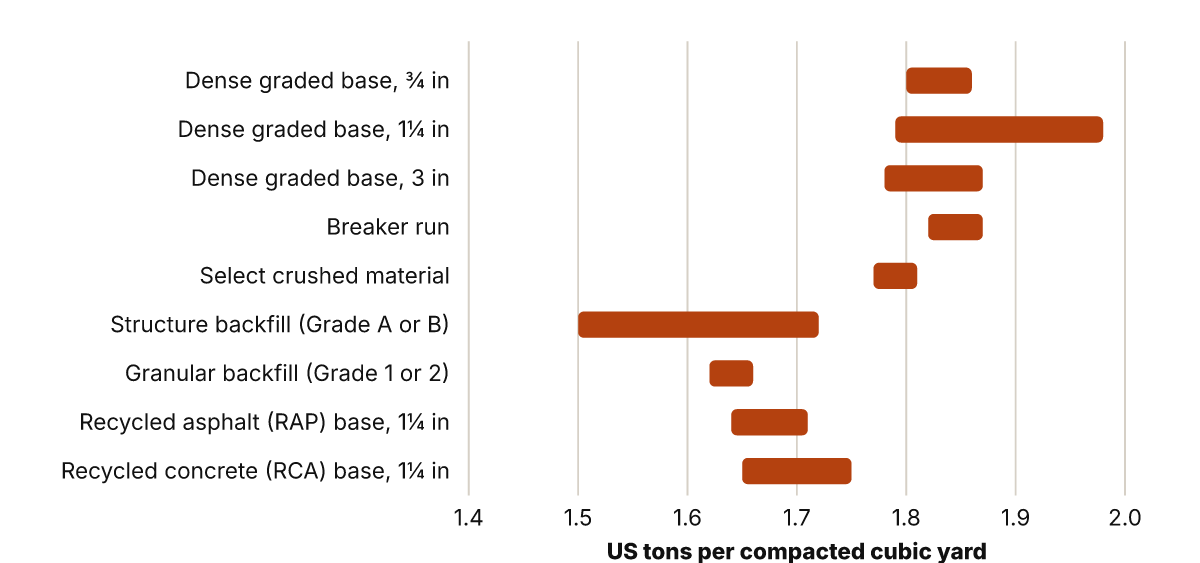
In a 2023 study for the Wisconsin Department of Transportation, researchers sampled aggregates used in Wisconsin road construction and measured them in the lab and in the field. WisDOT's conversion factors are, in the report's words, “essentially compacted unit weights (tons/cubic yard).” Across the aggregates tested, they ranged from 1.50 to 1.98 US tons per cubic yard.
| Material | Tons per compacted yd³ | Expansion, compacted → loose |
|---|---|---|
| Dense graded base, ¾ in | 1.8–1.86 | 36–47% |
| Dense graded base, 1¼ in | 1.79–1.98 | 34–52% |
| Dense graded base, 3 in | 1.78–1.87 | 34–45% |
| Breaker run | 1.82–1.87 | 27–30% |
| Select crushed material | 1.77–1.81 | 27–29% |
| Structure backfill (Grade A or B) | 1.5–1.72 | 35–48% |
| Granular backfill (Grade 1 or 2) | 1.62–1.66 | 38–52% |
| Recycled asphalt (RAP) base, 1¼ in | 1.64–1.71 | 35–46% |
| Recycled concrete (RCA) base, 1¼ in | 1.65–1.75 | 37–60% |
Measured on Wisconsin transportation aggregates. Landscape products such as pea gravel or decorative rock were not part of the study. Use these to sanity-check a supplier's figure, not in place of it.
Two things stand out. First, even one product type spans a range: ¾ in dense graded base measured 1.80 to 1.86 tons per yard. Second, the recycled and backfill materials sit lower than the crushed base materials. Your supplier's stone comes from a different pit, so expect its density to differ from the table too.
Loose versus compacted
A truck carries loose stone. Once it is spread and rolled, the same stone occupies less space. The report measures this as an expansion factor, the percentage by which the loose volume exceeds the compacted volume:
expansion (%)  = (compacted density ÷ loose density − 1) × 100
loose density  = compacted density ÷ (1 + expansion ÷ 100)
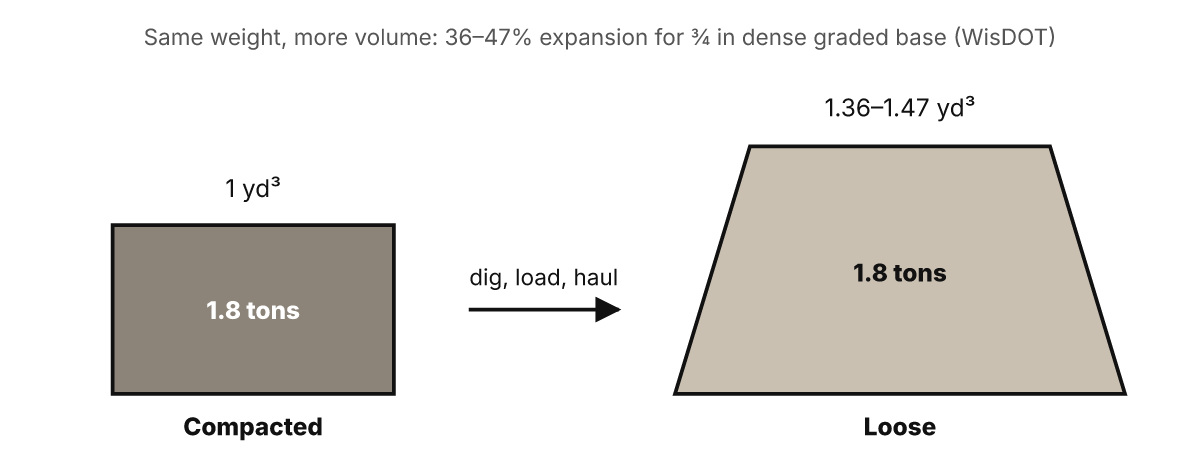
For ¾ in dense graded base at 1.8 tons per compacted yard and 36 to 47% expansion, one loose yard weighs roughly 1.22 to 1.32 tons. Across all the aggregates in the study, expansion ran from 27% to 60%.
Converting yards and tons
One US (short) ton is exactly 2,000 lb and one cubic yard is 27 ft³ (NIST Handbook 44). With a density from your supplier, the conversions are:
tons          = cubic yards × tons per yd³
cubic yards   = tons ÷ tons per yd³
tons per yd³  = lb per ft³ × 27 ÷ 2,000
example: 1.8 tons/yd³ = 1.8 × 2,000 ÷ 27 = 133.3 lb/ft³
The calculator accepts density in US tons per yd³, lb per ft³, tonnes per m³, or kg per m³, so enter it in whatever unit the supplier quotes. The one thing to confirm is which state the figure describes. A loose density divided into a compacted volume, or the reverse, can be off by a third or more.
Worked example: a 40 × 10 ft driveway pad
Say the pad is 40 ft by 10 ft, the finished layer is 4 in deep, and you add a 10% allowance. The supplier says their base material runs 1.8 tons per compacted yard, the low end of the ¾ in base row above.
Volume      = 40 × 10 × (4 ÷ 12) ÷ 27 = 4.94 yd³
+ 10%       = 5.43 yd³ in place (order 5.5 yd³ if sold by the half yard)
Weight      = 5.43 × 1.8 = 9.78 tons (19,556 lb)
Loose yards = 5.43 × (1.36 to 1.47) = 7.39 to 7.99 yd³
Because weight doesn't change when stone is compacted, ordering about 9.8 tons covers the compaction automatically. If the supplier sells loose yards instead, you would need roughly 7.4 to 8 loose yards to end up with 5.43 compacted yards. Try your own dimensions and density in the gravel calculator.
Hauling it yourself
A small load can quickly reach a vehicle's limit. To find how much you can carry per trip, divide the payload your vehicle maker publishes (usually on a door-jamb label or in the owner's manual) by the weight of one loose yard of the product. For example, with a 1,500 lb payload (an example, not a typical figure) and stone at 1.22 tons per loose yard:
1,500 lb ÷ (1.22 × 2,000 lb) = 0.61 yd³ per trip
Wet stone is heavier, so leave a margin, and check the trailer and hitch ratings if you tow. For most driveway-size jobs, a delivery is far fewer trips; see planning a bulk delivery for site and access checks.
What to ask your supplier
- Tons per cubic yard for this exact product, and whether that is loose, compacted, or as stockpiled.
- Do you sell it by the ton or by the yard? If by the yard, ask how a yard is measured (a loader bucket, a box, or weight converted to volume).
- How much extra for compaction? They know how their material behaves under a roller.
- Minimum order and truck capacity. A truck may be limited by weight before it is full by volume.
For small jobs, bagged stone may be simpler: the weight is printed on each bag. See bagged vs. bulk materials to compare, and what a cubic yard is for the volume arithmetic.
Frequently asked questions
How many tons are in a cubic yard of gravel?
It depends on the product. Wisconsin DOT research measured compacted road aggregates at 1.50 to 1.98 US tons per cubic yard, and loose material weighs less than that. Use the figure your supplier gives for the exact product you are buying.
Does a loose yard weigh the same as a compacted yard?
No. Compacting packs more stone into each cubic yard. The Wisconsin study found aggregates take up 27% to 60% more volume loose than compacted, so a loose yard of the same stone weighs correspondingly less.
How do I convert tons of gravel to cubic yards?
Divide the tons by the supplier's tons per cubic yard. At 1.80 tons per compacted yard, 9 tons fills 5 compacted cubic yards. Check whether the density is for loose or compacted material before you divide.
Why does the gravel calculator ask for a density?
Because no single density is correct for every stone. The calculator works out the volume from your measurements, then multiplies by the density you enter, so the weight matches the product your supplier actually sells.
How much gravel can my truck carry?
Divide the payload printed by your vehicle maker by the weight of one cubic yard of the product you are hauling. Wet stone weighs more than dry stone, so leave a margin and never exceed the payload or the tire ratings.
Related calculators and guides
Calculators
- Gravel Calculator — Gravel, crushed rock, or landscape rock volume in cubic yards and meters, with an optional weight from your supplier's density.
Guides
- Gravel driveway layers: base, depth, and stone types — Layer thickness, stone choice, crown, ditches, and ordering for a gravel driveway, from road agency manuals.
- What Is a Cubic Yard? — What a cubic yard is, how to convert area × depth into yards, and how much ground one yard covers.
- How to Plan a Bulk Material Delivery — Rounding to supplier increments, questions to ask, and a checklist before bulk material arrives.
- Bagged vs. Bulk Materials: Which Should You Buy? — How to compare bags and bulk delivery using bags per cubic yard and your own local prices.
Sources
- Weight-Volume Relationships and Conversion Factors for Soils and Aggregates of Wisconsin (WHRP G22-05 final report, December 2023) — Wisconsin Department of Transportation (Wisconsin Highway Research Program). Used for: Compacted 1.50–1.98 tons/yd³; compacted→loose expansion 27–60%. Table E2: Dense Graded Base ¾ in 1.80–1.86 (36–47%); 1¼ in 1.79–1.98 (34–52%); 3 in 1.78–1.87 (34–45%); Breaker Run 1.82–1.87 (27–30%); Select Crushed Material 1.77–1.81 (27–29%); Backfill Structure 1.50–1.72 (35–48%); Backfill Granular 1.62–1.66 (38–52%). Checked 2026-10-05.
- Gravel Roads Manual (2021) — Local Highway Technical Assistance Council (Idaho). Used for: Crown ≈ ½ in per foot (4%), not above 6% or below 2%; loose loads lose 25–30% of volume when spread and compacted. Checked 2026-10-05.
- NIST Handbook 44 (2026), Appendix C: Units of Mass — National Institute of Standards and Technology. Used for: 1 ton (short ton) = 2,000 lb; 1 metric ton = 1,000 kg = 2,204.623 lb. Checked 2026-10-05.
- NIST Handbook 44 (2026), Appendix C: General Tables of Units of Measurement — National Institute of Standards and Technology. Used for: 1 yd³ = 27 ft³; 1 US gal = 231 in³. Checked 2026-10-03.