Guide
How to Pour a Concrete Slab
Plan, form, mix, place, finish, joint, and cure a slab, following the manufacturer's published method.
By the Yardwork editorial team · Published
A small slab for a shed, a landing, or a patio is one of the most common bagged-concrete jobs. This guide walks through it in order: measuring and ordering, the site and forms, mixing, placing, finishing, control joints, andcuring. The method follows the instructions QUIKRETE publishes for its Concrete Mix (No. 1101). If you use a different product, read its bag and data sheet, because amounts and limits differ.
Before you start
This guide covers how to place a slab, not how to design one. Slab thickness, reinforcement, the base under the slab, and any footing or thickened edge depend on what the slab carries and on local rules. Get those from your plans or your local building department before you buy anything.
Plan the pour for a stretch of mild, settled weather. The manufacturer's curing period is shorter in warm weather and longer in cool weather (see curing below). The slab must be protected from freezing for its first 48 hours.
Measure and order the concrete
Measure the inside of the forms: length, width, and the actual height of the form boards. Lumber is smaller than its name. The softwood lumber standard lists a nominal 6 in width at 5-1/2 in dressed, so a “6 inch” form board does not give you a 6 inch slab. Then convert to volume, add an allowance, and divide by the yield on the bag. The concrete calculator does this for you. Here is the same arithmetic written out.
Worked example
A 14 × 12 ft slab at 4 in thick, with a 10% allowance, using 80 lb bags of QUIKRETE Concrete Mix. The size, thickness, and allowance are example inputs, not recommendations.
Volume     = 14 × 12 × (4 ÷ 12) = 56 ft³ (2.07 yd³)
+ 10%      = 61.6 ft³
Bags       = 61.6 ÷ 0.6 ft³ per bag = 102.67 → 103 bags
Water      = 103 × 6–9 pt = 618–927 pt ≈ 77.3–115.9 gal
Batches    = 103 bags ÷ 3 bags per 3 ft³ mixer load = 35 loads
103 bags is a lot of mixing. At around this size it is worth comparing bags with ready-mix delivered by truck. The bagged vs bulk guide shows how to compare them with your own prices, and planning a delivery covers what to ask a ready-mix supplier. Yields differ between products and bag sizes; see concrete bag yields.
The water range comes from QUIKRETE's mixing table for an 80 lb bag of Concrete Mix: start with about 6 pints and expect a final water content of about 6 to 9 pints. The mixer figure comes from the same sheet: allow at least 1 ft³ of mixer capacity for each 80 lb bag mixed at one time.
Prepare the site and sub-base
QUIKRETE's surface preparation step is short: stake out the planned area, remove sod or soil to the desired depth, set the forms, and tamp and compact the sub-base until firm. In practice that means:
- Mark the outline with stakes and string. Check that the corners are square by measuring both diagonals, which should be equal.
- Dig out sod and soil to the depth your plans call for: the slab thickness plus any base material.
- Spread any base material your plans specify, and compact it until firm. Size a gravel base with the gravel calculator.
Build the forms
The forms set both the shape and the thickness of the slab, so they have to be solid. The manufacturer says to nail and stake forms securely in place. Set the top edge of the boards at the finished height of the slab, and check it with a level and string before you mix anything: the screed board rides on these edges, so the surface will only be as flat as the forms.
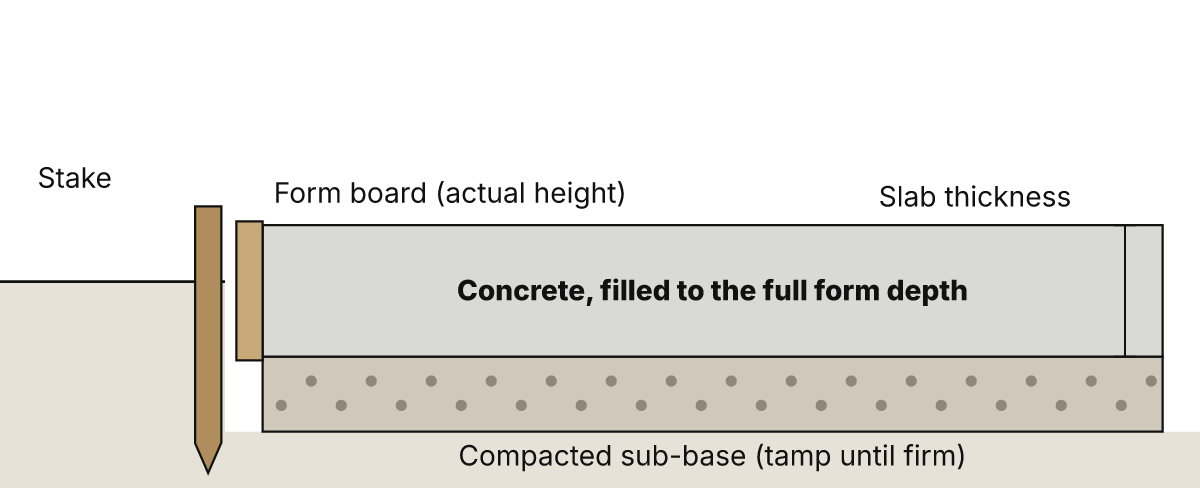
- Stake the outside of the boards closely enough that they don't bow when concrete pushes against them.
- Measure the finished depth inside the form in several places. That is the thickness you are pouring, and the one to enter in the calculator.
- If you want the surface to shed water, build that slope into the form heights now. You can't add it later.
Mix the concrete
QUIKRETE's data sheet gives two ways to mix its Concrete Mix.
Machine mixing
Use a barrel-type concrete mixer or a mortar mixer. Allow at least 1 ft³ of mixer capacity for each 80 lb bag in a batch. Add about 6 pints of fresh water per 80 lb bag to the mixer, start it, then add the concrete. If the mix gets too difficult to work, add water until it is workable. With a slump cone, adjust the water for a 2 to 3 in slump.
Hand mixing
Empty the bag into a mixing tub, add about 6 pints of clean water per 80 lb bag, and work it with a shovel, rake, or hoe. Add water as needed until the mix is stiff and moldable. Make sure there are no dry pockets, and don't leave standing puddles.
| Bag | Starting water | Maximum expected water |
|---|---|---|
| 40 lb | 3 pt | 4-1/2 pt |
| 50 lb | 3-1/2 pt | 5-1/2 pt |
| 60 lb | 4 pt | 7 pt |
| 80 lb | 6 pt | 9 pt |
| 90 lb | 7 pt | 10 pt |
From Table 2 of the QUIKRETE Concrete Mix (No. 1101) product data sheet. Other products publish different amounts.
Place, strike off, and float
The published slab method, step by step:
- Dampen the sub-grade just before placing concrete. Don't leave standing puddles.
- Fill to the full depth of the form, working continuously from one end to the other. Avoid partial-depth fills, which can leave cold joints.
- Spread and compact the concrete so it fills the forms completely, with no air pockets.
- Strike off immediately. Rest a straight board (the screed) on the forms and move it back and forth with a saw-like motion as you pull it along.
- Float with a darby or bull float to level ridges and fill voids left by the screed.
Edges and control joints
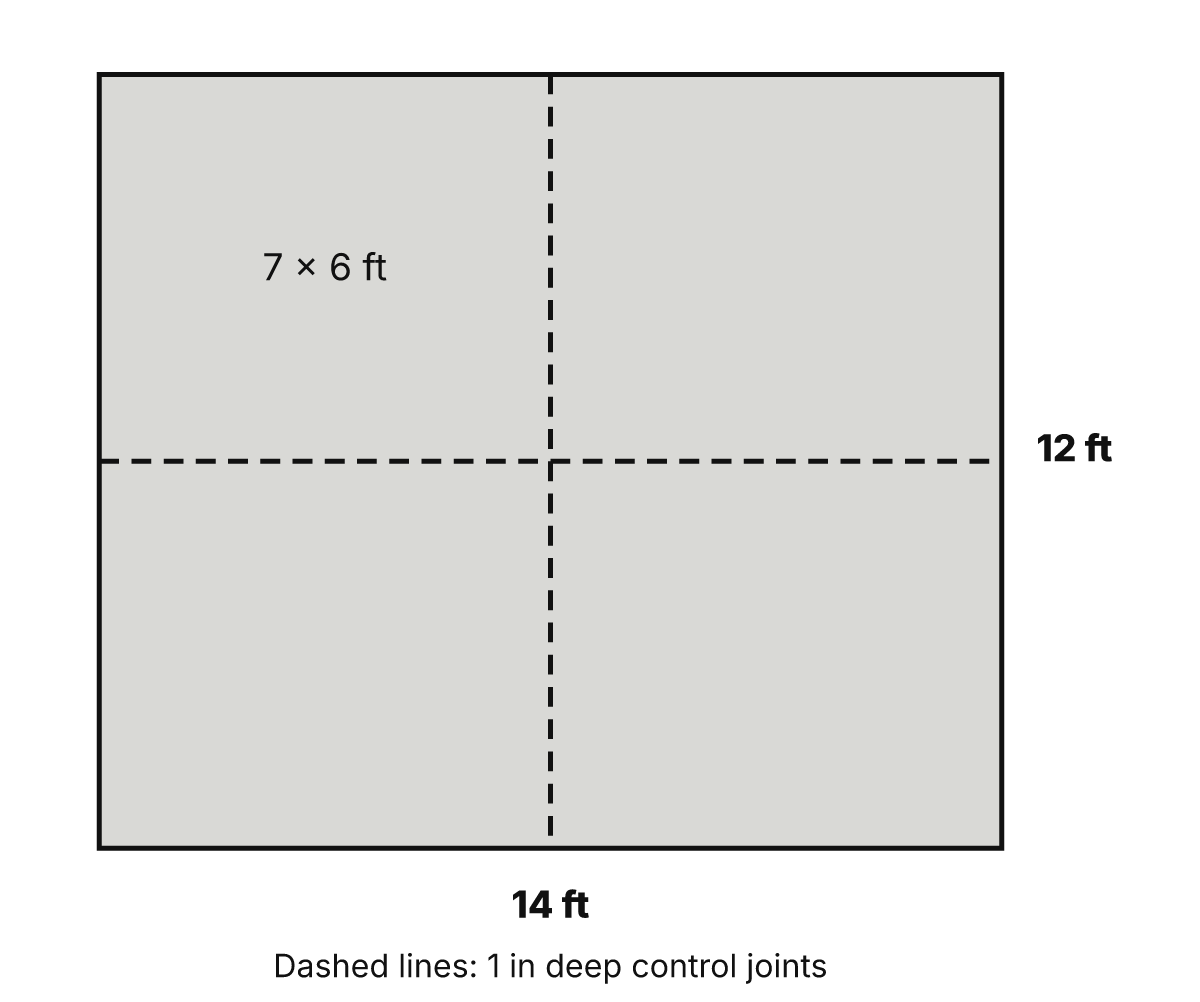
Run an edging tool or trowel along the forms to cut the concrete away from them and compact the slab edges. Then cut control joints with a grooving tool. For this product the data sheet calls for joints 1 in deep every 6 to 8 ft. If your plans give a different spacing, follow the plans.
To lay out the joints, split each side into the fewest equal panels that are no longer than the maximum spacing. For the example slab:
14 ft side: 14 ÷ 8 = 1.75 → 2 panels of 7 ft (1 joint)
12 ft side: 12 ÷ 8 = 1.5 → 2 panels of 6 ft (1 joint)
Finish the surface
Let the concrete stiffen slightly, and wait until all the water has evaporated from the surface before you trowel or apply a broom finish. QUIKRETE notes that any standard finishing technique works with this product: hand troweling, power troweling, a broom finish, or specialty finishes. Its one caution is the most important: for the best results, don't overwork the material.
- Troweled: a smooth, dense surface, typical indoors.
- Broom finish: drag a broom across the surface for texture, typical on walks and patios.
Cure and protect the slab
The data sheet calls curing one of the most important steps: proper curing increases strength and durability, and a poor curing job can ruin an otherwise good slab. Start as soon as possible and keep going for:
| Weather | Cure for |
|---|---|
| Warm: 70 °F (21 °C) or higher | 5 days |
| Colder: 50 °F to 70 °F (10 °C to 21 °C) | 7 days |
Ways to cure that the manufacturer lists:
- A cure-and-seal compound, applied by spray, brush, or roller after the final finishing, when the surface is hard. Complete coverage is essential.
- Wet burlap, kept continuously moist. New burlap should be washed first.
- Plastic sheeting or waterproof paper, laid flat, sealed at the joints, and anchored along the edges.
- A lawn sprinkler or soaker hose, run continuously so curing isn't interrupted.
Pouring near freezing, or in heat, sun, and wind? See pouring concrete in cold or hot weather for the precautions and curing times at each temperature.
Safety
Wet concrete is caustic. The data sheet's warning reads: causes severe skin burns and serious eye damage, and prolonged or repeated inhalation of dust may cause lung damage or cancer. It tells you to read the Safety Data Sheet and wear impervious gloves (such as nitrile), a mask, and eye protection. Long sleeves and boots keep wet concrete off your skin while you place and finish. Lift bags with your legs, and split the work between people: a large bagged slab is a lot of material to move.
Frequently asked questions
How much water goes into an 80 lb bag of concrete mix?
For QUIKRETE Concrete Mix (No. 1101), the data sheet says to start with about 6 pints of water per 80 lb bag and expect a final water content of about 6 to 9 pints. Other products publish their own amounts, so follow the bag you buy.
How far apart should control joints be in a slab?
QUIKRETE's slab method for its Concrete Mix calls for control joints 1 inch deep every 6 to 8 feet, cut with a grooving tool. If your plans specify joint spacing, follow the plans.
How long should a new concrete slab cure?
QUIKRETE's data sheet for Concrete Mix says curing should start as soon as possible and continue for 5 days in warm weather at 70 °F or higher, or 7 days in colder weather between 50 °F and 70 °F.
When can I trowel or broom the slab?
After striking off and floating, let the concrete stiffen slightly and wait until all water has evaporated from the surface before troweling or applying a broom finish. The manufacturer also warns not to overwork the material.
Can I pour concrete if a frost is coming?
Fresh concrete must be protected from freezing during its first 48 hours. QUIKRETE recommends plastic sheeting and insulation blankets if temperatures are expected to fall below 32 °F.
How thick should my slab be?
That depends on what the slab carries and on local requirements, so take it from your plans or building department. QUIKRETE Concrete Mix itself is described as designed for pours 2 inches thick or more.
Related calculators and guides
Calculators
- Concrete Calculator — Slab volume in cubic feet, cubic yards, and cubic meters, with ready-mix order size and bag counts for documented products.
- Gravel Calculator — Gravel, crushed rock, or landscape rock volume in cubic yards and meters, with an optional weight from your supplier's density.
Guides
- Pouring and Curing Concrete in Cold or Hot Weather — Temperature limits, freeze protection, hot-weather drying, and curing time for a new slab, with a worked example.
- Concrete Bag Yields by Bag Size — Published cubic-foot yields for bagged concrete mixes, with bags per cubic foot, cubic yard, and cubic meter.
- Bagged vs. Bulk Materials: Which Should You Buy? — How to compare bags and bulk delivery using bags per cubic yard and your own local prices.
- How to Plan a Bulk Material Delivery — Rounding to supplier increments, questions to ask, and a checklist before bulk material arrives.
- How to Measure an Irregular Area — Split odd shapes into rectangles, triangles, circles, and trapezoids, then average width and depth.
Sources
- QUIKRETE Concrete Mix (No. 1101) product data sheet: installation, application, and curing — QUIKRETE Companies. Used for: Control joints 1 in deep every 6–8 ft; water about 6–9 pt per 80 lb bag; cure 5 days at 70 °F or higher, 7 days at 50–70 °F; protect from freezing for 48 h. Checked 2026-10-05.
- QUIKRETE Concrete Mix (No. 1101) product data sheet — QUIKRETE Companies. Used for: 40 lb = 0.30 ft³; 60 lb = 0.45 ft³; 80 lb = 0.60 ft³; 90 lb = 0.675 ft³ (regional). Checked 2026-10-03.
- Voluntary Product Standard PS 20-25, American Softwood Lumber Standard — National Institute of Standards and Technology. Used for: Nominal 6 in width = 5-1/2 in minimum dressed (dry). Checked 2026-10-03.