Guide
Pouring and Curing Concrete in Cold or Hot Weather
Temperature limits, freeze protection, hot-weather drying, and curing time for a new slab, with a worked example.
By the Yardwork editorial team · Published
Concrete doesn't dry to harden. It hardens through a chemical reaction with water, called hydration, and that reaction needs the right temperature and enough moisture for days after the pour, which is what curing provides. Cold weather slows it down or stops it; hot, dry, or windy weather steals the water it needs. This guide collects what manufacturer and agency documents say about both extremes. For the pour itself, see how to pour a concrete slab; to work out how much you need, use the concrete calculator.
Why temperature matters
QUIKRETE's data sheet for its Concrete Mix puts it plainly: “In near freezing temperatures the hydration process slows considerably. When the weather is too hot, dry, or windy, water is lost by evaporation from the concrete,” which can cause “finishing difficulties and shrinkage cracking.” The ideal conditions, it says, are “ample moisture and moderate temperature and wind conditions.”
The Federal Highway Administration's paving guidance lists what goes wrong at each extreme:
- Hot weather: rapid slump loss (the mix stiffens and gets harder to work), premature stiffening, plastic shrinkage cracking, and thermal cracking.
- Cold weather: delayed setting, slow strength development, and cracking from slowed hydration.
The temperatures to watch
No document gives a single “too cold” or “too hot” number. Instead, different precautions start at different temperatures:
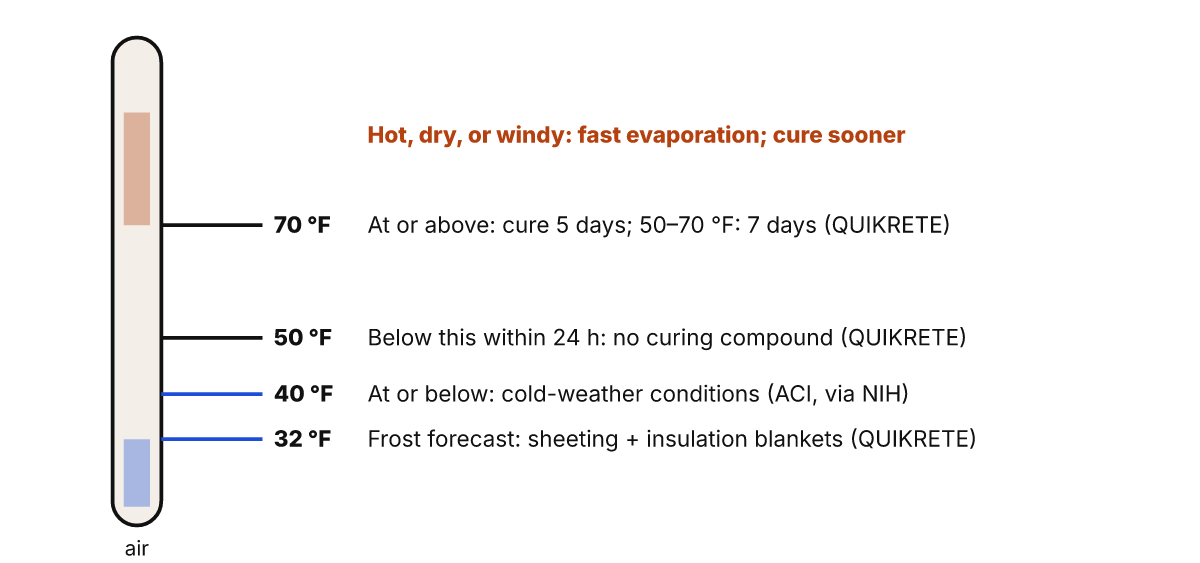
An NIH bulletin adds an important detail: the limits that matter are concrete temperatures, not air temperatures. It recommends monitoring and recording the surface temperature of the concrete, because that shows whether the protection is working whatever the air is doing.
Pouring in cold weather
The NIH Office of Research Facilities' bulletin on cold-weather concreting, quoting the American Concrete Institute, says cold-weather conditions exist when the air temperature “has fallen to, or is expected to fall below, 40°F” during the protection period. Below 40 °F, it says, hydration slows and the concrete stops gaining strength.
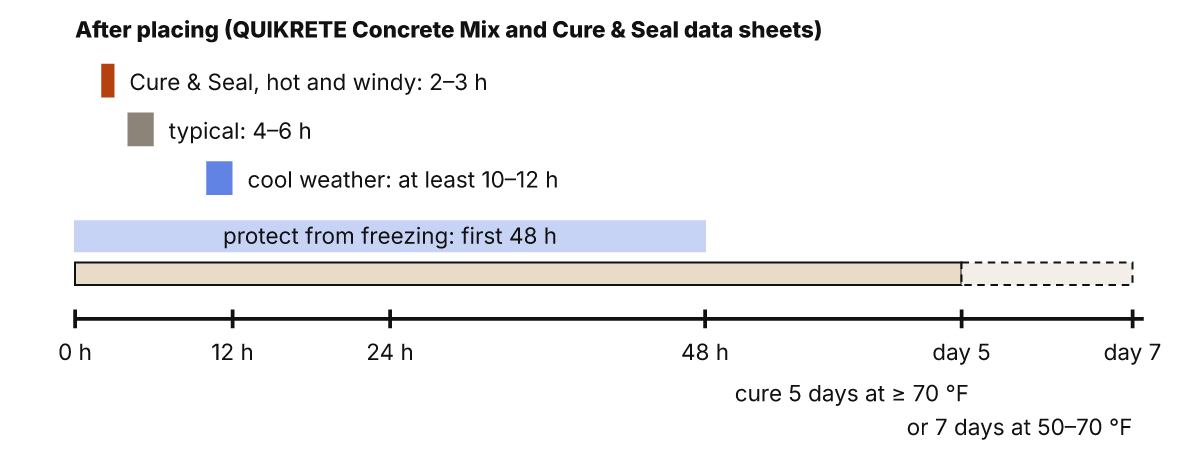
The key rule is not to let fresh concrete freeze. The bulletin recommends protecting it until it reaches 500 psi of compressive strength, “about two days (48 hours) after placement for most concrete that is maintained at 50°F.” Concrete that freezes early “can lose up to 50% of its ultimate strength.” QUIKRETE's instructions match: protect the concrete from freezing for the first 48 hours, and use plastic sheeting and insulation blankets if temperatures are expected to fall below 32 °F.
Practices from the NIH bulletin that apply to a home project:
- Plan ahead and have blankets and sheeting on site before the cold arrives.
- Keep ice and snow off the ground and forms, and keep them above freezing. Insulating the subgrade with blankets for a few days before the pour helps.
- Schedule the pour for the warmest part of the day.
- For ready-mix, ask the producer about a cold-weather mix and the delivery temperature.
- Cover the finished slab with insulation blankets, or enclose and heat it.
- Avoid a sudden temperature drop when you remove the protection.
Pouring in hot, dry, or windy weather
Heat, sun, low humidity, and wind all speed up evaporation. Fresh concrete brings water to its surface (bleeding), and FHWA explains that “plastic shrinkage occurs when the rate of evaporation exceeds the rate of bleeding.” The surface dries and shrinks while the concrete below is still soft, and it cracks.
For highway paving, FHWA treats evaporation above 0.2 lb per square foot per hour as high, calling for preventive measures such as fogging the air above the surface or applying an evaporation retarder. That threshold comes from paving practice, but the lesson carries over: watch the temperature, wind, and humidity on the day, and be ready to protect the surface early.
For a small slab, that usually means:
- Dampening the sub-grade before placing, as QUIKRETE's slab method already requires, without leaving puddles.
- Having finishing tools, help, and curing materials ready so nothing waits on the slab.
- Starting curing sooner. QUIKRETE's Cure & Seal normally goes on 4 to 6 hours after placing, but in hot, windy weather the right time “will be reduced to as little as 2 to 3 hours.”
How long to cure, and how
Curing means keeping the concrete moist and at a reasonable temperature while it gains strength. QUIKRETE says curing “should be started as soon as possible” and continued for 5 days at 70 °F or higher, or 7 days at 50 °F to 70 °F.
| Method | How | Watch out for |
|---|---|---|
| Curing compound (Cure & Seal) | Two thin coats at right angles, 200 sq ft per gallon in total | Not if rain, heavy dew, or below 50 °F is expected within 24 h |
| Plastic sheeting | Laid flat, sealed at joints, anchored at edges | Can cause patchy color on colored concrete |
| Wet burlap | Placed once the surface can take it, kept continuously moist | Wash new burlap first; can discolor colored concrete |
| Water (sprinkler or soaker) | Keeps the surface continuously wet | Must not stop and start during curing |
Worked example: a 10 × 12 ft slab in cool weather
Say you pour a 10 × 12 ft slab, 4 in thick, with a 10% allowance. The forecast stays between 50 °F and 70 °F for the next three days, with no rain.
Area          = 10 × 12 = 120 sq ft
Concrete      = 1.63 yd³ with allowance → 74 × 80 lb bags, or 1.75 yd³ ready-mix
Cure & Seal   = 120 ÷ 200 = 0.6 gal → buy 1 gal
Apply         = at least 10–12 h after placing (cool weather)
Cure for      = 7 days (50–70 °F)
The Cure & Seal sheet doesn't define “cool weather”; on a day in the 50s and 60s, waiting the longer 10 to 12 hours is the cautious reading. If the forecast changes, two rules take over: if a frost is possible in the first 48 hours, cover the slab with sheeting and insulation blankets; and if it may drop below 50 °F within 24 hours of applying the compound, cure under sheeting instead. Run your own slab size in the concrete calculator, and see concrete bag yields if you are mixing by hand.
Before you pour: a weather checklist
- Check the forecast for the pour day and the next 48 hours (freezing) and the next 24 hours (curing compound).
- Cold: blankets and sheeting on site; ground and forms free of frost; pour in the warmest part of the day.
- Hot, dry, or windy: sub-grade dampened, crew and tools ready, curing materials within reach.
- Pick a curing method you can keep going for the full 5 or 7 days.
- Follow the data sheet for the product you buy; times and limits differ between products.
Frequently asked questions
What is the lowest temperature you can pour concrete in?
There is no single cutoff. An NIH bulletin quoting the American Concrete Institute treats air at or below 40 °F during the protection period as cold weather, which calls for precautions. QUIKRETE adds that fresh concrete must not freeze in its first 48 hours.
How long does concrete take to cure?
For QUIKRETE Concrete Mix, the data sheet says to start curing as soon as possible and continue for 5 days at 70 °F or higher, or 7 days between 50 °F and 70 °F. Other products publish their own times.
What happens if fresh concrete freezes?
Early freezing can do permanent damage: the NIH bulletin says concrete can lose up to 50% of its ultimate strength. It recommends protection until the concrete reaches 500 psi, about 48 hours for most concrete kept at 50 °F.
When should I apply cure and seal in hot weather?
QUIKRETE's Acrylic Cure & Seal normally goes on 4 to 6 hours after placing, once the surface water has gone. In hot, windy weather that can drop to 2 to 3 hours; in cool weather wait at least 10 to 12 hours.
Why does concrete crack in hot weather?
If water evaporates from the surface faster than it rises from the concrete below, the surface shrinks and cracks while still plastic. FHWA paving guidance calls for fogging or an evaporation retarder when evaporation tops 0.2 lb per square foot per hour.
Can I use a curing compound on a slab poured in late fall?
QUIKRETE says not on surfaces where de-icers will be used that winter, because the compound can keep the concrete from air drying, which it needs to resist de-icer damage. Use another curing method instead.
Related calculators and guides
Calculators
- Concrete Calculator — Slab volume in cubic feet, cubic yards, and cubic meters, with ready-mix order size and bag counts for documented products.
Guides
- How to Pour a Concrete Slab — Plan, form, mix, place, finish, joint, and cure a slab, following the manufacturer's published method.
- Concrete Bag Yields by Bag Size — Published cubic-foot yields for bagged concrete mixes, with bags per cubic foot, cubic yard, and cubic meter.
- How to Plan a Bulk Material Delivery — Rounding to supplier increments, questions to ask, and a checklist before bulk material arrives.
Sources
- QUIKRETE Concrete Mix (No. 1101) product data sheet: installation, application, and curing — QUIKRETE Companies. Used for: Control joints 1 in deep every 6–8 ft; water about 6–9 pt per 80 lb bag; cure 5 days at 70 °F or higher, 7 days at 50–70 °F; protect from freezing for 48 h. Checked 2026-10-05.
- QUIKRETE Concrete Mix (No. 1101) product data sheet: curing in hot, cold, dry, and windy weather — QUIKRETE Companies. Used for: No curing compound if rain or temperatures below 50 °F are expected within 24 h; no curing compound in late fall where de-icers will be used. Checked 2026-10-05.
- QUIKRETE Acrylic Concrete Cure & Seal – Satin Finish (No. 8730) product data sheet — QUIKRETE Companies. Used for: 200 ft²/gal as a curing compound; apply 4–6 h after placing, 2–3 h in hot windy weather, at least 10–12 h in cool weather; not if rain, heavy dew, or < 50 °F expected within 24 h. Checked 2026-10-05.
- Cold Weather Concreting (Technical Bulletin, Issue 111, April 2021) — National Institutes of Health, Office of Research Facilities. Used for: Protect from freezing until 500 psi (about 48 h at 50 °F); cold weather = air at or expected below 40 °F during the protection period; early freezing can cost up to 50% of ultimate strength. Checked 2026-10-05.
- Curing Practice for Slipformed Concrete Pavements (TechBrief FHWA-IF-06-003, October 2005) — Federal Highway Administration. Used for: Evaporation above 0.2 lb/ft²/h (1.0 kg/m²/h) calls for preventive measures such as fogging or an evaporation retarder. Checked 2026-10-05.
- QUIKRETE Concrete Mix (No. 1101) product data sheet — QUIKRETE Companies. Used for: 40 lb = 0.30 ft³; 60 lb = 0.45 ft³; 80 lb = 0.60 ft³; 90 lb = 0.675 ft³ (regional). Checked 2026-10-03.