Guide
How Many Coats of Paint Do You Need?
Coats and primer by situation from paint makers' data sheets, recoat times, and how each coat changes the gallons to buy.
By the Yardwork editorial team · Published
Most interior paint jobs take two coats of finish paint, and some also need a coat of primer first. That isn't a rule of thumb: it is what paint makers print on each product's technical data sheet, and the answer changes with the product, the surface, and how far the color moves. This guide collects what Benjamin Moore, Sherwin-Williams, PPG, and USG state for named products, how long to wait between coats, and how each coat changes the paint you buy in the paint calculator.
The short answer: usually two coats
Benjamin Moore's data sheet for Regal Select Eggshell (N549), a paint and primer in one, puts it plainly. One coat sometimes covers, but the company “recommends two coats to achieve full color development and to optimize performance.” On bare surfaces it recommends two coats; previously painted surfaces “can be finished with 1 or 2 coats.” Sherwin-Williams' ProMar 200 Zero VOC Eg-Shel data sheet specifies one coat of primer and two coats of finish over new drywall, plaster, masonry, and wood.
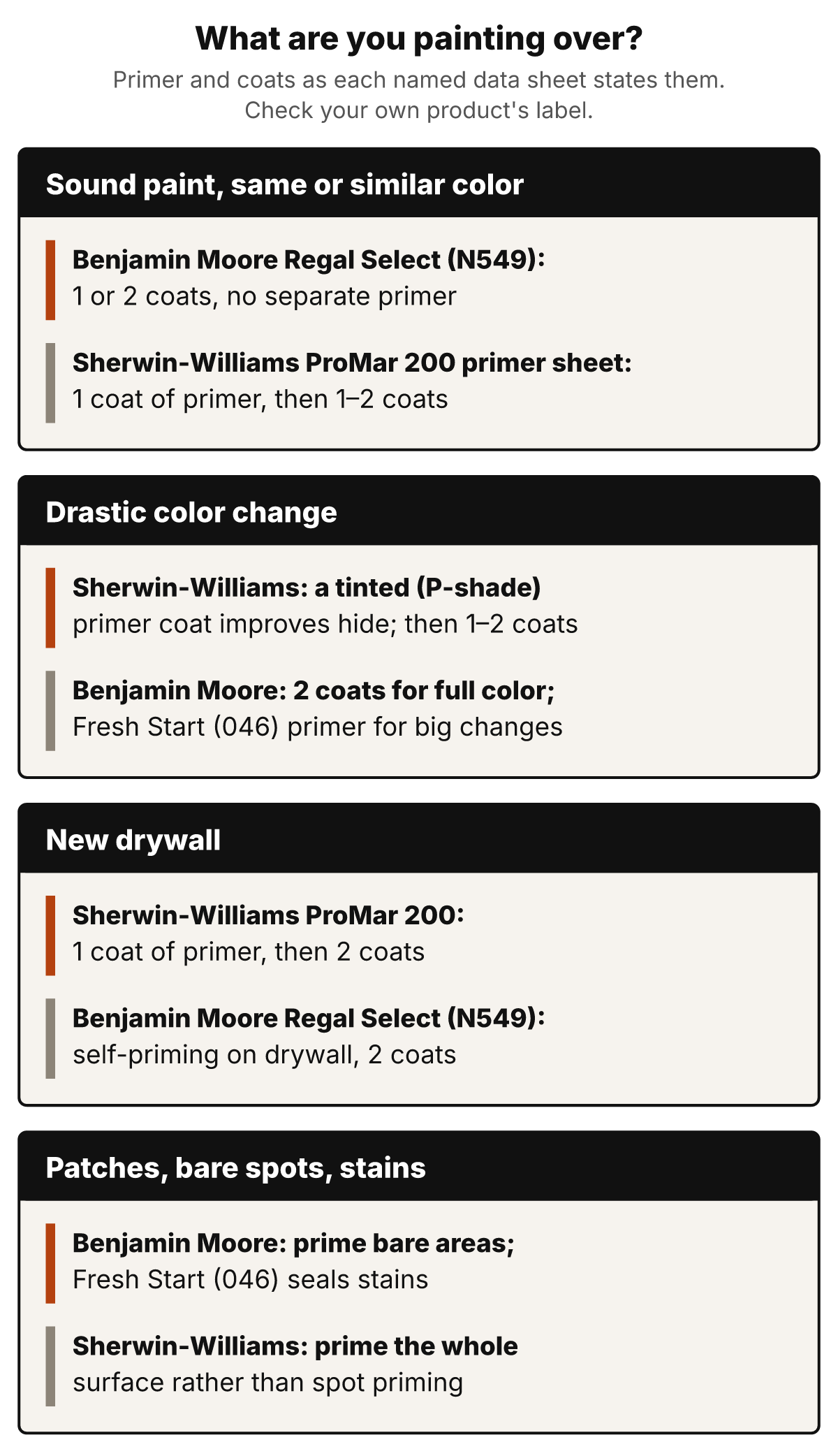
Where the makers differ is on primer. The chart below sets out what each data sheet says for the four common situations; the sections after it give the wording.
Repainting in the same or a similar color
Over sound paint in a close color, one coat may hide what's there. Benjamin Moore allows 1 or 2 coats of Regal Select over previously painted surfaces, with no separate primer except on bare spots. Sherwin-Williams' primer data sheet is more conservative: its specification for previously painted walls is 1 coat of ProMar 200 Zero VOC primer, then 1–2 finish coats. PPG's bulletin for Speedhide Lo Lustre (6-3011) adds a caution: “Some colors, drastic color changes, or porous substrates may require more than one coat to achieve a uniform finish.”
So plan on two coats and treat the second as the one you might skip once the first has dried. Decide before you buy, though: the second coat doubles the paint, which in the worked example below is the difference between 1 and 2 gallons. Preparation is the same either way. The data sheets call for a clean, dry wall with glossy areas dulled (Sherwin-Williams: “sanded dull”) and, on drywall, no sanding dust.
Changing color
A big color change is where primer earns its place. Sherwin-Williams' ProMar 200 data sheet says: “When repainting involves a drastic color change, a coat of primer will improve the hiding performance of the topcoat color.” Both of its ProMar 200 sheets also point to “the recommended P-Shade primer” for the best hide and color development, and the primer sheet allows tinting the primer “to approximate the topcoat color.”
Benjamin Moore describes its Fresh Start High-Hiding All-Purpose Primer (046) as “the go-to for significant color change,” and its Regal Select sheet notes that certain custom colors “may require a Deep Base Primer tinted to a special prescription formula.” Ask the store to tint the primer for your color. Then apply two finish coats, since full color development is exactly what Benjamin Moore's two-coat recommendation is for.
New drywall
Bare drywall is two surfaces at once: the paper face and the joint compound over the joints and fasteners. USG explains that “joint banding” and “photographing” (joints and fasteners that stay visible through the paint) “are usually caused by differences between the porosities and surface textures of gypsum panel face paper ... and the finished joint compound, and are magnified by the use of gloss paints.” Its Sheetrock First Coat primer is made to even out both, and USG says it is “not intended as a final coating” and should be painted over once dry.
The paint makers handle new drywall in two ways, so follow the sheet for the paint you buy:
- A separate primer, then two coats. Sherwin-Williams specifies 1 coat of ProMar 200 Zero VOC primer and 2 coats of finish on drywall. PPG's Speedhide Lo Lustre bulletin says to prime all bare drywall with a PPG primer.
- A paint rated self-priming on drywall. Benjamin Moore lists drywall as “Self-priming” for Regal Select (N549), with two coats recommended on bare surfaces. PPG says its Speedhide High Build Ultra Flat (6-91) “may be used self-priming on new drywall.”
Primer coverage can differ sharply from paint, so estimate it separately from its own label. USG lists 180–200 sq ft per gallon for First Coat, half or less of the 400–450 sq ft Benjamin Moore lists for Regal Select. If you are still hanging the board, choose it with drywall thickness and types and size it with the drywall calculator.
Patches, bare spots, and stains
Patching compound and bare spots take paint differently from the painted wall around them. Benjamin Moore's repaint instruction for Regal Select is to “prime bare areas with the primer recommended above for the substrate.” Sherwin-Williams goes further in its ProMar 200 primer data sheet: spot priming can leave “a non-uniform appearance of the final coat ... due to differences in holdout between primed and unprimed areas. To avoid this, prime the entire surface rather than spot priming.”
Stains need a stain-blocking primer, not more coats of paint. Sherwin-Williams says stains from water, smoke, ink, pencil, and grease “should be sealed with the appropriate primer-sealer.” Benjamin Moore lists water stains, smoke damage, markers, crayons, and nicotine among the stains Fresh Start (046) seals, and warns that “two coats of primer may be required on severe stains.” After the primer, finish with 1 or 2 coats as for any repaint.
How long to wait between coats
Each data sheet gives a recoat time: how long a coat must dry before the next one goes on. The figures are measured at set conditions, 77 °F and 50% relative humidity for all six products below, and each of these makers says real rooms vary. Benjamin Moore: “High humidity and cool temperatures will result in longer dry, recoat and service times.” Sherwin-Williams: recoat times are “temperature, humidity, and film thickness dependent.” PPG: they “may vary depending on temperature, humidity, film build, color, and air movement.”
| Product | Type | Recoat time | Stated at | Minimum application temperature |
|---|---|---|---|---|
| Benjamin Moore Fresh Start High-Hiding All-Purpose Primer (046) | Primer | 1 hour | 77 °F, 50% RH | 40 °F |
| Benjamin Moore Regal Select Eggshell (N549) | Paint and primer | 1–2 hours | 77 °F, 50% RH | 50 °F |
| PPG Speedhide Lo Lustre (6-3011) | Paint | 2–4 hours | 77 °F, 50% RH | 50 °F |
| PPG Speedhide High Build Ultra Flat (6-91) | Paint | 2–4 hours | 77 °F, 50% RH | 50 °F |
| Sherwin-Williams ProMar 200 Zero VOC Primer | Primer | 4 hours | 77 °F, 50% RH | 50 °F |
| Sherwin-Williams ProMar 200 Zero VOC Eg-Shel | Paint | 4 hours | 77 °F, 50% RH | 50 °F |
Benjamin Moore states a minimum surface temperature during application; Sherwin-Williams says to apply above 50 °F; PPG gives 50–90 °F for air, product, and surface.
Recoat time is not the same as cured. Benjamin Moore says Regal Select can be washed after two weeks; PPG says to wait at least 30 days before cleaning Speedhide. USG gives only a dry-to-touch time for First Coat, under 30 minutes at 75 °F and 50% relative humidity, and says to paint over it “when dry.”
Why coverage depends on film thickness
A spread rate such as 400–450 sq ft per gallon isn't a property of the can alone. It is the area a gallon covers when it goes on at the film thickness the maker recommends, measured in mils: thousandths of an inch (NIST defines 1 mil as exactly 0.001 in). Benjamin Moore pairs Regal Select's 400–450 sq ft with a wet film of 3.6–4.0 mils.
The arithmetic is simple. A US gallon is exactly 231 cubic inches. Spread as a wet layer, it covers 231 cubic inches divided by the layer's thickness in inches, and dividing by 144 turns square inches into square feet:
At 4.0 mils wet: 231 ÷ 0.004 in ÷ 144 = 401 sq ft
At 3.6 mils wet: 231 ÷ 0.0036 in ÷ 144 = 446 sq ft
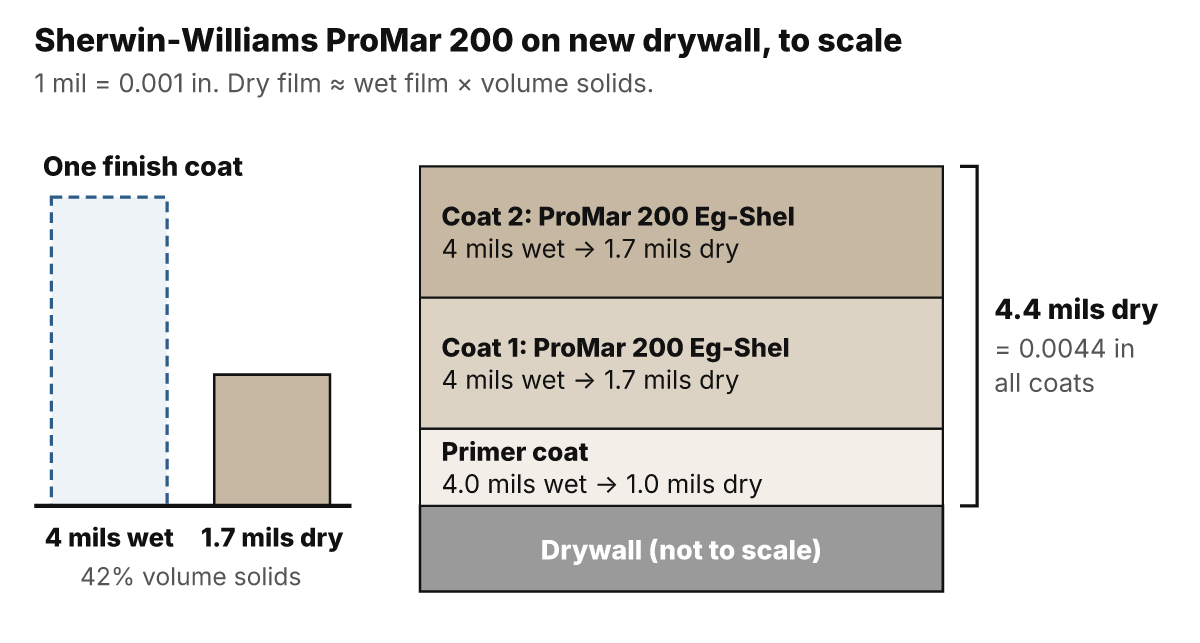
Dry film   ≈ 4.0 mils × 45% volume solids ≈ 1.8 mils (sheet: 1.6–1.8 mils dry)
That reproduces the published 400–450 sq ft once rounded. The table runs the same arithmetic for the other products. The paints' published figures match it once rounded; USG's primer figure is far below it. Always order from the published figure, not from this arithmetic. PPG notes that its coverage figures “do not include loss due to surface irregularities and porosity or material loss due to application method or mixing.”
| Product | Published coverage | Recommended wet film | 231 in³ spread at that film |
|---|---|---|---|
| Benjamin Moore Regal Select Eggshell (N549) | 400–450 sq ft/gal | 3.6–4.0 mils | 401–446 sq ft |
| Sherwin-Williams ProMar 200 Zero VOC Eg-Shel | 350–400 sq ft/gal | 4.0 mils | 401 sq ft |
| Sherwin-Williams ProMar 200 Zero VOC Primer | 400 sq ft/gal | 4.0 mils | 401 sq ft |
| PPG Speedhide Lo Lustre (6-3011) | 300–400 sq ft/gal | 4.0–5.3 mils | 303–401 sq ft |
| PPG Speedhide High Build Ultra Flat (6-91) | 200–300 sq ft/gal | 5.3–8.0 mils | 201–303 sq ft |
| USG Sheetrock First Coat Primer | 180–200 sq ft/gal | 3–5 mils | 321–535 sq ft |
Published figures from each data sheet; the last column is 231 in³ ÷ wet film ÷ 144, rounded. A thinner film than recommended covers more area per gallon only by leaving less paint on the wall.
Each coat also dries thinner than it went on: on these sheets the dry film is roughly the wet film times the volume solids. The diagram shows the Sherwin-Williams drywall system to scale: a primer that dries to 1.0 mil and two finish coats of 1.7 mils each, 4.4 mils in all.
Worked example: one coat vs two
A 12 × 15 ft room with 8 ft walls has 54 ft of wall. Take off 40 sq ft for a door and a window, and use 400 sq ft per gallon, the low end of Benjamin Moore's range for Regal Select. The paint calculator's own formula gives:
Wall area  = 54 ft × 8 ft = 432 sq ft
Paintable  = 432 − 40 = 392 sq ft
1 coat     = 392 × 1 ÷ 400 = 0.98 gal → 1 × 1-gallon can
2 coats    = 392 × 2 ÷ 400 = 1.96 gal → 2 × 1-gallon cans
One coat fits in a single gallon with almost nothing to spare; the second coat needs a second gallon. Primer is a separate product with its own spread rate, so it is calculated separately and rounded up to whole cans on its own:
| Situation | Primer (1 coat) | Finish coats | 1-gallon cans to buy |
|---|---|---|---|
| Same color, one coat | None | Regal Select, 1 coat: 0.98 gal | 1 |
| Same color, two coats | None | Regal Select, 2 coats: 1.96 gal | 2 |
| Drastic color change | Fresh Start (046) at 400: 0.98 gal | Regal Select, 2 coats: 1.96 gal | 1 + 2 |
| New drywall, Sherwin-Williams system | ProMar 200 primer at 400: 0.98 gal | ProMar 200 Eg-Shel at 350, 2 coats: 2.24 gal | 1 + 3 |
| New drywall, USG primer | First Coat at 180: 2.18 gal | Regal Select, 2 coats: 1.96 gal | 3 + 2 |
Computed with the paint calculator's formula. Coverage is the low end of each published range; rough or porous walls use more.
Run your own walls in the paint calculator twice: once for the primer with its label coverage and 1 coat, and once for the paint with the number of coats you chose. For gable walls, stairwells, and ceilings, measure first with how to measure a room for paint and drywall and measuring irregular areas. Spraying the coats instead of rolling them? See the best paint sprayers for interior walls.
Frequently asked questions
Is one coat of paint enough?
Sometimes, over sound paint in a similar color. Benjamin Moore says previously painted surfaces can be finished with 1 or 2 coats of Regal Select, but recommends two coats for full color development. Bare surfaces and drastic color changes need more.
Do I need primer if my paint is paint and primer in one?
Often not: Benjamin Moore lists Regal Select as self-priming on most properly prepared surfaces, drywall included. The same data sheet points to special-purpose primers for water-stained, smoke-damaged, grease-stained or very slick surfaces, and a tinted Deep Base Primer for certain custom colors.
How long should I wait between coats of paint?
Use the recoat time on your product's data sheet. At 77 °F and 50% humidity it is 1–2 hours for Benjamin Moore Regal Select Eggshell, 2–4 hours for PPG Speedhide Lo Lustre, and 4 hours for Sherwin-Williams ProMar 200 Zero VOC. Benjamin Moore notes that high humidity and cool temperatures make it longer.
How many coats of primer do I need?
Usually one. Sherwin-Williams' specifications for new drywall and previously painted walls call for 1 coat of ProMar 200 Zero VOC primer. Benjamin Moore notes that two coats of its Fresh Start 046 primer may be needed over severe stains.
Should I prime just the patches or the whole wall?
Benjamin Moore says to prime bare areas before repainting. Sherwin-Williams warns that spot priming can leave the final coat looking uneven, because primed and unprimed areas hold the paint differently, and recommends priming the entire surface.
Related calculators and guides
Calculators
- Paint Calculator — Gallons or liters of paint for your walls and number of coats, using the coverage printed on your paint's label.
- Drywall Calculator — Drywall sheet count for walls and ceilings from room dimensions or total area, minus openings, by sheet size.
Guides
- How to Measure a Room for Paint and Drywall — Measure each wall and ceiling, subtract openings, handle gables, slopes, and stairwells, and keep it all on one sheet.
- Drywall Thickness and Types: Which Panel Goes Where — Drywall thicknesses and types compared from manufacturer data: uses, weights, ceiling spacing, Type X, and moisture-resistant board.
- How to Measure an Irregular Area — Split odd shapes into rectangles, triangles, circles, and trapezoids, then average width and depth.
Buying guides
- Best Paint Sprayers for Interior Walls (2026) — Six airless, HEA and HVLP paint sprayers ranked on published specs for interior walls, with the paint per room and the refills worked out from the paint calculator.
Sources
- Benjamin Moore Regal Select Interior Paint & Primer, Eggshell (N549) technical data sheet: coats, priming and recoat time — Benjamin Moore & Co.. Used for: Two coats recommended (1 or 2 over previously painted surfaces); self-priming on drywall; recoat 1–2 hours at 77 °F and 50% RH; 45 ± 2% volume solids; 50 °F minimum surface temperature. Checked 2026-10-06.
- Benjamin Moore Regal Select Interior Paint & Primer, Eggshell (N549) technical data sheet — Benjamin Moore & Co.. Used for: 400–450 sq ft per gallon at the recommended film thickness. Checked 2026-10-03.
- Benjamin Moore Fresh Start High-Hiding All-Purpose Primer (046) technical data sheet — Benjamin Moore & Co.. Used for: 400–450 sq ft per gallon at 3.6–4.0 mils wet (1.4–1.6 mils dry); 41 ± 2% volume solids; recoat 1 hour at 77 °F and 50% RH; 40 °F minimum surface temperature. Checked 2026-10-06.
- Sherwin-Williams ProMar 200 Zero V.O.C. Interior Latex Eg-Shel (B20-Series) product data sheet — The Sherwin-Williams Company. Used for: 350–400 sq ft per gallon at 4 mils wet (1.7 mils dry); 42 ± 2% volume solids; recoat 4 hours at 77 °F and 50% RH; drywall: 1 coat primer + 2 coats. Checked 2026-10-06.
- Sherwin-Williams ProMar 200 Zero V.O.C. Interior Latex Primer (B28W02600) product data sheet — The Sherwin-Williams Company. Used for: 400 sq ft per gallon at 4.0 mils wet (1.0 mils dry); 26 ± 2% volume solids; recoat 4 hours at 77 °F and 50% RH; prime the entire surface rather than spot priming. Checked 2026-10-06.
- PPG Speedhide Interior Latex Paint Lo Lustre (6-3011 Series) technical data bulletin — PPG Architectural Finishes, Inc.. Used for: 300–400 sq ft per gallon at 4.0–5.3 mils wet (1.2–1.6 mils dry); 30% ± 2% volume solids; recoat 2–4 hours at 77 °F and 50% RH; prime bare drywall. Checked 2026-10-06.
- PPG Speedhide Interior High Build Latex Ultra Flat (6-91 Series) technical data bulletin — PPG Architectural Finishes, Inc.. Used for: 200–300 sq ft per gallon at 5.3–8.0 mils wet (1.8–2.7 mils dry); 34% ± 2% volume solids; recoat 2–4 hours at 77 °F and 50% RH; may be used self-priming on new drywall. Checked 2026-10-06.
- USG Sheetrock Brand First Coat Primer submittal sheet (J1095, rev. 6-21) — United States Gypsum Company. Used for: 180–200 sq ft per gallon at 3–5 mils wet (0.7–1.2 mils dry); dries to touch in under 30 minutes at 75 °F and 50% RH; not a final coat. Checked 2026-10-06.
- NIST Handbook 44 (2026), Appendix C: mil, US gallon and square foot — National Institute of Standards and Technology. Used for: 1 mil = 0.001 in; 1 US gal = 231 in³; 1 ft² = 144 in². Checked 2026-10-06.