Guide
Architectural vs 3-Tab Shingles
3-tab shingles are one flat layer; architectural shingles are two or more layers bonded together. Compared product by product from CertainTeed and IKO data: size, exposure, coverage per bundle, weight, and wind warranty.
By the Yardwork editorial team · Published
Most asphalt shingle roofs use one of two kinds of shingle: the flat, single-layer 3-tab strip, or the thicker, layered architectural shingle. Besides the look, they differ in size, weight, and wind warranty, and sometimes in how many bundles a roof needs. This guide compares four current products from CertainTeed and IKO using the manufacturers' own data, then runs one roof through the roofing calculator with each product's coverage.
How they are built: one layer or two
CertainTeed's guide to shingle types gives the clearest definitions. Strip shingles, “also known as 3-tab shingles (due to the cut of the shingle),” “are made from a single layer of asphalt and have a very flat appearance.” Dimensional shingles, “also known as architectural or laminate shingles,” “are manufactured with two or more layers of asphalt that are fused together for a thicker and richer multi-dimensional appearance,” and are made to look like wood shake or slate.
The data sheets say the same in product terms. IKO describes Cambridge as “a laminated, two-piece asphalt shingle,” and CertainTeed says of Landmark that “two pieces of the shingle are firmly laminated together.” A 3-tab is a single piece, named for the cut that splits its lower edge into three tabs.
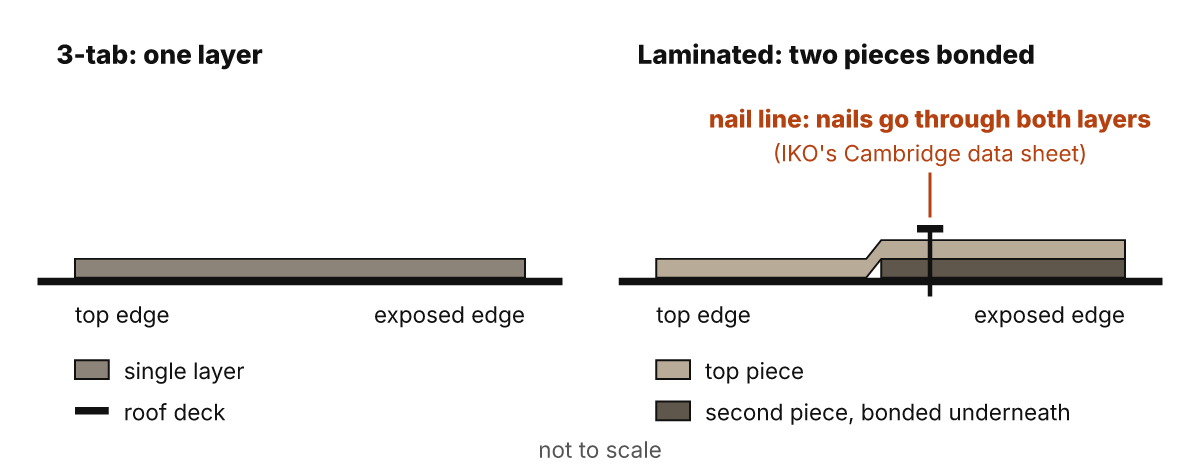
The second layer is why nail placement is spelled out so carefully for laminated shingles. IKO's Cambridge sheet says “it is critical that nails are located in the nail line so that nails penetrate both shingle layers.”
Size and exposure
Exposure is the part of each shingle left showing once the course above covers the rest. IKO's Cambridge sheet, for example, says to install it “with 5 7/8-inch shingle exposure to the weather.” Size and exposure vary by product as much as by type.
IKO notes that the traditional strip or 3-tab shingle measured 12 by 36 inches, still “considered standard asphalt shingle dimensions,” and that it introduced a “metric-size” shingle of 13-1/4 by 39-3/8 inches. Both sizes are sold as 3-tabs today. CertainTeed XT 25 comes in “English” dimensions only, 12 × 36 in with a 5 in exposure. IKO says Marathon Plus AR has the metric dimensions: 13 1/4 × 39 3/8 in with a 5 5/8 in exposure.
Laminated shingles vary too. CertainTeed Landmark is 13 1/4 × 38 3/4 in with a 5 5/8 in exposure; IKO Cambridge is 13 3/4 × 40 7/8 in with a 5 7/8 in exposure. In IKO's words, “the dimensions of architectural shingles may vary from one manufacturer to another.”
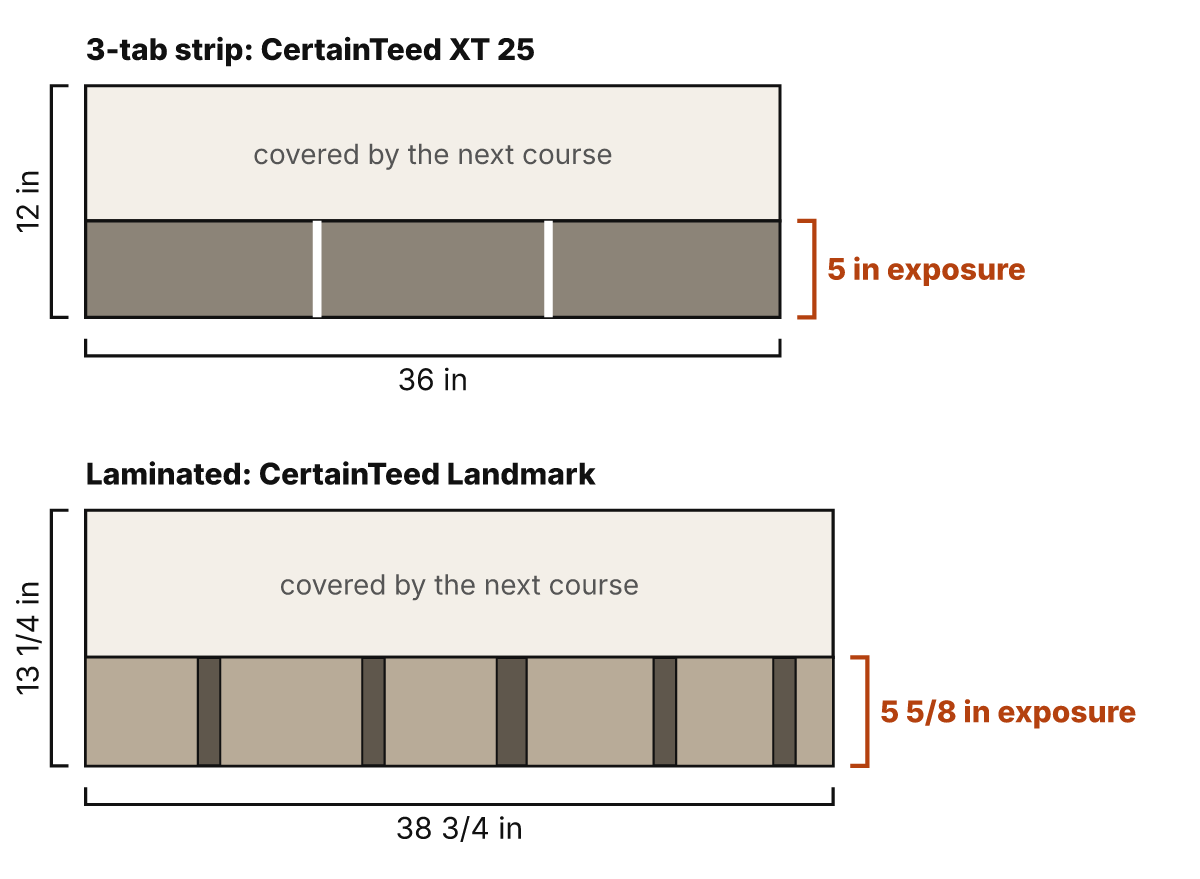
Length and exposure set coverage. Each shingle covers its length times its exposure, and the shingle count does the rest. The published counts agree with the published sizes:
CertainTeed XT 25     36 × 5 in = 180 sq in × 80 per square = 100 sq ft (exactly one square)
CertainTeed Landmark  38 3/4 × 5 5/8 in = 217.97 sq in × 65 per square = 98.39 sq ft (sheet: 98.4 sq ft)
IKO Marathon Plus AR  39 3/8 × 5 5/8 in = 221.48 sq in × 21 per bundle = 32.3 sq ft (page: 32.3 sq ft)
IKO Cambridge         40 7/8 × 5 7/8 in = 240.14 sq in × 20 per bundle = 33.35 sq ft (page: 33 1/3 sq ft)
A larger exposure means fewer courses up the roof and fewer shingles per square. CertainTeed lists 80 XT 25 shingles per square against 65 for Landmark, and IKO lists 65 Marathon Plus AR shingles against 60 for Cambridge.
Four products compared
Every figure below is as published by the manufacturer (checked 2026-10-06). Where a source does not publish a figure, the cell says so rather than filling in an estimate.
| Product | Type | Size | Exposure | Bundles per square | Coverage per bundle | Weight per square | Wind warranty |
|---|---|---|---|---|---|---|---|
| CertainTeed XT 25 | 3-tab | 12 × 36 in | 5 in | 3 | not published | 190–203 (unit not printed) | 60 mph, 5 years |
| IKO Marathon Plus AR | 3-tab | 13 1/4 × 39 3/8 in | 5 5/8 in | not published | 32.3 sq ft | not published | 60 mph |
| CertainTeed Landmark | laminated | 13 1/4 × 38 3/4 in | 5 5/8 in | 3 | not published | 211 to 225 lb | 110 mph, 15 years (160 mph upgrade) |
| IKO Cambridge | laminated | 13 3/4 × 40 7/8 in | 5 7/8 in | not published | 33 1/3 sq ft | not published | 110 mph (130 mph upgrade) |
Sources: CertainTeed's XT 25 and Landmark data sheets, Roofing Selection Guide and Landmark product page; IKO's Marathon Plus AR and Cambridge product pages. Landmark's weight is per 100 sq ft and depends on the manufacturing plant. IKO says all values shown are approximate.
Bundles per square and coverage per bundle
A square is 100 sq ft of roof, and IKO points out that “the key dimension you need to look at is the area covered per bundle.” Packaging differs between products, even from one manufacturer:
- IKO Cambridge (laminated): 20 shingles and 33 1/3 sq ft per bundle; the data sheet lists 100 sq ft per three bundles.
- IKO Marathon Plus AR (3-tab): 21 shingles and 32.3 sq ft per bundle, but 65 shingles per square. That is 3.1 bundles per square; three bundles cover 96.9 sq ft.
- CertainTeed XT 25 and Landmark: 3 bundles per square each. Landmark's three bundles cover “approximately 98.4 square feet,” or 32.8 sq ft per bundle.
So a flat “three bundles per square” rule overstates the coverage of Marathon Plus AR, and of Landmark by a little. The roofing calculator divides by the coverage per bundle instead, which is why it asks for the figure printed on the wrapper. IKO's own short video explains why it packs its laminated shingles to cover a full square:
Weight per square
CertainTeed says strip shingles, being a single layer, “generally weigh and cost less than other asphalt shingles,” and that dimensional shingles “are typically heavier than strip shingles.” Its data sheets give the figures:
- Landmark: 211 to 225 lb per square, which the sheet defines as “weight per 100 square feet” and “dependent on manufacturing location.”
- XT 25: 190–203 (unit not printed), approximate. The Landmark sheet in the same format uses pounds, but the XT 25 sheet prints no unit, so this guide does not convert it.
IKO's product pages for Marathon Plus AR and Cambridge do not list a weight. Weight matters for the delivery, for stacking bundles on the roof, and for whoever carries them up the ladder. The worked example below turns Landmark's figure into a total for one roof.
Wind ratings and wind warranties
Shingle literature carries two kinds of wind figure, and they are easy to mix up:
- Test classes. All four products here list ASTM D3161 Class F and ASTM D7158 Class H wind resistance. On these sheets the classes are the same for the 3-tabs and the laminated shingles.
- Wind warranties. These differ by type. CertainTeed lists a “5-year 60 mph wind-resistance warranty” for XT 25 and a “15-year 110 mph wind-resistance warranty” for Landmark. IKO lists a 60 mph limited wind warranty for Marathon Plus AR and 110 mph for Cambridge.
The higher figures come with conditions. IKO's 130 mph upgrade for Cambridge requires its High Wind Application, and the Cambridge data sheet calls for 4 nails in a standard application and 6 for steep-slope or high-wind application. CertainTeed's upgrade to 160 mph for Landmark requires CertainTeed starter and CertainTeed hip and ridge.
What changes on the order
- Hip and ridge. CertainTeed's XT 25 sheet says to cap hips and ridges with “field shingles of a like color,” so the caps come out of the same product. Its Landmark sheet calls for its Shadow Ridge, Cedar Crest, or Mountain Ridge shingles, a separate product to order.
- Warranty accessories. If you want an upgraded wind warranty, order what it names, such as CertainTeed starter and hip and ridge for Landmark's 160 mph upgrade.
- Nails. Take the nail count from the instructions for your product. For Cambridge it is 4 for a standard application and 6 for steep-slope or high-wind application.
- Slope and underlayment. The slope limits on these sheets do not change with the type. CertainTeed gives XT 25 and Landmark the same rule: use on slopes greater than 2 in per foot, with additional underlayment from 2:12 to under 4:12. IKO says never to apply asphalt shingles below 2:12. Check the pitch with the roof pitch calculator, and see roof underlayment basics for low-slope underlayment.
- Very steep roofs. The XT 25 sheet adds a step for slopes greater than 21 in per foot: a spot of roofing cement under each tab corner.
What drives the cost difference
This guide quotes no prices; they change with region, supplier, and season. What the sources do say:
- CertainTeed says strip shingles “generally weigh and cost less than other asphalt shingles” because they are a single layer.
- Dimensional shingles “have improved warranty protection,” in CertainTeed's words. On these four products that means a lifetime limited warranty for Landmark and Cambridge, against 25-year limited warranties for XT 25 and Marathon Plus AR.
- Quantity can differ: in the worked example below, the 3-tab Marathon Plus AR needs 2 more bundles than the laminated Cambridge for the same roof.
- Accessories add up: Landmark's hip and ridge shingles are a separate purchase, while XT 25 hips and ridges are capped with its field shingles.
To compare quotes, have each one priced on the same roof area, and check each bundle count against the product's coverage.
Worked example: one roof, four products
Take the roofing calculator's default roof: a 40 × 30 ft footprint with 1 ft overhangs, a 6/12 pitch, and a 10% allowance. Here it is run with each product's coverage per bundle, and with a flat three-bundles-per-square assumption:
Roof area         = 1,502.6 sq ft; + 10% = 1,652.9 sq ft (16.53 squares)
Marathon Plus AR  = 1,652.9 ÷ 32.3 = 51.17 → 52 bundles
Landmark          = 1,652.9 ÷ 32.8 = 50.39 → 51 bundles  (98.4 ÷ 3)
Cambridge         = 1,652.9 ÷ 33.3 = 49.64 → 50 bundles
3 per square      = 1,652.9 ÷ 33.33 = 49.59 → 50 bundles
Ordering Marathon Plus AR at three bundles per square would leave this roof 2 bundles short. The laminated Cambridge needs 2 fewer bundles than the 3-tab Marathon because each bundle covers more.
Weight = 16.53 squares × 211 to 225 lb per 100 sq ft = 3,488 to 3,719 lb
That is roughly 3,488 to 3,719 lb of shingles to deliver and lift onto the roof. XT 25 gets no total here because its sheet prints no unit. Try your own roof and coverage in the roofing calculator.
Choosing between them
The sources answer a few of the questions that decide it:
- Matching an existing roof? CertainTeed says strip shingles are now used most often on inexpensive new homes and by homeowners reroofing houses that already have strip shingles.
- Windy site? Compare the wind warranty and its conditions. The ASTM classes are the same on all four products here.
- Look? Laminated shingles are made to imitate wood shake or slate; 3-tabs have “a very flat appearance.”
- Budget? Strip shingles “generally weigh and cost less,” so get quotes for both on the same roof.
Whichever you choose, count bundles from the coverage on the wrapper of the exact product and measure the slope first (how to measure roof pitch). Then follow the manufacturer's installation instructions and your local code.
Frequently asked questions
What is the difference between architectural and 3-tab shingles?
Construction. CertainTeed describes 3-tab (strip) shingles as a single layer of asphalt with a flat look, and architectural (dimensional or laminate) shingles as two or more layers fused together for a thicker, multi-dimensional look that imitates wood shake or slate.
Are architectural shingles heavier than 3-tab shingles?
Generally, yes. CertainTeed says dimensional shingles are typically heavier than strip shingles. Its data sheets list Landmark at 211 to 225 lb per 100 sq ft, depending on the plant, and XT 25 3-tab at 190-203 per square, with no unit printed.
Do architectural shingles have a better wind rating than 3-tab shingles?
Not in the published test classes: CertainTeed XT 25, CertainTeed Landmark, IKO Marathon Plus AR, and IKO Cambridge all list ASTM D3161 Class F and D7158 Class H. The wind warranty differs: 60 mph for the two 3-tabs, 110 mph for the two laminated lines, with upgrades that have installation conditions.
Does a bundle of 3-tab cover the same area as a bundle of architectural shingles?
Not always. IKO lists 32.3 sq ft per bundle for Marathon Plus AR (3-tab) and 33 1/3 sq ft for Cambridge (laminated). CertainTeed sells both XT 25 and Landmark at 3 bundles per square. Count bundles from the coverage on the wrapper of the product you buy.
Do architectural shingles need special hip and ridge caps?
It depends on the line. CertainTeed's XT 25 sheet says to cap hips and ridges with field shingles of a like color, while its Landmark sheet calls for its Shadow Ridge, Cedar Crest, or Mountain Ridge shingles. Follow the hip and ridge instructions for the shingle you buy.
Are 3-tab shingles still made?
Yes, though in fewer lines. CertainTeed still offers XT 25 and IKO lists Marathon Plus AR. CertainTeed says strip shingles are now used most often on inexpensive new homes and to reroof houses that already have strips, while dimensional shingles are the most prevalent.
Related calculators and guides
Calculators
- Roofing Calculator — Roof area, roofing squares, and shingle bundles from a footprint and pitch, using the coverage on your shingle wrapper.
- Roof Pitch Calculator — Pitch as x/12, roof angle in degrees, slope percentage, and the sloped length for a given horizontal run.
Guides
- Roof Underlayment Basics: Synthetic, Felt, and Ice Barrier — Underlayment and ice barrier explained, with laps, low-slope rules, and a worked roll count for a gable roof.
- How to Measure Roof Pitch — Measure rise over 12 in of run from the attic or roof, read an angle, or work it out from plans, then convert.
Buying guides
- Best Roofing Nailers for DIY Reroofs (2026) — Six coil roofing nailers ranked on published specs for a DIY asphalt-shingle reroof, with the nails, magazine loads and battery charges worked out from the roofing calculator.
Sources
- Types of Asphalt Roofing Shingles (CertainTeed) — CertainTeed. Checked 2026-10-06.
- XT 25 Shingles technical data sheet (CertainTeed, 05/21) — CertainTeed. Used for: 12 × 36 in; 5 in weather exposure; 80 shingles per square; weight per square approx. 190–203 (the sheet prints no unit). Checked 2026-10-06.
- Landmark Shingles technical data sheet (CertainTeed, 08/24) — CertainTeed. Used for: 13 1/4 × 38 3/4 in; 5 5/8 in weather exposure; 65 shingles and 3 bundles per square; approx. 98.4 sq ft per square; 211 to 225 lb per 100 sq ft. Checked 2026-10-06.
- Roofing Selection Guide (CertainTeed, 06/26) — CertainTeed. Used for: XT 25: 12 × 36 in, 5 in exposure, 3 bundles per square, 5-year 60 mph wind-resistance warranty. Checked 2026-10-06.
- Landmark Shingles product page (CertainTeed) — CertainTeed. Used for: 15-year 110 mph wind-resistance warranty; upgrade to 160 mph available with CertainTeed starter and hip and ridge. Checked 2026-10-06.
- Marathon Plus AR Traditional 3-Tab Shingles product page (IKO) — IKO Industries. Used for: 39 3/8 × 13 1/4 in; 5 5/8 in exposure; 32.3 sq ft and 21 shingles per bundle; 65 shingles per square; 60 mph limited wind warranty. Checked 2026-10-06.
- Cambridge architectural shingles product page (IKO) — IKO Industries. Used for: 40 7/8 × 13 3/4 in; 5 7/8 in exposure; 33 1/3 sq ft and 20 shingles per bundle; 110 mph limited wind warranty, 130 mph upgrade with High Wind Application. Checked 2026-10-06.
- Cambridge technical data sheet (IKO, 11/2023) — IKO Industries. Used for: 33.3 sq ft per bundle; 100 sq ft per three bundles; 4 nails standard, 6 for steep-slope or high-wind application. Checked 2026-10-06.
- How IKO Shingle Dimensions Provide an Advantage (IKO) — IKO Industries. Used for: Standard strip shingle 12 × 36 in; metric-size shingle 13-1/4 × 39-3/8 in. Checked 2026-10-06.
- How Many Square Feet in a Bundle of Shingles (IKO) — IKO Industries. Used for: 1 square = 100 sq ft; Cambridge 33.3 sq ft/bundle (3 per square); Armourshake 20 sq ft/bundle (5 per square). Checked 2026-10-04.