Guide
Topsoil vs Garden Soil vs Fill Dirt
What each soil product is, where each one belongs, how to check a load before you buy, and how much to order.
By the Yardwork editorial team · Published
Landscape suppliers sell topsoil, garden soil and fill dirt side by side, and the names sound interchangeable. They are not. Fill builds up the ground, topsoil is what roots grow in, and garden soil improves the soil you already have. This guide explains what each one is, where each belongs, how to check a load before you pay for it, and how to work out how much to order with the topsoil calculator and the mulch calculator.
The short answer
| Topsoil | Garden soil | Fill dirt | |
|---|---|---|---|
| What it is | The surface layer of soil (the A horizon), sold screened or unscreened | A bagged blend made to be mixed into existing soil | Soil excavated somewhere else and hauled in |
| Use it for | Lawns, the top layer over fill, the soil part of a raised-bed mix | Amending in-ground beds and planting holes | Filling holes and low spots, raising the grade under topsoil |
| Watch for | Pit material sold as topsoil may not be topsoil at all (Utah State) | Planting straight into it: Miracle-Gro advises against it for its in-ground garden soil | Varies widely in quality (UF/IFAS); a poor choice for a vegetable bed (UConn) |
Product names vary by supplier, and none of these is a regulated grade. Ask what is actually in the pile.
What topsoil is
In the ground
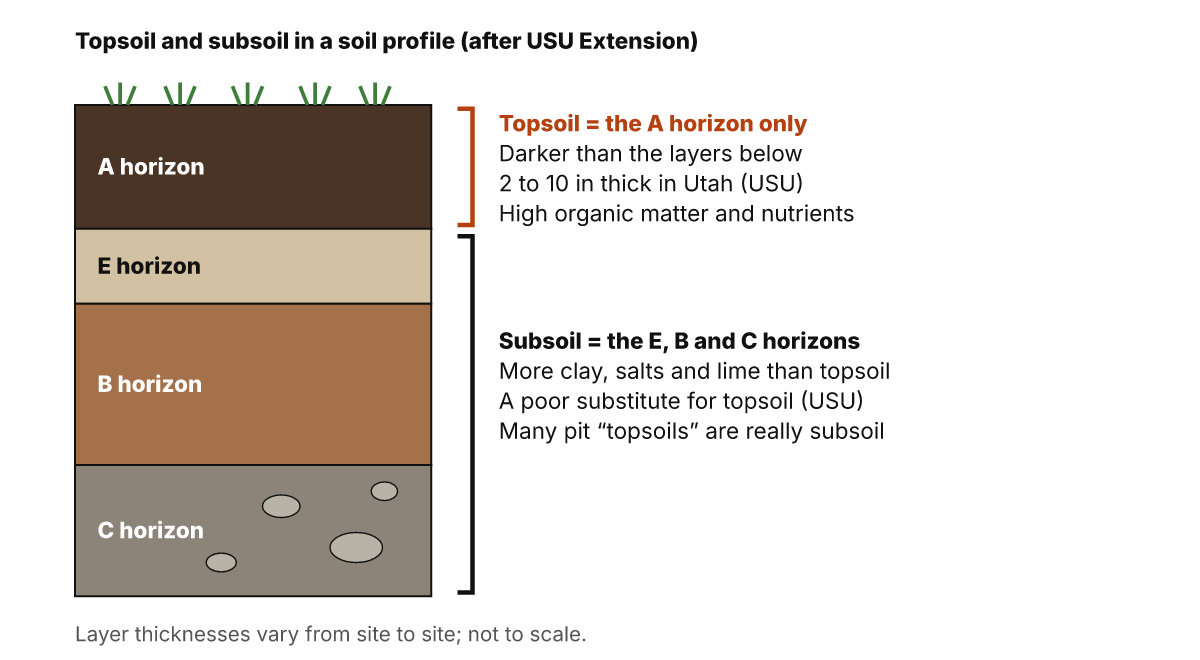
Soil forms in layers called horizons. Utah State University Extension defines topsoil as the A horizon only: the surface layer, darker than the layers below because of its organic matter. The E, B and C horizons beneath it make up the subsoil, which has higher levels of clay, salts and lime, and USU calls subsoils “poor substitutes for topsoils.”
The layer is thin: USU says topsoil layers in Utah commonly range from two to ten inches thick. That is one reason material dug deeper, or from a pit, may not be topsoil at all.
As a product
Sold topsoil has no fixed specification. UNH Extension points out that New Hampshire has no legal definition of topsoil and no regulations governing its sale (it is also sometimes sold as “loam”), and UConn Extension notes that Connecticut has no state-run grading or certification system. What arrives depends on where it was dug:
- Screened topsoil has been passed through a screen. UNH warns that unscreened topsoil can be full of rocks and roots.
- Pit material can be mislabeled. USU says many materials sold as topsoils, particularly those from pits, are in fact subsoils, because the true topsoil was removed from the surface of the pit in the first sale.
What garden soil is
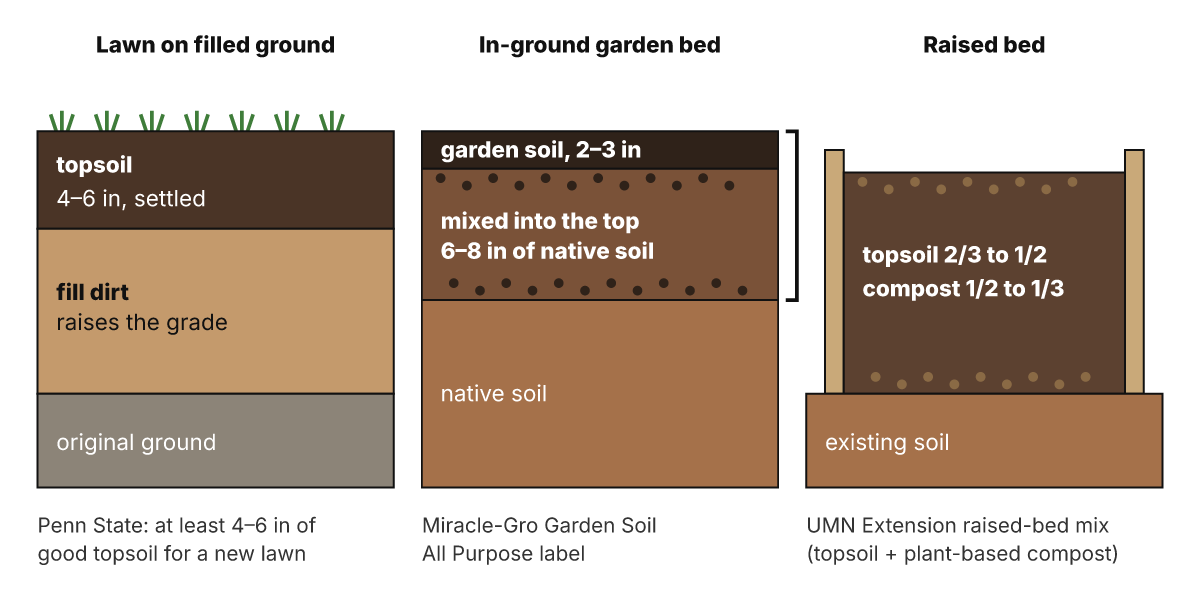
“Garden soil” is a product name, not a soil layer, so the bag tells you what it is for. Take Miracle-Gro Garden Soil All Purpose: the maker describes it as soil “for in-ground use” that feeds plants and improves existing soil. The directions are to spread 2–3 inches in the bed and mix it into the top 6–8 inches of native soil, and Miracle-Gro says it doesn't recommend planting directly into it.
In other words, a garden soil of this kind is an amendment. It changes the top few inches of the soil you have; it is not meant to build a bed or raise a lawn on its own. Other bags are made for other jobs. For raised beds, UMN Extension suggests looking for mixes labeled “raised bed mix” or similar, and it says potting soil, though suitable for pots and seedlings, dries out too quickly in raised beds.
What fill dirt is
Fill dirt, or just fill, is soil brought in to fill a hole or raise the ground. UF/IFAS Extension describes how it turns up on new home sites: construction often begins by removing all native vegetation and the topsoil, and fill material may be soil excavated while digging nearby stormwater ponds or material hauled in from another location. “As a result, fill material can vary widely in its physical and chemical properties.” Building sites are also compacted, partly on purpose to support the structure.
If fill was dug from below the surface layer, it carries the subsoil traits USU lists: more clay, salts and lime, and less organic matter than topsoil. That is fine for its job, which is volume. UConn Extension puts it plainly: material sold for grading can be fine for filling low spots but is a poor choice for a vegetable bed.
Which one to use where
A new or repaired lawn
Penn State Extension's lawn guidance starts with the grade. Grading begins on the subsoil, before the topsoil is replaced, and that subgrade should be lowered to leave room for several inches of topsoil. Then: “a minimum of 4 to 6 inches (firmed or settled depth) of a good-quality topsoil is needed to establish good-quality turf.” Ideally 2 inches of the topsoil are worked into the upper 2 to 3 inches of the subsoil, so the two layers blend instead of meeting at a sharp line. UNH gives similar advice for purchased topsoil: incorporate it into the top few inches of your existing soil rather than simply spreading it on top, because plant roots grow best in a single zone of topsoil.
Garden beds in the ground
Improve the soil that is already there. A garden soil like the one above is mixed into the top 6–8 inches, and UF/IFAS Extension notes that compost can be mixed into the rooting zone when preparing new plant beds. Once planted, a layer of mulch goes on top: see how to mulch garden beds for depths.
Raised beds
UMN Extension's recommendation is a mix of around 2/3 to 1/2 topsoil and 1/2 to 1/3 plant-based compost, ideally with a loam or sandy loam topsoil, avoiding very sandy or clay soil. UConn Extension agrees that a blend of topsoil and finished compost works better than straight compost or straight mineral soil. UMN also notes that buying in bulk by the cubic yard is generally much cheaper than buying bags; see bagged vs. bulk materials.
Low spots and grade changes
Use fill for the depth that is below the finished topsoil layer, and topsoil for the layer roots will grow in. On a lawn, that means leaving room for Penn State's 4 to 6 settled inches of topsoil above the fill.
Checking quality before you buy
You can't judge topsoil from the pile. UNH says soil experts consider it impossible to judge quality just by looking, and USU says visual appearance alone is not a reliable indicator. Before you order:
- Ask where it came from, whether it has been screened, what it is meant for (lawn repair, general grading, or a vegetable garden), and whether compost is mixed in and how much. These are UConn Extension's questions.
- Ask for test data. UNH suggests asking the vendor for the product's test results, or for a sample to have tested yourself; USU recommends testing before purchase where possible.
- Smell it. UNH says not to buy a product with a chemical or other off-odor.
- Try a few seeds in a sample if you are worried about herbicide residue, as UNH suggests: see whether they germinate.
- Compare it with what you have. USU advises checking whether the soil will be any better than the material already on the site before buying.
When the test results come back, these are the targets the extension services publish:
| Property | What the source says | Source |
|---|---|---|
| pH | 5.5 to 7.5 acceptable | UNH Extension |
| pH | 5.5 to 7.5 ideal | Utah State |
| Texture | Loam or sandy loam best | UNH Extension |
| Organic matter | Less than 1.0% unacceptable | Utah State |
| Stones and gravel | More than 5.0% coarse fragments (over 2 mm) unacceptable; no fragments over 1½ in | Utah State |
The sources differ, so they are listed separately rather than averaged. Utah State's table was written for Utah soils.
Settling and how much to order
Spread soil settles. Penn State's lawn depth is a “firmed or settled depth.” University of Illinois Extension calls settling “simply a fact of raised bed gardening,” because freshly installed fill has little soil structure, and suggests an annual top dressing of a few inches of compost or high-quality topsoil to keep up. UConn adds that very light, peaty or woody material may settle quickly after a season or two.
None of these sources gives a settling percentage, and neither does this guide. Ask your supplier how much their product settles, then set the allowance in the topsoil calculator to cover it.
The volume itself is area × depth. Bulk soil is sold by the cubic yard, which is 27 cubic feet; see what a cubic yard is for the conversions. Bags are labeled in cubic feet, so divide the cubic-foot volume by the bag size and round up. For delivery logistics, see planning a bulk delivery.
Worked examples
A lawn over filled ground
A 30 × 20 ft area sits 9 in below the finished grade. Raise it with 3 in of fill, then cap it with 6 in of topsoil, the top of Penn State's 4–6 in range. Both come from the topsoil calculator's formula with its default 10% allowance and half-yard order steps. That allowance is an input you choose, not a measured settling rate.
Fill     = 30 × 20 ft × 3/12 ft = 150 ft³ = 5.56 yd³
           + 10% = 6.11 yd³ → order 6.5 yd³
Topsoil  = 30 × 20 ft × 6/12 ft = 300 ft³ = 11.11 yd³
           + 10% = 12.22 yd³ → order 12.5 yd³
If the supplier says their topsoil settles more than 10%, raise the allowance; the 6 in is meant to be measured after settling. The FAQ on ordering extra for settling in the topsoil calculator covers the same point.
A raised bed
A 4 × 8 ft bed filled 12 in deep holds 32 cubic feet (1.19 cubic yards). Splitting the depth by UMN's range gives each component's volume. The compost is computed with the same area × depth formula, as a volume only, with no allowance and quarter-yard order steps:
2/3 topsoil: 8 in = 21.3 ft³ = 0.79 yd³ → 1 yd³
1/3 compost: 4 in = 10.7 ft³ = 0.4 yd³ → 0.5 yd³
1/2 each:    6 in = 16 ft³ = 0.59 yd³ → 0.75 yd³ of each
The bed will settle over the season, so plan on the yearly top-up Illinois Extension describes.
Checking a garden soil label
Miracle-Gro says two 2 cu ft bags of Garden Soil All Purpose cover 24 sq ft at 2 in, or three bags at 3 in. The mulch calculator's bag count works for any bagged material sold by the cubic foot, so it can check the label. For a 6 × 4 ft bed with no allowance:
At 2 in: 24 ft² × 2/12 ft = 4 ft³ ÷ 2 = 2 → 2 bags
At 3 in: 24 ft² × 3/12 ft = 6 ft³ ÷ 2 = 3 → 3 bags
Both match the label. Run your own bed through the mulch calculator with the bag size you are buying, and remember the garden soil gets mixed into the top 6–8 in rather than left as a layer.
Frequently asked questions
Can you plant directly in fill dirt?
Not well. Fill is soil excavated somewhere else, and UF/IFAS Extension notes it can vary widely in its physical and chemical properties. UConn Extension says material sold for grading can be fine for filling low spots but is a poor choice for a vegetable bed, so cover fill with topsoil before you plant.
Is garden soil the same as topsoil?
No. Topsoil is soil; garden soil is a blended product for improving the soil you have. Miracle-Gro labels its Garden Soil All Purpose for in-ground use, spread 2–3 inches deep and mixed into the top 6–8 inches of native soil, and advises against planting directly into it.
What should I fill a raised bed with?
UMN Extension recommends around 2/3 to 1/2 topsoil and 1/2 to 1/3 plant-based compost, with a loam or sandy loam topsoil. It says potting soil dries out too quickly for raised beds, and UConn Extension says a topsoil-compost blend works better than straight compost or straight mineral soil.
How much topsoil should go over fill for a new lawn?
Penn State Extension says a minimum of 4 to 6 inches of good-quality topsoil, measured firmed or settled. At 6 inches, a 30 × 20 ft lawn takes 11.1 cubic yards before any allowance, and loose soil settles, so order more than that.
How can I tell if topsoil is good before I buy it?
Not by looking: UNH Extension says quality can't be judged from the pile. Ask for test results or test a sample. UNH calls pH 5.5 to 7.5 acceptable with loam or sandy loam best, and Utah State rates organic matter under 1.0% or coarse fragments over 5.0% as unacceptable.
Related calculators and guides
Calculators
- Topsoil Calculator — Topsoil volume in cubic yards and meters for lawns, beds, and fill, with an optional weight from your supplier's density.
- Mulch Calculator — Mulch volume in cubic yards for any bed, plus a whole-bag count for the bag size you are buying.
Guides
- How to mulch garden beds: depth, timing, and types — Extension-backed mulch depths, timing, materials, and tree-ring technique, with a worked example for buying bags.
- What Is a Cubic Yard? — What a cubic yard is, how to convert area × depth into yards, and how much ground one yard covers.
- Bagged vs. Bulk Materials: Which Should You Buy? — How to compare bags and bulk delivery using bags per cubic yard and your own local prices.
- How to Plan a Bulk Material Delivery — Rounding to supplier increments, questions to ask, and a checklist before bulk material arrives.
Sources
- Topsoil Quality Guidelines for Landscaping — Utah State University Extension. Used for: Topsoil = the A horizon only; Utah topsoil layers 2–10 in thick; ideal pH 5.5–7.5; unacceptable: organic matter < 1.0%, coarse fragments (> 2 mm) > 5.0%; no fragments larger than 1 1/2 in. Checked 2026-10-06.
- Purchasing Top Soil [fact sheet] — UNH Cooperative Extension. Used for: Acceptable pH 5.5–7.5; loam or sandy loam texture best. Checked 2026-10-06.
- What to Know Before You Buy Topsoil — UConn Home Garden Education Office. Checked 2026-10-06.
- Lawn Establishment — Penn State Extension. Used for: Minimum 4–6 in of good-quality topsoil, firmed or settled depth; ideally 2 in of it mixed into the upper 2–3 in of subsoil. Checked 2026-10-06.
- Raised bed gardens — University of Minnesota Extension. Used for: Around 2/3 to 1/2 topsoil and 1/2 to 1/3 plant-based compost. Checked 2026-10-06.
- Soils and Fertilizers for Master Gardeners: Urban Soils and Their Management Issues (SL276/MG456) — UF/IFAS Extension. Checked 2026-10-06.
- Refreshing raised bed soil generates exceptional results — University of Illinois Extension. Checked 2026-10-06.
- Miracle-Gro Garden Soil All Purpose product page — The Scotts Company. Used for: Spread 2–3 in and mix into the top 6–8 in of native soil; two 2 cu ft bags cover 24 sq ft at 2 in, three at 3 in. Checked 2026-10-06.